
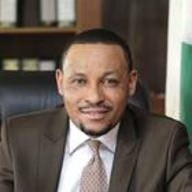
On Thursday, a High Court of the Federal Capital Territory (FCT) sitting in Maitama, Abuja, remanded former Chairman of the Code of Conduct Tribunal (CCT), Danladi Umar, at Kuje Correctional Centre.
The Federal Government had arraigned him on a four-count charge bordering on alleged corruption and abuse of office.
Justice Peter Kekemeke ordered Umar’s remand after he pleaded not guilty to the charges filed against him by the Economic and Financial Crimes Commission (EFCC). The Federal Government alleged that Umar abused his office by receiving illicit payments from contractors while serving as chairman of the tribunal.
While in office, several influential politicians and public officials appeared before the tribunal over allegations ranging from false asset declaration to violations of the Code of Conduct for public officers. The contrasting outcomes in the cases shaped public debate over the effectiveness, consistency and independence of the tribunal in holding public officials accountable.
Below are some of the most notable cases.
WALTER ONNOGHEN
In January 2019, the Federal Government arraigned then Chief Justice of Nigeria, Walter Onnoghen, before the CCT on six counts bordering on false asset declaration.
The prosecution accused him of failing to declare several domiciliary bank accounts and the funds contained in them.
Despite resigning while the trial was ongoing, Onnoghen was convicted by the tribunal, which ordered his removal from office, disqualified him from holding public office for 10 years and directed the forfeiture of assets linked to the undeclared accounts. The conviction of the former CJN remains one of the most significant rulings ever delivered by the CCT.
The case generated intense political and legal debate, with critics questioning both the timing of the trial and the procedure adopted in suspending the country’s top judicial officer.
BUKOLA SARAKI
Former Senate President Bukola Saraki faced one of the longest trials in the history of the tribunal after he was arraigned in September 2015 on an 18-count charge of false asset declaration. The trial lasted nearly three years, with the prosecution calling four witnesses and tendering dozens of exhibits.
In June 2018, the tribunal dismissed all charges, ruling that the prosecution failed to establish a prima facie case and that much of its evidence amounted to hearsay. Although the Federal Government appealed the decision, the Supreme Court later affirmed Saraki’s acquittal, bringing the case to an end.
BOLA TINUBU
President Bola Tinubu, a former governor of Lagos State, was arraigned before the CCT in 2011. He was alleged to have operated multiple foreign bank accounts while serving as governor, contrary to constitutional provisions. The tribunal, however, dismissed the case at an early stage. It held that the charges were fundamentally defective because they failed to establish that the foreign accounts actually belonged to Tinubu.
The tribunal also noted that some of the accounts listed in the charge bore female names, making the prosecution’s case unsustainable.
Despite numerous allegations against Tinubu, that was about the only time he was docked.
Then Attorney-General of the Federation, Mike Adoke, said he prevailed on the Nigerian government to step down appeal process against Tinubu.
“Even I am told that the Tinubu people think I was the one responsible for his trial at the Code of Conduct Bureau, but I was not the one. In fact, when the government wanted to appeal, I stood my ground that Tinubu should not be disgraced. I argued that there are people in Nigeria that we just cannot afford to rubbish over anything,” Adoke said in an interview.
On his part, Umar also said he was under serious pressure at the time of Tinubu’s trial.
He had said: “During the trial of Bola Tinubu, we were under serious influence. But you saw what happened. We did what we needed to do based on what was before us.”
GODSDAY ORUBEBE
Former Minister of Niger Delta Affairs, Godsday Orubebe, was prosecuted in 2016 over allegations that he failed to declare a property located in Asokoro, Abuja. Orubebe maintained that he had disposed of the property before assuming public office and therefore had no obligation to include it in his asset declaration.
The tribunal disagreed, holding that the property’s title documents still bore his name, and consequently convicted him and ordered the forfeiture of the property.
However, the Court of Appeal overturned the conviction in 2017 after finding that evidence showed the property had indeed been sold, despite the delayed transfer of title.
SYLVESTER NGWUTA
Late Supreme Court Justice Sylvester Ngwuta was arraigned before the CCT in 2017 following a raid on his residence by the Department of State Services (DSS), which alleged that large sums of cash had been recovered. He was charged with false asset declaration, among other allegations.
The tribunal, however, struck out the charges, holding that as a serving judicial officer, Ngwuta could not be prosecuted until disciplinary procedures had first been conducted by the National Judicial Council (NJC).
The ruling reinforced the constitutional role of the NJC in disciplining judicial officers before criminal proceedings can commence.

Leave a Reply