
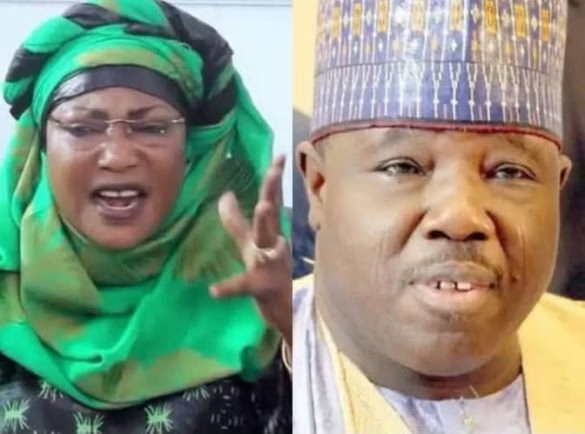
By Najaatu Mohammed
Former presidential adviser and activist Najaatu Mohammed has launched a blistering attack on former Governor Ali Modu Sheriff, reviving long-standing allegations linking him to the terrorist group Boko Haram after the ex-governor criticised the presidential candidate of the African Democratic Congress (ADC), Peter Obi.
The latest exchange followed Sheriff’s recent interview in which he accused Obi of supporting separatist groups agitating for the creation of Biafra and argued that the North would never support his presidential ambition because, according to him, the former Anambra State governor merely pretends to believe in a united Nigeria while allegedly backing separatist elements.
Sheriff’s comments sparked widespread reactions across social media and other public platforms, with supporters and critics of both men engaging in heated debates over the remarks and their implications for Nigeria’s political landscape ahead of the 2027 general elections. Demographics
Responding to the interview, Mohammed said Sheriff lacked the moral authority to question Obi’s patriotism, insisting that the former Borno State governor should instead answer lingering questions surrounding his alleged links to the emergence of Boko Haram before attacking any presidential hopeful.
“A man who allegedly created the vicious Boko Haram group, who should be paying for his sins, would gather the liver to troll a presidential candidate. That is the height of hypocrisy,” Mohammed said.
She added, “Those who know the history of the insurgency know where it all started. Nigerians should not allow anyone to rewrite history.”
She further stated, “It is unfortunate that someone facing such grave allegations is now questioning another person’s patriotism.”
She also declared, “You cannot lecture others on national unity when your name has repeatedly come up in discussions about one of Nigeria’s darkest chapters.”
Mohammed maintained that Sheriff could not credibly question Obi’s commitment to Nigeria’s unity while, in her view, unresolved allegations about his alleged role in the origins of Boko Haram continue to linger in the public domain. Politics
The allegations linking Sheriff to Boko Haram are not new and have resurfaced at different times over the years, particularly because he served as governor of Borno State during the period the group emerged and rapidly expanded its operations.
Sheriff has consistently denied the allegations, insisting that he neither founded nor sponsored the insurgent organisation.
The controversy dates back to the early years of the insurgency when Boko Haram, under the leadership of its founder, Mohammed Yusuf, transformed from a radical religious movement into a violent extremist group operating in northeastern Nigeria.
In July 2009, Yusuf was captured alive by security forces during a military crackdown on Boko Haram in Maiduguri.
He was subsequently handed over to the police. Hours later, police announced that Yusuf had died after allegedly attempting to escape while his followers engaged officers in a gun battle.
The circumstances surrounding Yusuf’s death were widely condemned by local and international human rights organisations, which described it as an extrajudicial killing.
The incident also fuelled widespread speculation and conspiracy theories, with some commentators arguing that his death denied investigators the opportunity to question him about the origins of Boko Haram and the identities of any alleged sponsors or backers.
Those claims, however, have never been conclusively established in a court of law
Rather than ending the insurgency, Yusuf’s death marked a turning point.
Under new leadership, Boko Haram evolved into one of Africa’s deadliest terrorist organisations, unleashing a wave of bombings, suicide attacks, kidnappings and mass killings that have claimed tens of thousands of lives, displaced millions of people and devastated communities across Nigeria and the wider Lake Chad Basin.
Over the years, several politicians, activists and public commentators have made allegations linking Sheriff to Boko Haram.
The former governor has consistently rejected those claims, describing them as false, politically motivated and entirely without merit.
He has repeatedly maintained that he had no role in the creation, sponsorship or activities of the insurgent group and has never been convicted or found liable by any court over such allegations.
Sheriff has also argued that he was himself a victim of Boko Haram’s violence, noting that the insurgents targeted political leaders, traditional rulers and ordinary citizens alike during the height of the insurgency.
Mohammed, however, insisted that questions surrounding the origins of Boko Haram have not been fully answered and argued that those issues should not be ignored whenever discussions about national unity and patriotism arise.
Her latest remarks have added a fresh dimension to the growing political war of words triggered by Sheriff’s criticism of Obi, with many Nigerians taking to social media to express sharply divided views on both the allegations against the former Borno governor and his comments about the ADC presidential hopeful.
As of the time of filing this report, neither Sheriff nor Peter Obi had publicly responded to Mohammed’s latest remarks.
The renewed exchange has nevertheless reignited public debate over the long-running allegations surrounding the origins of the Boko Haram insurgency while further intensifying political discourse ahead of the 2027 general elections.



Leave a Reply