
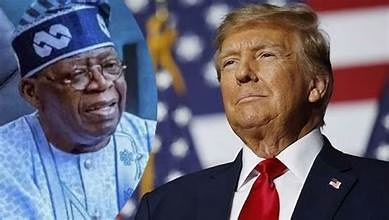
A United States-based lobbyist, Von Batten-Montague-York, has called on President Donald Trump and the US Congress to expand their scrutiny of Nigeria to allegations surrounding the controversial Presidential Foreign Intervention Promotion Council (PFIPC).
The lobbyist alleged that senior members of President Bola Tinubu’s administration may have participated in a scheme to fraudulently obtain or divert international funding linked to the United States through the disputed federal agency.
He specifically called for scrutiny of the Chief of Staff to the President, Femi Gbajabiamila, who has repeatedly denied any connection with the council and publicly disowned its acclaimed Director-General, Adeniyi Adeyemi.
In a social media post, Batten-Montague-York alleged that the PFIPC secured a ₦1.3bn allocation in Nigeria’s 2026 budget, which also contained projects financed by international development institutions.
“We are now officially lobbying for the investigation to be expanded to include a possible conspiracy by senior members of the Tinubu government to defraud the United States by participating in a scheme to illegally obtain or divert US-linked funding,” he said.
The allegations have not been independently verified, while neither the US government nor Congress had publicly announced such an investigation as of the time of filing this report.
Gbajabiamila’s US Disciplinary Case
The renewed controversy has also drawn attention to Gbajabiamila’s disciplinary proceedings in the United States before he rose to prominence in Nigerian politics.
In February 2007, the Supreme Court of Georgia suspended him from legal practice for 36 months after he admitted violating professional rules governing client funds.
According to The Guardian, court records showed that he received a client’s $25,000 settlement, deposited the money in his attorney trust account and failed to promptly remit it.
He also admitted using the funds for personal purposes before closing his legal practice and relocating to Nigeria.
Gbajabiamila subsequently repaid the client before the disciplinary proceedings were concluded.
The court stated that the misconduct would ordinarily attract disbarment but accepted his petition for voluntary discipline and imposed a three-year suspension.
Reports later indicated that his membership of the State Bar of Georgia was terminated after he failed to apply for reinstatement following the suspension.
Questions Over ₦1.3bn Allocation
Meanwhile, questions over how the PFIPC secured a place in the 2026 national budget intensified following fresh claims by Adeyemi.
The Presidency has described the council as fictitious and accused Adeyemi of forging appointment letters and official documents to present himself as its Director-General.
Adeyemi has denied the allegations and is facing criminal proceedings over alleged forgery, impersonation and related offences.
The controversy has placed Gbajabiamila and the Secretary to the Government of the Federation, George Akume, under growing public scrutiny as civil society organisations, opposition politicians and other stakeholders demand explanations regarding the agency’s budget allocation.
Speaking in a viral video interview on Wednesday, Adeyemi denied preparing or defending the PFIPC budget proposal.
He said he was in police detention during the period when the 2026 budget was being prepared and processed.
“I was detained for 23 days between October 27 and November 19. During that period, I was not involved in any budget preparation, and nobody from the agency appeared before any committee to defend a budget,” he said.
Adeyemi argued that his detention raised questions about who processed the agency’s allocation and how it passed through the executive and legislative stages of the appropriation process.
“If the agency truly did not exist, how did it get into the national budget? How did it pass through the Senate, the House of Representatives and eventually get transmitted to the President? Those are questions that must be answered,” he said.
He described as confusing the insistence by senior government officials that the agency did not exist despite its appearance in the Appropriation Act.
According to him, the budget allocation suggested that the council received recognition from some government institutions.


Leave a Reply