
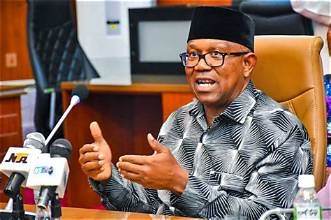
As Nigeria marks its 66th Independence Anniversary, Peter Obi, the presidential candidate of the Nigeria Democratic Congress (NDC), has issued a sobering address demanding an immediate structural overhaul of the nation’s governance.
He warned that persistent leadership failures have pushed over 140 million Nigerians into severe hardship and abject poverty.
In an official Independence Day message released on Thursday, Obi declared that while October 1 should naturally serve as a moment of thanksgiving, unity, and gratitude for the country’s vast human and agricultural potential, the occasion must not be reduced to mere ceremonial festivities.
Instead, he described the anniversary as a crucial moment for deep, honest national reflection.
“Independence anniversaries must never be reduced to mere celebration. They are moments for honest national reflection. We must look back, examine where we stand today, and ask ourselves whether we are moving in the direction our founding fathers envisioned,” Obi stated.
Nigeria @66: Gov Aliyu Pays Tribute to Founding Fathers, Seeks More Collaboration to End Insecurity
Independence broadcast: Atiku Knocks Tinubu’s Prosperity Claim, Demands Relief For Nigerians
Critiquing the performance of the ruling All Progressives Congress (APC) administration, the former Anambra State governor highlighted a catalog of systemic crises deteriorating across major sectors of the nation:
He said over 140 million citizens live in extreme poverty, with projections indicating more than 40 million Nigerians face acute starvation by the end of 2026.
According to him, out-of-school children have surged past 18 million, alongside an estimated 35 million unemployed or underemployed youths.
The NDC presidential candidate said drug abuse among Nigerian youth has reached 14%, more than double the global benchmark of 6%, adding that high infant and maternal mortality rates persist, while national life expectancy stands at 54 years—significantly trailing the global average of 74 years.
Obi noted that escalating terrorism, banditry, and mass abductions continue to jeopardize lives, citing a recent incident where 37 young Nigerians lost their lives.
Recalling his recent two-day joint visit to Sokoto State alongside Senator Rabiu Kwankwaso, Obi detailed the harrowing conditions they witnessed at the Ramin Kura Internally Displaced Persons (IDP) camp near Sokoto metropolis.
He described thousands of displaced women and children living without basic access to healthcare, clean water, or schooling—a situation he termed a microcosm of widespread displacement and insecurity across the country.
“What we saw in Ramin Kura is not an isolated story; it is a reflection of the suffering experienced across many parts of Nigeria. While ordinary Nigerians struggle with these realities, this present government often behaves as though these problems belong to another country. Political leaders have failed our country and, most importantly, we have failed our children,” Obi noted.
Rejecting the notion that Nigeria is naturally cursed, Obi argued that the nation’s core tragedy stems from leadership failures in converting abundant national wealth into productivity, human safety, and shared welfare.
Detailing a vision for a potential presidency, Obi committed to actionable reforms designed to shift Nigeria from a consumption-led model to a productive economy driven by agriculture, manufacturing, and human development.
He promised to eliminate terrorism and banditry so that farmers can safely return to their fields and displaced families can leave IDP camps.
Obi said as President, he would spend all official holidays within Nigerian states—including Zamfara, Borno, Kwara, Ebonyi, Edo, and Ekiti—to remain connected to the daily realities of citizens.
Obi concluded his statement with a call to action for the citizenry, emphasizing that real change demands sustained civic accountability and principled leadership.
“The Nigeria we desire will not be built by prayers alone, nor by promises alone,” Obi urged.
“It will be built by leadership that understands that public office is a sacred trust, by citizens who demand accountability, and by all of us who refuse to accept failure as our destiny.”


Leave a Reply