
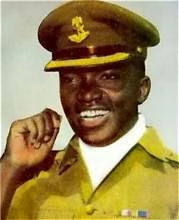
General Paul Chabiri Tarfa joined the Nigerian Army as a cadet in 1962 and remained there until 1988, serving for 26 years. In that span of time he held many positions – Assistant Adjutant General, Provost Marshal, Commandant of the Nigerian Defence Academy. He also served as the governor of the old Oyo State in 1978.
After retirement, he served as the managing director of the Nigerian Railways and also had a brief assignment to reorganise the Nigerian Customs.
At 85, he is still busy as the chairman of the North-East Development Commission. He shared his experiences with Weekend Trust.
I would like to start with your home, Garkida, which I think is a well-known centre for missionary and western education. Do you think the fact that you were born there has had a very huge impact on how your life turned out?
Of course, Garkida is one of the old places in the North where missionaries set up and gave us good footing in education.
I must say that in those days we were privileged to have been among the early people in the North, especially the North-East, to be introduced to western education.
Habiba: The woman behind ‘Jaiz Bank’s N100m investment scheme’
2027: Opposition’s battle for space
That is not to say that Islamic education was not there, but surely, we were lucky to have the missionaries as far back as March 1923, to be precise. You can imagine that it is well over 100 years now. We have benefitted.
We had early education and were introduced to secondary school. We had good medical care, which many of our people in the North were not privileged to have. We went from primary to secondary school, from where we had the advantage of being successfully qualified to get enrolled into the Nigerian Army.
I think you went to secondary school in Yola and not Garkida, right?
Well, Garkida laid the foundation before going to Yola – provincial secondary school in those days. There were only 12 in the entire North and Yola was one of them. It was from there that I had the opportunity to get into the army.
You became a cadet in the army in April 1962, but it didn’t take long before you were taken to Canada, a very strange place for someone coming from this part of the world.
Before going there, we were told what it would be. Even before then, in Geography in secondary school, we had known about temperate countries, hot countries and so on, of which Canada was one. So when we got to Canada, we were very well equipped and properly prepared, physically and mentally.
Your career in the army took off after you returned to Canada. This was 1963?
Yes. We came back in December 1963, received at Kano airport, taken to Kaduna and received by the duty officer, who at that time happened to be a man called Benjamin Adekunle. He was a captain and we were just second lieutenants.
The so-called “black scorpion”?
He asked: “Who among you is Paul Tarfa?” I said I was the one and he said “congratulations”. I asked for what, as we just arrived from Kano into the office in Kaduna. He said: “I want you to eat quickly because you will be on your way to Enugu. There is a Land Rover waiting for you outside here. They want you in the Congo.”
It was strange and shocking. Congo was where they were fighting and I had just come back as a second lieutenant.
You didn’t even go home to see your family?
Even my colleagues were surprised by that news. And they were very anxious to know where they too would go. Of course we went into the officers’ mess and I ate, etc. And true to what he said, there was a Land Rover waiting for me. Everybody was surprised.
He said this officer called Paul was going to Enugu because he was posted to a battalion and he was to serve in Congo. They wanted him there as a platoon commander. To be a platoon commander in time of war is life and death because you are supposed to lead by example – lead by the front, not back.
General Paul Tarfa
Why do you think they chose you to do that straightaway?
Just posting; everyone of us was posted.
It was just random?
Of course it would have been another officer. It was not on merit. It just happened to be my luck on that day.
So that Land Rover took you to Enugu straight?
I went to Enugu straight. I drove that night from Kaduna to Enugu with the condition of the road. But of course there were good drivers and good discipline. Cars were not so many.
So I was taken to Enugu and received by the officer on duty, who said they had been waiting for me.
We were preparing ammunition, food and gifts for soldiers – from wives to their husbands in front – and you were going to take them there. To my surprise, everything was prepared, and seven days sharp, I found myself boarding an aircraft from Lagos. We travelled from Enugu to Lagos, from where we took off.
What surprised me was how delighted the soldiers who were going with me to war were. They were excited that they were going to Congo. They were going to a warfront and they were happy. I asked why they were happy and they said: “Don’t worry sir. They will give us troops comfort fund. They will give us beautiful watches. We can get radios. Our salary will be increased and we will fight well.”
So they were thinking of the money?
That’s right. When we got to Congo, I was posted to A company and appointed the number one platoon commander, which means that if there was any assignment, it was my platoon that would spearhead it and be in front. So I was introduced to battle in the first week of my arrival in Congo.
I thought it was peacekeeping, not fighting; how much action did you see?
Well, that was the title, but it didn’t mean that you won’t fight if there was a reason for that. As a matter of fact, I had to lead a platoon to drive away what they called gendarmes, who were attacking their brewery one night. Fortunately, I was successful. I displaced them.
You spent six months in Congo. What happened when you came back to Nigeria?
When we returned, General Gowon, who was the Adjutant of the Nigerian Army, was there to welcome us back.
On parade he saw my name, which was known to him in Zaria because he was a Zaria man. My people were also there. I think they were neighbours.
Gowon told the Staff Captain to take my name. We were given three weeks after that arrival to go home and see our people. That was the first time I was going to see my people.
When we returned, I saw that my name was posted from Enugu to Lagos to the Federal Guards, as it was. I tried to say no, because Enugu was a very nice place. We were used to one another. It was not a very big town. We are talking about the 1960s. They were beautiful and handsome people; beautiful girls, all kinds of things.
I appealed to the commanding officer, that I didn’t want to leave Enugu, but he said: “I wish I can keep you, but it is beyond me. If you are posted to Lagos, it means they must have seen something good in you. You are going to the Federal Guards, which is a good place for good officers like you.”
So I found myself in Lagos in the Federal Guards, where we had a different mission.
Was life in Lagos duller than what obtained in Enugu?
Nigeria was exciting at all times, whether you were in Kano, Zaria or Kaduna. The life of the military was exciting everywhere, especially for young officers, not to talk of Lagos.
It was like moving from a good house to another good house. So life continued like that.
Were you married at this stage?
Of course not. We were young officers. I was about 20 then; We continued with good life until January 15, 1966.
You were in the Federal Guards when the coup happened. A lot of people have commented on it but we want to hear it from you. What happened during that period?
I can write books on this subject, but of course, time will not permit that. As I said earlier, life in the army was good – we were brothers, friends and colleagues – whatever you call it.
As officers, we didn’t know whether you were Abdullahi, Chukwu or Ola. So we mixed very well, played very well, ate very well, discussed very well and did everything together as officers.
There were good officers I loved when I was in Enugu. One of them was Bajowa and the other one was Ikechukwu. I had no idea whether he was Yoruba or not; we were fine.
I tried to emulate the example of Bajowa or Ikechukwu. That was how it was until the night of January 15 came and we started getting to know one another by tribe and where you came from, which was completely bad.
What did you see during that coup?
The fact that the people who spearheaded the coup were mainly of Igbo extraction. We heard of Okafor, Ifeajuna, Igbueze, Chukwumereji and so on.
And for the victims, you heard, Maimalari, Pam, Tafawa Balewa. What happened to the opposite side made it sound one-sided. So we believed it was actually against us, otherwise how could it be like that?
I think you played a key role in stopping that coup in Lagos. Was it accidental?
No. We didn’t have any idea whatsoever how it came to be. It was very strange. In the night of the coup, I was out on cinema with my girlfriend. It ended around 10/ 11 o’clock or thereabouts. We were driving in Ikoyi when we saw a long queue of cars and stopped.
The girl asked what was happening and I said the Brigadier was having a party for officers coming into the Brigade and sending off officers to other units. She asked why I was not there and I said I was too young and junior to be here.
In Maimalari’s house?
Yeah. It was on a road called Brown. The party was taking place at 11, Brown Road. The young woman kept quiet. When we got to my residence, she said I should take her back. She was a very fine and disciplined Igbo girl.
Early in the morning, to my surprise, there was a knock on the door around 4 o’clock. When I looked downstairs from the window I saw Samuel Tayo from the Federal Guards.
When he saw me he thanked God that I was still alive. They were praising God that I was still alive and asked me to get down quickly. He said: “Come down now now sir, the country no good. Even as we dey here now, e no good for we. Come down sir, they don do coup for this country and they don kill Maimalari, kill prime minister.”
I quickly removed my pyjamas and got dressed, went to a small window and prayed briefly and told God to give me courage and take charge of my life. I didn’t know what was happening and where I was going.
I went down and just jumped into the Land Rover. When we got to the Federal Guard, I was the only officer left. Garba was not there anymore. Igbueze, who was supposed to be an officer there, was not there. Okafor, who was the OC, was not there. One gentleman called Osuma was not there. One officer called Ezedibo, who was posted in to take over from Garba, was not there. So I was the only one.
General Paul Tarfa
And you were a Second Lieutenant?
I was a Second Lieutenant. I was in charge, so nobody gave me orders.
So you knew you were in the frontline?
I was in the frontline already. That they had killed Maimalari and prime minister was front line enough.
What gave you the courage to start detaining those officers when they started coming back?
I was still the only officer there. Remember I told you that from that time onwards, I was in charge. I ordered all the soldiers to take their arms, fill up their magazines and take orders from nobody but me. They were excited and opened the magazines and the boxes. They were very happy.
I was a Second Lieutenant, but because in those days the infantrymen were largely northern officers and soldiers, I happened to be the only one there. Others were people of Igbo extraction.
But you mentioned Garba, another northern officer, right?
(Joseph) Garba was with us, but they posted him out. Probably, they knew of the coup that was going to take place, so they posted Garba to Kashmir, outside the country. They replaced him with a man called Ezedibo.
So most of the officers were Igbo and you were the only northerner in the Guards?
That’s me. Igbueze was also posted around that time. He was a fine officer and very brilliant. Maybe in preparation for whatever he would do, he was not there. So it was me, Ezedibo, Osuma and one man called Asoya; all of them were of Igbo extraction. And on that night, all of them were not there, including Okafor, who was the Officer Commanding.
Okafor was the Major?
Yeah. So I gave an order and said, ‘From now on, I am in charge.’ The soldiers agreed and were protecting me. They didn’t want anything to touch me. Even a fly couldn’t touch me that night.
So, it was 6 o’clock, 7 o’clock, 8 o’clock and 9 o’clock. Around 9:30, I started seeing officers coming inside. The first one to come in was called Nweke, with his rifle on his shoulders comfortably coming in.
When he saw me he exclaimed because he happened to be my junior in Canada. I asked what was happening. He was not an officer of that unit but he was the first to come inside.
I asked him and he said I should wait and see. So I just winked to the soldiers to disarm him because he was not even in the mood of fighting. He couldn’t even fight the way he was.
They took his gun away quickly and I said they should take him to what we converted as guardroom. That was the office of the commanding officer of the unit. We brought him there and put some guards. I locked him up.
Within a short time, another one came in. They were looking as if they had conquered something. We dismantled him. One after another, six of them came in.
Including Okafor, the Major?
No. None of the officers of the Federal Guard was among them. I locked them up. They were anxious to see people; maybe the senior officers to come in to meet them, but none of them came.
Meanwhile, I had ordered that if they made any mistake I would deal with them. And there were so many angry soldiers who would, with one word, shoot them – innocent people. Anyway, I controlled it.
At that time, it was no longer news that people had been killed, including officers and the prime minister, Sardauna and others. It was not only on the BBC but other radio stations. It was serious and against us. At that time, no one had come to give me any order at all.
Did Gowon come at some point?
I will come to that. After that, senior Igbo officers came, including the commanding officer of 2nd Battalion. The organisers also came. When they came, I was dressed. From afar, they saw me. They were looking to see where they would meet those officers, but they couldn’t see them.
I took them to Okafor’s office, where I converted as guardroom. The condition was such that they didn’t like it. And these officers were also thinking that their saviours had come. Behind me and them were soldiers with rifles ready to even kill them.
They looked at themselves and me. Immediately, I could see that they were planning how best to release them and possibly get rid of me.
As they were going out from the gate, they just stopped again and said, “Officer, please you have to go to Apapa to Kur Mohamed’s house”.
Their aim was that I wouldn’t have reached Carter Bridge and they would knock me off. My soldiers said, “No sir, you are not going anywhere. They are going to kill you.”
Then, within an hour or so, General Gowon and ( Alhaji) Ahmadu Kurfi came in. When they saw me they were surprised. When I showed them the people I detained (they were there actually to wait for their next assignment), they were scared.
Gowon said “well done” and addressed the soldiers and officers. He said, “Gentlemen, I am sure you know why you are here. I am afraid you will remain here until the situation becomes clearer.”
Gowon was a Lieutenant-Colonel then?
Yeah. That’s what he told them. So I was left with those people to deal with them.
I want to ask you a question that has lingered in history. From your vantage position in what happened in 1966, do you think that General Ironsi, who became the beneficiary of the coup, knew about it?
Well, I would be wrong to tell you that he knew about it or he didn’t know. I think one has to leave that to the people who were close to him or to God. All I can say is that it is difficult to absolve him, in the sense that that night, he was able to move from Ikoyi to places where the soldiers were deployed, up to Ikeja, where he met the officer commanding a battalion, and other officers in the mess, for whatever was discussed in the name of quenching the coup.
I certainly wouldn’t say that he knew about the coup, but how did he escape from the soldiers that were positioned by the coup makers, who also said that people like him were targets? How did he survive it – from Ikoyi through Carter Bridge to Ikeja?
The other thing that puzzled people like me was when Tayo, who went to see whether I was alive or not that night, said that Ironsi was with them in the barracks briefly and said: “Take orders from nobody except Maimalari.”
James Pam’s wife, Margaret, of blessed memory, said she called Ironsi and told him that “Soldiers from Maimalari’s house are in our house. They have come to kill my husband and Maimalari.” That’s what Margaret said to me.
She called Ironsi to tell him that?
According to her, she was talking to Ironsi and he kept saying, “I see, I see,” and dropped the phone. And you cannot say whether it was after or before the coup, so I cannot say that Ironsi had an idea.
But Ironsi was at the party organised by Maimalari at 11th Brown Road. According to General Gowon, Ironsi said: “Go and enjoy yourself because you will not know what tomorrow holds.” So, if you put these together, you may not know what to think.
Let me take you to another coup, you were still in the Brigade of Guards or Federal Guards during the Gowon coup of 1975. Why did senior officers like you and Garba turn against Gowon?
First and foremost, I was not against Gowon, there was no question of that at all.
But Garba was the commandant of the Guards.
All I can tell you is that my relationship with Gowon was perfect. We served Gowon as Federal Guard and Brigade of Guard officers.
It was one night, that the story of Gowon’s coup came about to me. One afternoon we were coming from Yaba from our tailor called Banjo to collect our dress. In fact, it was Garba’s dress. We were very close.
So you were with Garba, who was the commandant of the Guard?
He was the commanding officer of the Federal Guard. We called ourselves ‘kamarad’. When we were close to the office mess, where we lived, he told the driver, Maman Sokoto to stop. When he stopped, he said: “kamarad”, today I will tell you something.” I asked what and he said the commander-in-chief had travelled to Kampala but he would not come back as the commander-in-chief because there was going to be a coup against him. What a shock!
We continued to the officers’ mess, which was just a few minutes from where we stopped. We got to the officers’ mess and started playing billiards roughly, not seriously.
Because you were disturbed?
I cannot go into details about what happened, who was behind it, who was doing this and that.
Then the ADC to Gowon, Welby, a very jovial funny officer, came in. He took us by surprise.
Because he came back from Kampala?
He just came and walked into the mess and said ‘kinack’ in their ( Garba’s) language.
Garba was surprised. In fact, both of us were surprised. Garba just dropped the queue on the table, wondering how the hell he found himself here. Does it mean the commander-in-chief was aware of what was happening?
When Welby came in, Garba just went to the corner of the mess, called Shehu Yar’adua and told him that the commander-in-chief’s ADC was back. And Shehu responded: ‘So what?’
Shehu said the coup would take place, even if it would be bloody because even the commander-in-chief himself was aware that something like this would happen. That’s what Shehu told him.
From there, we parted. Welby was taken by Garba to where Shehu told them to meet him and I went back to my place. And I called Shehu and asked how something like this would happen and I had no idea about it.
Shehu was my course mate. Garba was our senior. He said he was surprised I didn’t know because, according to him, as a matter of fact, Garba should have told me.
Shehu said, “These soldiers have more confidence in you. As a matter of fact, we planned that Garba should go and play basketball in Cotonou. I am surprised he did not tell you.” Both of them are late now.
What did you going forward?
What else can I do? There was nothing I could do about it because I was part and parcel of the Federal Guards, even though I was no more commanding. I was already in the Army Headquarters at that time as an Adjutant.
There are all sorts of stories about the coup, indiscipline in the army, as well as corruption etc. What would you say was the motive of the coup?
I don’t know. As I said, I was not part of the coup. I was not part of the planners. I don’t know what they discussed. Garba said everybody seemed to be doing what he liked. Our soldiers’ rifles and boots looked as if nobody cared.
Garba never told me how he got involved – whether he was forced into it, up to his death. But I was told by some officers that he probably had to become part of it or be killed; whatever it was.
All I know very well is that Garba was a very fine officer and very loyal to Gowon at the time we were together. What must have happened or what was inside him, I cannot say. But from the time we met in the Federal Guard to when we developed friendship, and how we served until the day of the coup, I can tell you who Garba was.
You had a brief stint as governor of Oyo State in 1978; was that something you enjoyed doing?
Very interesting. But they didn’t want us to be called governors; we were military administrators. We took over from those they called governors, so they said we were sole administrators.
Apart from administering the states, we were also to command the troops as garrison commanders. So we had a dual role to play.
Shehu was the deputy head of state to Obasanjo. So one night, as we were playing billiards in his house in Ikoyi, he said: “Paul, good news for you.” I asked what it was and he said the people in Ibadan were waiting for me. I asked what sort of joke that was and he said, “You are going to take over from Jemibewon?” I also asked what I had done.
You didn’t like it?
I was the Provost Marshal and enjoying myself, so I asked why I should go to Ibadan. Shehu said: “Well, we intend to change all the governors in preparation for handover. Initially, we wanted you to go to Sokoto, but because you are a Christian, we have changed you with Nasko. So, Nasko will go to Sokoto and you are going to Ibadan.”
I asked if I could be spared this, but he said no and explained that they wanted somebody tough in Ibadan. “They have heard about you, so they are waiting for you,” Shehu added.
How was your experience as an administrator?
As Shehu said, the people had heard of my life as a Provost Marshal and how I disciplined bad drivers or criminals with koboko. And Yoruba people don’t want koboko at all; they think it is something else. It is a taboo for a Yoruba man to have Koboko.
When I went to Ibadan, they were thinking that I was a giant. Some people were thinking I was a big, wicked-looking person, only to see a slim, innocent man like me. But I told them that I did not come with koboko, I only had my cane. Eventually, they loved me because they saw the sincerity about it.
Let me touch on two other assignments you did after your retirement. One, the Nigeria Railway Corporation; then this very odd thing you did in the Customs during the Abacha regime. Normally officers retire; why didn’t you go home?
Again, it is something that has a long story behind it. I was not supposed to have gone to the railway in the first place. I understood I was to go to the ports, but perhaps, because of my attitude to the coup, the authorities said Port Authority was too good for me, I should go to where there was trouble.
But you lasted long in the railway, right?
I did not. I don’t think I lasted even for a year because soon after the death of my wife, I was not there anymore. What was promised was never given. What was announced was never done.
So they didn’t give you the resources to do anything about the railway?
Nothing at all. One day, I was interviewed by Newsweek and I told them all about my experience. I told them my dissatisfaction and what was happening, etc. And it didn’t please the government.
My friend, Abacha, asked why I was abusing the government. I asked how and he said I accused the government of not doing anything.
He was the Chief of Army Staff?
Yeah. I just told them the truth about what was happening with me and the railway, as well as what I expected.
He said they would change me if I were not interested. I said it was beautiful if that was the case, not knowing that they had made up their mind to send Ogbemudia to take over from me.
I went to Kaduna, thinking that I would prepare handover notes to Ogbemudia. I was in Kaduna for few days, not up to a week and returned to Lagos, only to find Ogbemudia on the chair.
I was surprised. He welcomed me and we hugged each other. I told him that I went to Kaduna thinking I would prepare notes to hand over to him, but he said: “Don’t worry about that, I am already here”
So that was it for you?
That was it. But then, he painted old trains with green colour and so on. The railway men thought that here was a man of action. Soon, they discovered the truth about him going there. On his final day he had to sneak out through a corner. They were stoning him and shouting: “Ole, ole, ole.” That’s how it was.
It seems Abacha gave you another assignment when he was head of state to fix the Customs. Why did he do it?
10 years after.
Yes, 10 years after, he didn’t forget you?
Not Abacha. With due respect, we were still good friends. What happened was that, of course I couldn’t have done it if he didn’t like it. So I must give him that credit. General Mohammed Ali (we called him MC Ali), who was my officer when I was the commander, Brigade of Guards, eventually became the Chief of Army Staff; hence a member of the Supreme Military Council (SMC).
They said if you wanted something to be done you had to call General Tarfa; so they sent Wali Kazir. He is still alive. Wali was with me in Kaduna, and three times they sent him, saying the Chief of Army Staff asked if I would accept the assignment as chairman to reorganise and reposition Customs. I agreed. That was 1994 – from January to November.
I had about 30 members; and we did our best. We travelled to all the places, including Indonesia, to gather experience. We introduced what they call banking system, where you put dues directly into the bank and received by Customs. We laid a fine foundation.
What are you still doing in the Northeast Development Commission? Is it really something worth your while to do?
That’s another thing. That’s my friend, the late President Buhari.
Your course mate; right?
My course mate. I was with him many times, even before he went to Aso Rock. He had always said he was looking for what he would give me, what would be appropriate etc. That was until it came to the situation of Boko Haram and all its devastation.
Then there was a presidential committee to reconstruct the North. When it was being wound up, according to them, the president was reluctant because he thought it was a question of another way of spending money.
Names were mentioned and my name seemed to have featured higher. We were given terms of reference. Ours was an intervention committee – to bring life to the people again, recover all that had been damaged.
It is very remarkable that at 85 you are still serving the country in that capacity; how do you feel?
To God be the glory for that. I turned 85 just two weeks ago and I am still kicking, by His grace.
You still go to Maiduguri for meetings?
Yeah. I used to go to Maiduguri, flying or driving. And you know it is sometimes risky. There was a time we were going to see one of the areas where we have refugees. We were almost halfway when we were told to go back because the place was under attack. We were exposed to such situations in many ways, but God saved us. And we are still at it.
Let me touch a little bit on the private General Paul Tarfa. We all know your first wife died; you mentioned her often. How is family life for you now?
Well, thank God that I am still surviving. God has been kind to me. You see, whether one likes it or not, if you lose a good wife you will always find it difficult to have a replacement.
Not that I have not tried to have a replacement, but unfortunately, it has not succeeded. But I am still kicking. My children are all grown up, thanks to God Almighty. They are all married and looking after themselves. I am still around in a fairly good health, as you can see, doing one thing or another and still hoping to continue.
Her death has been painful; but of course everybody will die, it only happened that she was the one who died before me. I would have been the one before her.
So you haven’t remarried?
I remarried, but as I said, it did not work. Sometimes it is better if you could live (alone) than to live in a house that is leaking very badly.
How do you fill the typical day?
As you can see, I have friends like you. I have friends in the military, civil service, everywhere. I also have relatives.
What are your hobbies?
I played golf, but now, I rarely do. But I still go to meet friends to enjoy the sport.

Leave a Reply