
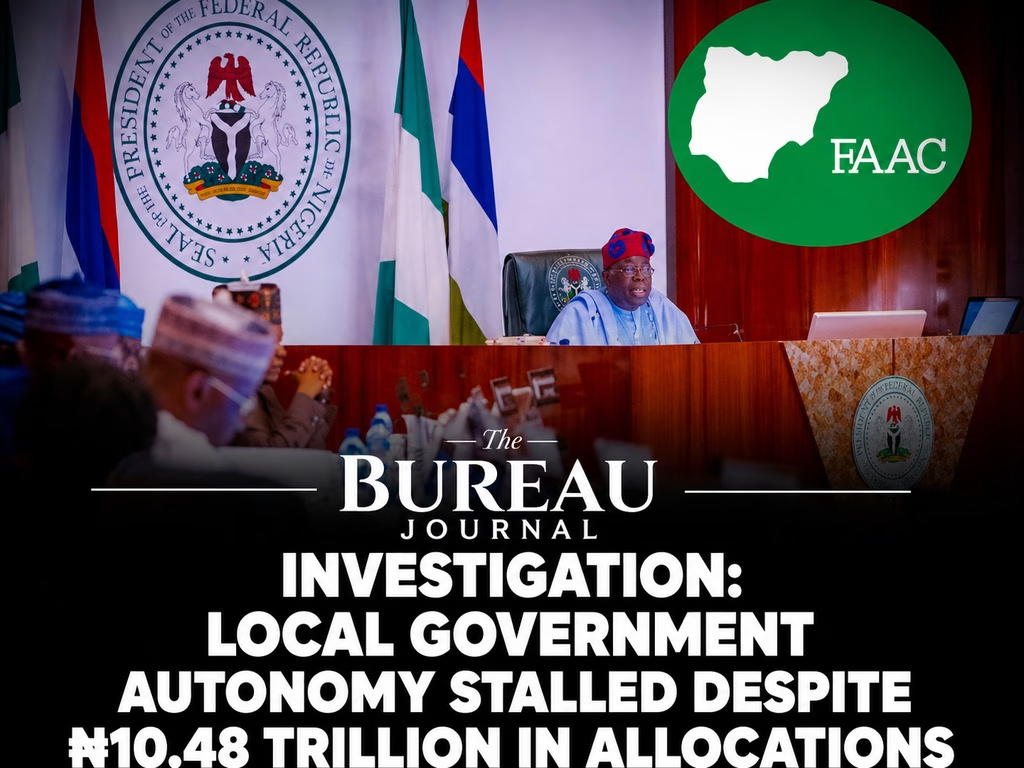
Nearly two years after the Supreme Court delivered a landmark judgment granting financial autonomy to Nigeria’s 774 local government councils, implementation of the ruling remains largely incomplete, raising fresh concerns about grassroots governance despite more than ₦10.48 trillion being allocated to councils during the period.
The July 11, 2024 judgment directed the Federal Government to pay statutory allocations directly into the accounts of democratically elected local governments, ending the long-standing practice of routing funds through State Joint Local Government Accounts.
The ruling was widely celebrated as a major step toward strengthening grassroots administration, improving accountability, and ensuring that local communities benefit directly from public funds.
However, available evidence suggests that implementation has been inconsistent across the country, with many councils still operating under financial arrangements largely controlled by state governments.
Allocations Rise Above ₦10 Trillion
An analysis of Federation Account Allocation Committee (FAAC) disbursements shows that local government councils received approximately ₦10.48 trillion between July 2024 and June 2026.
During the first twelve months following the Supreme Court judgment, councils received about ₦4.5 trillion. That figure increased significantly to nearly ₦6 trillion during the following twelve months, representing a year-on-year increase of more than 33 percent.
The sharp increase reflects improved revenue generation and higher FAAC distributions across all tiers of government.
Despite the larger allocations, many communities across Nigeria continue to complain about poor infrastructure, inadequate healthcare services, deteriorating roads, insufficient schools, and limited access to clean water.
Autonomy Still Largely Unimplemented
Although the Supreme Court clearly directed that allocations should be paid directly to local government accounts, reports from several states indicate that many councils are yet to receive their allocations independently.
Officials in different parts of the country say local governments still depend on state governments for the release of funds, while approval is often required before projects can be executed.
The continued operation of State Joint Local Government Accounts has become one of the major issues delaying full implementation of the judgment.
For many years, labour unions, civil society organisations and local government officials have argued that the joint account system weakens grassroots administration because councils lack full control over their finances.
NULGE Raises Fresh Concerns
The National Union of Local Government Employees (NULGE) says financial autonomy remains largely theoretical.
According to the union, allocations have not been paid directly to councils in many states despite repeated appeals to the Federal Government to fully implement the Supreme Court judgment.
NULGE maintains that genuine financial independence can only be achieved when local governments receive allocations directly into their own accounts without interference.
The union believes this would improve service delivery, strengthen accountability and enhance development at the grassroots level.
Implementation Differs Across States
Findings indicate that implementation varies from one state to another.
Officials in states including Kaduna, Kano, Benue, Plateau and Sokoto reportedly say councils still rely on state-controlled financial arrangements.
In several of those states, council chairmen reportedly require state approval before embarking on major projects.
However, Jigawa State has emerged as one of the few states where local government officials say direct federal allocations are already being paid into individual council accounts.
Officials there argue that the arrangement has improved transparency and enabled councils to respond more quickly to community needs.
Grassroots Communities Demand Better Services
Questions over local government autonomy have become increasingly relevant as communities continue to demand improved public services.
Residents in several parts of the country have called for better roads, functional primary healthcare centres, improved public schools, stronger security and enhanced rural infrastructure.
Many citizens argue that the significant increase in allocations should translate into visible improvements in their communities.
Development experts have consistently maintained that granting local governments genuine financial independence would strengthen grassroots democracy and improve accountability in public spending.
Federal Government Yet to Complete Implementation
Following the Supreme Court judgment, the Federal Government established an inter-ministerial committee to develop procedures for implementing direct allocation payments.
The committee was expected to resolve legal and administrative issues involving relevant institutions, including the Office of the Accountant-General of the Federation, the Central Bank of Nigeria, the Federal Ministry of Finance and the Office of the Attorney-General of the Federation.
However, nearly two years later, stakeholders say nationwide implementation remains incomplete.
Analysts believe that achieving full local government autonomy will require stronger political commitment, improved administrative coordination and strict compliance with the Supreme Court’s judgment.
Autonomy Seen as Key to Grassroots Development
Governance experts argue that local governments remain the closest tier of government to ordinary Nigerians and should therefore possess both administrative and financial independence.
They say effective local government administration is essential for improving primary education, healthcare, sanitation, rural roads, agriculture and community development.
As Nigeria continues discussions on constitutional reforms and governance restructuring, the implementation of local government financial autonomy is expected to remain one of the country’s most significant governance issues.
For many Nigerians, the real success of the Supreme Court judgment will not be measured by the amount allocated to councils but by whether those resources ultimately translate into improved living conditions at the grassroots.




Leave a Reply