
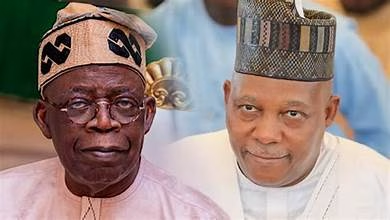
About 24 hours to the expiration of the deadline for the submission of presidential and National Assembly candidates for the 2027 general elections, the All Progressives Congress (APC) presidential candidate, President Bola Ahmed Tinubu, has settled for Vice President Kashim Shettima to run with him on the joint ticket.
The duo ran in 2023 under the Tinubu/Shettima joint ticket in what was widely described as same faith ticket due to their common religious beliefs, but they went ahead to win the presidential election.
One of the biggest controversies over the choice of a running mate for the presidential candidates of the parties for the 2027 elections had ironically come from the ruling All Progressives Congress (APC), which analysts say that under normal circumstances, should have been the first to be dispensed with since the party has a sitting vice president.
Our correspondents report that since 2024, however, there have been insinuations that Vice President Shettima might be substituted with someone else to pair with President Bola Ahmed Tinubu for the January 2027 election.
2 years after, internal crisis, controversies dog N/West commission
Lithium, Kaduna’s buried wealth
Reports had it that certain influences in the presidency were not comfortable with the continuation of the joint ticket and had suggested that it should be tinkered with to give the ticket a more balanced outlook.
Yesterday, however, the president named Shettima as his running mate, clearing all the doubts hanging over his reported reluctance to run on the same ticket with the vice president again.
The leadership of the APC confirmed the development while receiving the completed Independent National Electoral Commission (INEC) presidential nomination forms for President Bola Ahmed Tinubu and Vice President Kashim Shettima at an event that held in Abuja, which drew an array of high-profile party executives, state governors and legislators in a robust display of party solidarity.
Our correspondent reports that the forms were delivered on behalf of the Presidency by the Special Adviser on Political and Other Matters, Ibrahim Masari.
Receiving the documents, the national chairman of the APC, Prof Nentawe Goshwe Yilwatda, declared that the party’s massive base was already locked in to guarantee a second term victory.
“Today is a reflection of the wishes of over 12 million of our members who overwhelmingly voted Mr President as their candidate to flag off the party candidature in the 2027 presidential election. We are proud that members of the APC across the country voted overwhelmingly for him,” Yilwatda said.
Yilwatda expressed absolute confidence that the party’s actual support at the polls would expand significantly beyond its registered database, drawing in everyday citizens who have directly felt the impact of the administration’s social and structural reforms.
Addressing the party leadership, Prof Yilwatda urged governors and state party leaders to counter social media skepticism by aggressively marketing the administration’s core success stories.
The submission ceremony was attended by Senator Hope Uzodimma, the governor of Imo State and chairman of the Progressive Governors Forum.
Other key state executives in attendance included the governors of Borno, Kano, Kebbi, Adamawa, Kaduna and Yobe, alongside several deputy governors and National Assembly members.
Earlier, impeccable sources in the Presidential Villa informed our correspondent that the vice president was given the EC9 forms to fill to enable the APC upload details of its presidential candidate to the INEC portal.
Sources in the APC said that with this gesture, the vice president was good to go as he could only be substituted if he willingly withdraws from the race.
INEC sources, however, indicate that as at the time of filing this report, the APC and other parties were yet to upload the names of their presidential and National Assembly candidates on the commission’s portal.
Weekend Trust learnt that this is due to the fear of backlash among many National Assembly candidates whose names have been replaced with those of other aspirants.
The Electoral Act 2026 and the INEC regulations and guidelines for political parties require political parties to upload the names and particulars of their nominated candidates electronically through the Candidate Nomination Portal within the period specified in the commission’s timetable.
INEC Schedule provides that access code collection begins from Saturday, June 27 to Saturday, July 11, 2026 when the portal opens for presidential and National Assembly filings and for uploading of Forms EC9 and EC9A-E online.
INEC is also supposed to release the final list of presidential and National Assembly candidates on Monday, August 25, while the deadline for withdrawal or replacement of presidential and NASS candidates is Saturday, August 29.
The commission has repeatedly urged political parties to adhere strictly to the timetable, stressing that activities relating to the election will be conducted in accordance with the Electoral Act and the published schedule.
The Electoral Act 2026 makes it mandatory for political parties to submit the names of candidates who emerged from valid primaries within the period prescribed by law.
Section 29(1) of the Electoral Act 2026 provides that: “Every political party shall, not later than 120 days before the date appointed for a general election under this Act, submit to the commission, in the prescribed forms, the list of the candidates the party proposes to sponsor at the elections, who shall have emerged from valid primaries conducted by the political party.”
The Act further provides in section 29(2) that the list of candidates “shall be accompanied by an affidavit sworn to by the candidate” confirming that he or she has fulfilled the constitutional requirements for the office being sought.
In line with the law, the commission’s timetable and schedule of activities for the 2027 general elections fixed June 27 to July 11, 2026 by 11:59pm as the period for political parties to submit nomination forms for presidential and National Assembly candidates through the INEC Candidate Nomination Portal (ICNP). The timetable also states that governorship and state assembly nominations will be received between July 18 and August 8, 2026.
The INEC Regulations and Guidelines for Political Parties 2026 also require political parties to submit candidates electronically through the commission’s Candidate Nomination Portal using the prescribed forms and within the period specified in the timetable issued by the commission. The guidelines make it clear that nominations are to be made only through the portal using the access codes issued by INEC to registered political parties.
‘Parties that miss candidate submission deadline are out’
Weekend Trust learnt authoritatively from a senior commission official that parties that fail to submit the names of their nominated candidates to the Independent National Electoral Commission before the expiration of the deadline for the 2027 general elections will be excluded from the affected elections.
The official, who spoke to Weekend Trust on condition of anonymity said, “Any party which does not meet the deadline is, of course, out,” our source said.
The official said that as at Friday, 14 political parties had made submissions on the portal, although not all had completed the process for every elective office.
According to the source, the parties that had made submissions were Accord Party (A), Action Alliance (AA), African Action Congress (AAC), African Democratic Congress (ADC), All Progressives Grand Alliance (APGA), Allied Peoples Movement (APM), Labour Party (LP), Nigeria Democratic Congress (NDC), National Rescue Movement (NRM), People’s Democratic Party (PDP), Peoples Redemption Party (PRP), Social Democratic Party (SDP), Young Progressives Party (YPP) and Zenith Labour Party (ZLP).
The source, however, said only seven parties had successfully submitted both their presidential candidates and running mates. They are AA, AAC, ADC, NDC, Peoples Redemption Party (PRP), SDP and the Young Progressives Party (YPP).
According to the source, the APC is yet to make any submission as at the time of filing this report.
Asked to disclose the identities of the presidential candidates and their running mates already uploaded, the source declined, saying the commission was still processing the submissions.
“Sorry, I can’t give you that now because the relevant departments are still working on the submissions. Hopefully, they will conclude their reports by Monday,” the official said.
When contacted, INEC’s Director of Voter Education and Publicity, Victoria Eta-Messi, declined to comment on the status of submissions ahead of the deadline, saying the commission would issue an official statement after the nomination window closes.
“Let’s cross that bridge first. When we get to the deadline and there are parties that didn’t submit, the commission will make a statement. I can’t make a statement that I have not heard from the commission,” she said.
Eta-Messi added that INEC would provide a comprehensive update after the deadline, including the parties that complied with the submission requirements and those that did not.
Why candidates delay in choosing running mates
Even as presidential primaries have been concluded since May, most of the parties are yet to decide on the choice of running mates, sources at the INEC have confirmed.
Due to the nature of the primaries conducted, not a few of the parties have remained undecided about the choice of vice presidential candidates.
The crisis in the Accord Party over its presidential candidate has lingered till date, that Gbenga Olawepo-Hashim, who, for long has been touted as the candidate on Thursday, took the matter to court to establish that he has fulfilled all necessary arrangements to qualify as the candidate of the party and for INEC to be compelled to recognise him as such.
Some of the parties like the Social Democratic Party have also been battling with the issue of leadership.
Sources said this had been responsible for the delay in pairing their presidential tickets.
Further probe has shown that presidential candidates who have been unable to pick vice presidential candidates would be left with the option of submitting names of place holders to get by statutory provisions.
The candidates
Apart from Tinubu of the APC, there are other presidential candidates, including former Vice President Atiku Abubakar of the ADC, who is running with a former governor of Rivers State, Rotimi Amaechi; Peter Obi of the NDC, who is paring with a former governor of Kano State, Rabiu Musa Kwankwaso.
As political activities gather momentum ahead of the 2027 general elections, several political parties have unveiled their presidential candidates with a mix of former governors, activists, legal practitioners and policy experts seeking to challenge the dominance of the country’s major parties.
Among them is a lawyer and entrepreneur, Adewole Adebayo, who will again fly the flag of the Social Democratic Party after contesting in 2023. A former Cross River State governor, Donald Duke, has also emerged as the presidential candidate of the People’s Redemption Party. The Young Progressives Party (YPP) has presented Anita Zugwai-Chukwu as its standard bearer, making her one of the few women in the 2027 presidential race.
The Oyo State governor, Seyi Makinde, will contest the presidency on the platform of the Allied Peoples Movement (APM).
The African Action Congress has once again nominated its national leader, Omoyele Sowore as its presidential candidate.
The Nenadi Usman-led faction of the Labour Party has chosen governance expert and policy strategist, Dr Chibuzo Okereke as its presidential candidate.
Meanwhile, a political scientist at Bayero University, Kano (BUK), Dr Sa’idu Ahmad Dukawa, has raised concerns over the practice of substituting candidates before elections, describing it as a direct assault on Nigeria’s democratic process.
Speaking on the recent controversies surrounding the use of placeholders and last-minute replacements by political parties, Dr Dukawa argued that such actions undermine the sanctity of elections and erode public confidence in democracy.
He explained that while political parties have the responsibility to thoroughly screen candidates to minimise errors and prevent unqualified individuals from contesting, discrepancies discovered after elections should be resolved by returning to the electorate through fresh primaries.
“It is wrong for parties to simply send orders to INEC to replace one candidate with another,” he said.
Dr Dukawa noted that even in parliamentary systems, substitutions are limited to leadership positions within the parliament, not the parliamentary seats themselves.
He criticised the ruling APC’s recent substitution of a duly elected parliamentarian, calling it “strictly abnormal.”
According to him, the practice violates key democratic principles, including responsiveness and responsibility to the electorate.
“Those who benefit from such replacements will feel accountable only to the godfathers who imposed them, not to the people who voted,” he warned.
The don further cautioned that the trend could fuel voter apathy, disenchantment and ultimately weaken the legitimacy of elections.



Leave a Reply