
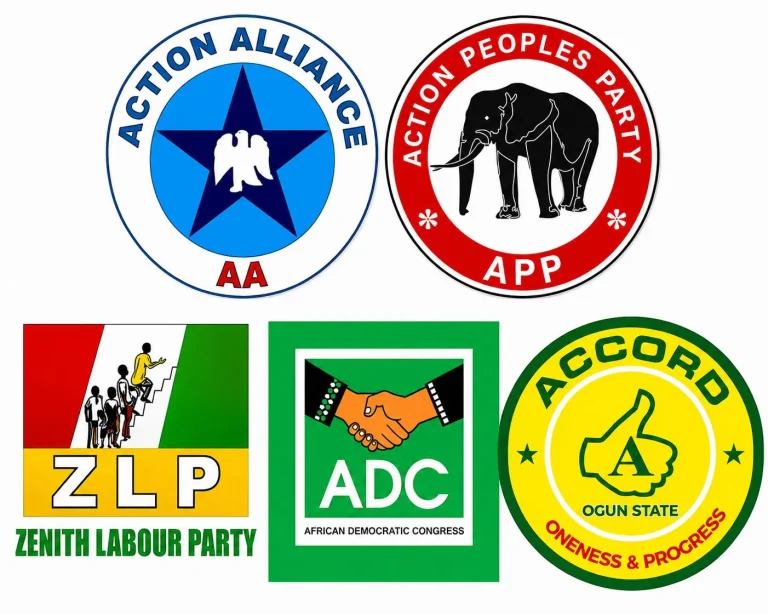
Chances of the presidential candidate of the African Democratic Congress (ADC) Atiku Abubakar, that of the governor of Osun State, Ademola Adeleke, and the presidential candidate of the Accord Party, Gbenga Olawepo Hashim, contesting in the next presidential and governorship elections appear threatened as a Federal High Court sitting in Abuja on Monday ordered the Independent National Electoral Commission (INEC) to deregister their parties.
Atiku and Olawepo-Hashim are contesting the presidential elections on the platform of their respective parties while Adeleke is the governorship candidate of the Accord Party in the August off-cycle elections in Osun State.
The parties listed in the suit and affected by the court’s order apart from ADC include: Accord, Action Alliance (AA), Action Peoples Party (APP) and Zenith Labour Party (ZLP).
Justice Peter Lifu, who made the order in a judgement, held that the affected parties breached Section 225 of the Nigerian constitution.
Kaduna, Lagos, others to kickstart Nigeria’s smart transport project
Nasarawa APC remains strong despite ex-IGPs resignation – State chair
Checks showed that the section quoted by the judge, gives INEC the power to deregister political parties that did not win any elective position in the previous round of elections at the federal, state and local government levels.
The judge’s order came a few hours after the ADC announced a former governor of Rivers State, Rotimi Amaechi, as the vice presidential candidate of the party.
Those behind the case
The suit, marked FHC/ABJ/CS/2637/2026, was filed by the Incorporated Trustees of the National Forum of Former Legislators, joined INEC, the Attorney-General of the Federation and some opposition political parties as respondents.
The plaintiffs argued that the parties no longer met the constitutional threshold for continued existence as registered political parties.
They relied on Section 225(a) of the Constitution and provisions of the Electoral Act, insisting the parties failed to win elective seats or meet minimum requirements in elections.
They asked the court to hold that INEC has a constitutional duty to deregister political parties that fail to meet the legal conditions.
The plaintiffs also sought an order compelling INEC to remove the parties from its register and restrain them from participating in future elections.
The Attorney-General of the Federation, Lateef Fagbemi, joined as a defendant in the suit, threw his weight behind it.
Earlier in May, political parties asked the Federal High Court to suspend proceedings in the same suit seeking their deregistration by the INEC.
They urged the court to stay proceedings pending the outcome of an appeal on the same subject matter before the Court of Appeal.
Specifically, at that May 11 hearing, lawyer to Accord Party, Musibau Adetumbi, argued that the trial court should not continue with the case because related issues had already gone before the Court of Appeal.
Adetumbi, a Senior Advocate of Nigeria, relied on Supreme Court authorities and argued that a lower court could not proceed on issues pending before a higher court.
The political parties’ lawyers, with S.E. Aruwa representing the ADC, Peter Abang for the Action Alliance, backed the call for the suspension of proceedings.
Their Zenith Labour Party and APP counterparts also supported the request.
The lawyers took turns to argue that allowing the case to continue while an appeal was pending could affect issues already before the appellate court.
APP’s lawyer, Abang, also informed the court that parties had been served with processes filed at the Court of Appeal on 7 May. He added that no response had been filed against the application.
The lawyer also questioned the competence of the suit. He argued that Action Alliance had already challenged the court’s jurisdiction and urged the judge not to take steps that could undermine the appeal proceedings.
Aruwa, ADC’s lawyer, also told the court that the appeal could be determined within a short time.
Opposing the applications, lawyer to the plaintiff, Yakubu Abdullahi Ruba, argued that the appeal was interlocutory and did not prevent the Federal High Court from continuing with the matter.
Ruba argued that no order from either the Court of Appeal or the Supreme Court directed the lower court to suspend proceedings.
For his part, INEC’s lawyer, Haliru Mohammed, told the court that the commission had already responded to the substantive suit and would abide by the law.
Lawyer to the Attorney General of the Federation, O.A. Abdulraheem, refrained from taking a stance on the applications.
But at Monday’s proceedings, Justice Lifu, who earlier dismissed all the preliminary objections filed by the defendants, ordered INEC not to allow the parties participate in the subsequent elections, including the 2027 general polls, “having failed to meet the constitutional threshold”.
Efforts by Daily Trust to obtain the reaction of the Independent National Electoral Commission (INEC) on the judgement were unsuccessful as of press time. Calls and WhatsApp messages sent to the commission’s Director of Voter Education and Publicity, Victoria Eta-Messi, and the Chief Press Secretary to the INEC chairman, Adedayo Oketola, seeking clarification on the commission’s next line of action were not responded to. However, a Deputy Director in the publicity department told our correspondent that he had only just received information about the court judgement and was unable to provide an official comment.
However, further checks showed that Leke Abejide, who defected to the ruling APC recently, won the House of Representatives seat in Yagba Federal Constituency of Kogi State on the platform of ADC in 2023.
It’s an attempt to undermine opposition – Atiku
In a swift reaction, former Vice President, Atiku Abubakar, who is the presidential candidate of the ADC, described the judgement as the “height of judicial rascality.”
Atiku, who commented on the development through one of his media aides, Paul Ibe, in a post on his verified Facebook handle, wondered why the case in the higher court where a stay action order was given would still have the attention of the lower court.
He said, “The so-called deregistration of the African Democratic Congress (ADC) along with other parties by Justice Peter Lifu may yet be the biggest manifestation of Tinubu’s hell-bent bid to undermine the opposition and entrench a de facto one-party state. The judgement is the height of judicial rascality.
“The Court of Appeal presided over by Justices Mohammed A. Danjuma, Adebunkunola A. Banjoko, Oyejoju O. Oyewumi had in Appeal CA/ABJ/CV/569/2026 and suit No. FHC/ABJ/CS/2637/2025 ordered Justice Peter Lifu to stay further action on the matter until the hearing and determination of the Appeal before it.
“The hearing for the appeal was scheduled for the 27th of October 2026. That order was dated 22nd of May 2026.
“Nigerians and the international community can see the level of desperation of the ruling party’s government to either have their way in the 2027 elections or destroy our democracy that was purchased at a huge cost.”
There will be consequences if we are not on the ballot – ADC
The ADC also rejected the judgement, warning that consequences may follow any effort to remove the party from the ballot.
In a statement by its National Publicity Secretary, Mallam Bolaji Abdullahi, the party argued that the “curious judgement is yet the clearest evidence of the desperation of the ruling party and the government to ensure that President Tinubu holds on to power by any means necessary, even if it means subverting democracy and throwing the country into a crisis of immense proportions.”
The party explained that the Constitution grants only INEC the power to register or deregister a political party, saying the judgement has “flagrantly contradicted INEC’s position on affidavit and ignored a subsisting order of stay of proceedings of the Court of Appeal”.
The ADC, therefore, vowed to challenge the ruling through all lawful means, while urging its members to remain calm and await further directives.
Part of the statement said; “We are deeply alarmed by the judgement reportedly delivered by Justice Peter Lifu of the Federal High Court, Abuja, in a case filed by the so-called National Forum of Former Legislators seeking the deregistration of the ADC and four other political parties. This judgement stands in direct conflict with constitutional principles and all known judicial processes and procedures.
“The facts are straightforward. The plaintiffs had argued that the ADC and four other political parties failed to satisfy constitutional requirements relating to continued registration.
“However, in its counter-affidavit filed before the court in May, INEC, the constitutional body empowered with the registration, regulation, and supervision of political parties in Nigeria, categorically maintained that the ADC had not violated any registration requirements and had not failed any constitutional electoral-performance threshold.”
ADC said, “INEC further made it clear that the deregistration of a political party cannot be driven by political pressure, sentiment, or the wishes of interested parties. It must be based strictly on constitutionally established grounds, none of which had been proven against the ADC.”
The party said, apart from INEC’s position in support of the party, the ADC finds it troubling that the trial judge was aware of a subsisting order of the Court of Appeal issued on May 22, 2026, directing a stay of proceedings on the matter. “The judge, however, chose to flagrantly and contemptuously disregard a clear order of a superior court in a manner that brings into question all known judicial traditions.
“The ADC considers this development not merely a legal dispute, but a dangerous escalation capable of destabilising the nation’s democratic process. Our position is anchored on the role that agents of the ruling party have played in this matter. It would be recalled that the case has been championed directly by individuals working with the president’s Chief of Staff. The decision of the Attorney-General of the Federation and Minister of Justice, who is a second defendant in the matter, to join the matter as a plaintiff in April, is an absurdity, which sends a signal that is impossible to ignore.
“We are, therefore, left in no doubt that this latest development is a continuation of the ruling party’s persistent efforts to undermine the opposition, especially the ADC. We also find the timing of this ruling quite curious. Despite all the obstacles placed in its way, the ADC has risen to the task and met all benchmarks and deadlines. Therefore, coming at a time when the party has concluded its primaries and is fielding candidates for all positions in the next election, especially the presidential election, it is clear what this is all about,” the ADC said.
The opposition party said at a time when millions of Nigerians are struggling under economic hardship, escalating insecurity, widespread unemployment, and growing national anxiety, “it is deeply disturbing that powerful forces appear more interested in eliminating political opposition than confronting the real crises facing the country.
“Let it be clearly stated: the ADC will not stand by while the democratic rights of millions of Nigerians are threatened. We reject any and all attempts to intimidate, suppress, deregister, or politically extinguish our party and other opposition parties through means that offend both the spirit and the letter of the Constitution”, the party added.
The ADC also said it would petition the National Judicial Council (NJC) over the matter.
“We call on all our members, candidates, supporters, and coalition partners across the country to remain calm, vigilant, and steadfast. Whatever it takes, the ADC will be on the ballot so long as the 2027 election is to hold. Further directives will be communicated through the appropriate channels,” he said.
federal high court lagos
federal high court lagos
‘Ruling violates Court of Appeal order’
Governor Ademola Adeleke also described the judgement as an abuse of court process and direct violation of a subsisting order of the Court of Appeal.
In a statement issued by Malam Olawale Rasheed, spokesperson to the state governor, Adeleke expressed surprise that the lower court still proceeded to deliver a ruling on a matter already acted upon by the Court of Appeal.
The governor urged the people to be calm as the Court of Appeal will take up the matter today (Tuesday), assuring the public that this “efforts to stop Osun people from exercising their voting rights will fail by the special grace of Almighty God. The Rule of Law and Humanity shall prevail at the end of the day.
“I call on Osun people to remain calm and be assured that our rights will be affirmed and our party, the Accord, will be on the ballot on August 15th.
“We will not only be on the ballot, we will win overwhelmingly, the forthcoming governorship election. We should remain calm and forge ahead with mobilisation of our people.
“I also want to assure our people that the flag off of our campaign is holding as scheduled tomorrow. They want to distract us. We are going ahead and we are winning this election”, the state governor posited.
ZLP not bothered- Nwanyawu
National chairman of the Zenith Labour Part (ZLP) Dan Nwanywu while reacting, said the party is not bothered by the ruling and will continue to remain strong and united.
The ZLP national chairman who spoke with our correspondent on phone said though he was in a meeting to discuss the matter, he wouldnt hesitate to dismiss the ruling as of no consequence since an appeal court had intervened on the matter.
He said the party will speak extensively on the matter today.
ADC, APP’ll remain registered despite court ruling – Ugochinyere
The national leader of the Action Peoples Party (APP), Hon. Ikenga Ugochinyere, has rejected the judgment of a Federal High Court in Abuja ordering the deregistration of five political parties, insisting that the ruling has been overtaken by existing decisions of higher courts.
Ugochinyere, who represents Ideato North/Ideato South Federal Constituency of Imo State in the House of Representatives, described the judgment as a threat to Nigeria’s democracy and warned that it could undermine political participation if allowed to stand.
Speaking in Abuja on Monday, Ugochinyere argued that the affected parties remained validly registered and would continue to participate in future elections.
He said previous judgments of the Federal High Court, the Court of Appeal and the Supreme Court had already interpreted Section 225A of the Constitution and established that political parties that secured elective positions could not be deregistered.
He also said Accord Party won a seat in the Imo State House of Assembly, adding that other affected parties had recorded electoral successes sufficient to retain their registration.
“Political parties cannot simply be wiped out in a democracy. Democracy thrives on participation, competition and the availability of choices for citizens,” he said.
The lawmaker further alleged that the trial court proceeded with the matter despite an order of the Court of Appeal staying proceedings pending the determination of an appeal related to the case.
He called on the National Judicial Council (NJC) to investigate the circumstances surrounding the judgment and take appropriate action if any misconduct was established.
Ruling could lead to electoral uncertainty – CDD
Reacting to the development, the Director of the Centre for Democracy and Development (CDD), Dr. Dauda Garuba, said while INEC is bound by the court order, the increasing resort to litigation to resolve political disputes raises serious questions about the health of Nigeria’s democracy.
“As of today, that is the judgement that is available and that is what binds INEC,” Garuba said.
He, however, lamented that issues that should ordinarily be resolved through democratic processes were increasingly being taken to court.
“Multiparty democracy is good for democracy and good for Nigeria. It is unfortunate that some of the very basic things citizens can assess and resolve within the democratic process now end up in court. Virtually every contest eventually ends in litigation,” he said.
Garuba noted that the timing of the judgement could have implications for the 2027 elections, especially given the numerous internal disputes currently rocking political parties.
He cited instances where multiple factions within political parties lay claim to party leadership, creating confusion ahead of elections.
“Things as basic as determining who a party’s candidate have become subjects of litigation. In some parties, you have multiple factions claiming legitimacy and multiple candidates laying claim to the same ticket. It makes one wonder whether our democracy is progressing or retrogressing,” he said.
He called for stronger political party institutions, arguing that the erosion of internal party discipline and the influence of powerful political actors were weakening democratic governance.
“We need to return to the culture of building strong political parties. Political parties should be the platforms for policy development and democratic decision-making, not instruments controlled by moneybags and powerful interests,” he added.
It’s bound to have far reaching consequences – YIAGA Africa
Also reacting, Executive Director of Yiaga Africa, Samson Itodo, warned that the judgement could have far-reaching consequences for political competition and inclusion in the country.
According to him, while political parties are expected to comply with constitutional and legal requirements, decisions affecting their continued existence must be assessed beyond legal considerations.
“The judgement ordering the deregistration of some political parties has grave implications for Nigeria’s democracy, especially with the 2027 general elections just six months away,” Itodo said.
He added, “At a time when concerns are mounting about the shrinking political space and the weakening of opposition politics, questions will arise as to whether legal processes of this nature could be weaponised, intentionally or otherwise, to undermine opposition parties and consolidate political advantage,” he said.
Itodo further noted that deregistering political parties after they had conducted primaries and nominated candidates could create fresh complications for political parties, candidates, INEC and voters.
“Any action that significantly alters the political landscape this close to a general election must be approached with utmost caution and sensitivity to its potential consequences for electoral integrity and public confidence in the democratic process,” he added.
A Kano-based lawyer, Barrister Umar Usman Danbaito, has faulted the ruling, warning that the trend could undermine Nigeria’s democracy.
He questioned the legal standing of the plaintiffs who brought the case before the court. “To me, I don’t think they have locus standi to file and prosecute this action. What benefit does deregistering political parties render to former legislators,” he asked.
He explained that Section 225 of the 1999 Constitution requires parties to win a certain number of seats to remain registered, but insisted that only parties directly affected should challenge their status.
“There is no locus standi. But whenever a court of law gives an order, that judgement is valid and binding until set aside by a superior court,” he noted.
Danbaito advised the affected parties to appeal the ruling, adding, “The only option open to them now is to file an appeal and an order of stay of execution. If they do so, the deregistration can be suspended pending determination of the appeal,” he said.
The lawyer warned that the ruling could shrink Nigeria’s political space. “This trend is not good for our political system. Indirectly, the accusation of opposition parties is gradually manifesting, that the ruling party intends to have a single-party system in Nigeria,” Danbaito cautioned.
Another Kano-based lawyer, Barrister Kamilu Ahmad Paki, said the ADC and other affected parties meet the constitutional grounds for deregistration, stressing that the Federal High Court ruling is consistent with Section 225A of the 1999 Constitution as amended.
He explained that the 2018 alteration to the constitution clearly sets conditions for political parties to remain registered.
“If a party fails to secure 25 percent in the presidential election, in any governorship election, or in local government elections, then that party stands to be deregistered. INEC cannot act alone; an order of court is required for compliance,” he said.
Paki noted that ADC did not meet the constitutional threshold in the 2023 general elections.
“ADC did not win 25 per cent in any state during the presidential election, nor in any governorship election. Even though it had one House of Representatives member from Kogi State, that alone does not qualify it to remain registered. The constitution speaks conjunctively, not disjunctively,” he explained.
While acknowledging that morality might suggest ADC should remain registered because it fielded a presidential candidate and maintained structures, he insisted that the law is clear.
“If we talk about law, particularly the constitution and the Electoral Act, ADC stands to be deregistered because of non-compliance. Registration of political parties is a purely constitutional issue, and whenever there is non-compliance, any person can challenge it before a court of law,” he added.
Deregistration pure judicial banditry – Kperogi
Professor Farooq Kperogi described the judgement ordering INEC to deregister five political parties as a politically engineered judicial violence against democratic pluralism.
Kperogi who is a professor of journalism and emerging media at Kennesaw State University in Georgia, United States in a post on his verified social media page said if the reported reason for the judgement is that the ADC failed to meet the constitutional threshold for continued registration as a political party then it is plainly false.
“In the 2023 elections, the ADC won two House of Representatives seats in Kogi State: Ijumu/Kabba Bunu and Yagba East/Yagba West/Mopa Muro. It also won a seat in the Kogi State House of Assembly. This is all in INEC’s public record.
“Section 225A of the Constitution permits deregistration only when a party fails to win the required electoral foothold, including at least one seat in the National Assembly or a State House of Assembly. The ADC met that requirement. A judgement that says otherwise is pure judicial banditry.
“Even if some ADC elected officials later defected to other parties, that does not cancel the fact that they were elected on the ADC platform in 2023. Defection is not retroactive electoral defeat. A party that won seats cannot be treated as a party that won none.
“Plus, if defection from the party counts against it, defections into it should compensate for defections from it. There are at least 25 federal legislators (Senate and House of Representatives) who have defected to the ADC in the current realignment cycle. Some people say the figure is higher than that.
“To deregister a party on a ground contradicted by official election records creates the strong impression that the judiciary is being used to do what political actors fear voters may not do.”
Justice Lifu and his rulings
Justice Peter Odo Lifu, a judge at the Federal High Court in Abuja, was born in Okpoma, Yala Local Government Area of Cross River State.
Before he joined the federal bench, he obtained his Law degree from the University of Jos. He was called to the Nigerian Bar in 1990.
He also holds a Masters degree in Political Science and a Master of Laws (LL.M.) from the University of Ibadan.
Before his judicial appointment, he practiced law in Ibadan and lectured at the Department of Public and International Law, University of Ibadan.
He has presided over several high-profile political and constitutional cases.
Justice Lifu frequently handles high-stakes political disputes, election matters, and regulatory cases. Some of his notable judgements include the recent affirmation of the Senator Nenadi Usman-led caretaker committee as the legitimate leadership of the Labour Party.
Before issuing the court order mandating the INEC to deregister the ADC and four other political parties, he had earlier presided over multiple cases involving the Peoples Democratic Party (PDP).
One of them was issuing injunctions restraining the party from removing Umar Damagum as Acting National Chairman and stopping the PDP’s national convention.
Justice Lifu was also the judge who restricted INEC from releasing the voters’ register to the Rivers State Independent Electoral Commission (RSIEC) for the conduct of local government elections in the state.
The judge also dismissed the motion filed by a plaintiff identified as Johnmary Jideobi and cleared former President Goodluck Ebele Jonathan to participate in the 2027 presidential race.
Following his orders and judgements, various groups and individuals had filed a series of petitions against the judge.
Prior to Monday’s judgement, the leadership of the ADC had earlier petitioned the National Judicial Council (NJC) over alleged bias against the judge.
The party also took legal action against the Chief Judge of the Federal High Court, Justice John Tsoho, over alleged disobedience of the orders of court.
The suit dated and filed on June 4, by the National Welfare Secretary of the ADC, Nkemakolam Ukandu, the party wrote to the NJC to prevail on Justice Tsoho to withdraw the case from Lifu, and reassign it to a new judge.
Ukandu, in the suit he personally filed at the Federal High Court, Abuja, faulted the CJ for reassigning the suit to Justice Lifu in alleged disregard of the orders of the Supreme Court.



Leave a Reply