
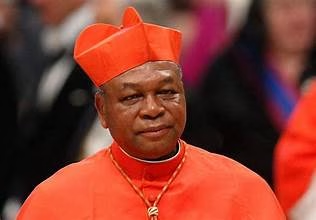
Here is my point to point response to each of the concerns raised.
1. Was it improper for Cardinal Onaiyekan to speak publicly on Arise News?
Not necessarily. The meeting between President Tinubu and the Catholic Bishops of Nigeria was not a sacramental confession that requires utmost secrecy, a diplomatic negotiation under secrecy, or a legally confidential proceeding. Unless the participants expressly agreed to confidentiality, there is no legal or moral principle that absolutely prevents either party from commenting on the discussion afterward.
2. The Church has both the right and the duty to speak
Catholic bishops are not merely private citizens expressing personal opinions. By virtue of their pastoral office, they have a responsibility to teach on moral and social issues. Catholic social teaching consistently affirms that the Church must speak whenever human dignity, justice, security, and the common good are at stake. That is exactly what the bishops did.
3. Speaking after a meeting is not necessarily a breach of trust
Providing one’s understanding of a discussion is different from revealing confidential state secrets. Democratic engagement often includes explaining to the faithful what was discussed, particularly when the meeting like theirs concerns issues affecting millions of citizens.
4. Criticism of government is not a denial of progress
One may acknowledge improvements while still concluding that much more remains to be done. Recognizing government achievements and identifying persistent failures are not mutually exclusive positions.
5. “Truth to power” remains relevant
The fact that a president receives intelligence briefings does not eliminate the value of independent voices. Security reports, economic data, religious leaders, civil society, academics, journalists, and ordinary citizens each offer different perspectives. No single source possesses the whole truth.
6. Access to privileged information does not settle public debate
The President undoubtedly possesses information unavailable to the public. However, democratic accountability also requires that government decisions remain open to public scrutiny and legitimate criticism.
7. Confidentiality should not become silence
If public officials may explain their side of a meeting, religious leaders should not automatically be denied the same opportunity, provided they do so truthfully, respectfully, and without disclosing genuinely confidential matters.
8. Clerical office does not diminish civic responsibility
The virtues expected of bishops such as prudence, temperance, and wisdom, do not require silence in the face of national concerns. History remembers many bishops who respectfully challenged civil authorities while remaining faithful to both the Gospel and legitimate constitutional order.
In all, the real issue is not whether Cardinal Onaiyekan spoke, but whether what he said was truthful, fair, and served the common good. I believe that in a constitutional democracy, respectful dialogue between religious leaders and civil authorities should continue not only behind closed doors but, when appropriate, also in the public square, just as Cardinal Onaiyekan did.

Leave a Reply