
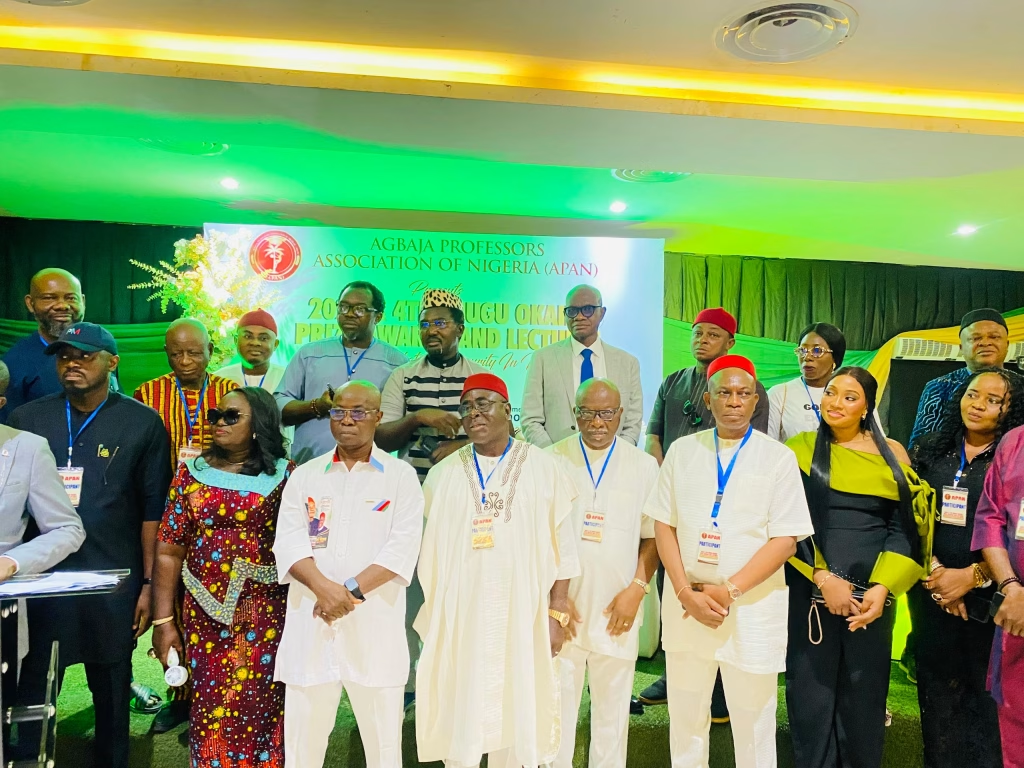
A former Chief of Staff to Enugu State Government, Rt. Hon. Dr. FSA Uzor, has delivered this year’s Obaibe lecture sponsored by Agbaja Professors Association of Nigeria (APAN)
In the lecture, Dr FSA Uzor examined the case for State Police within Nigeria’s wider security debate,
Similarly, an entrepreneur, Dr, Comas Agu, was recognized as the sole laureate of the 2026 Okaibe Prize for his contributions to business, engineering and construction, legal practice, infrastructure development and philanthropy.
Chief Agu’s career spans more than three decades in business, engineering, and construction, alongside legal practice and philanthropy
He founded COMAG Steel & Construction Company Limited, which has undertaken engineering, road construction and building projects, as well as the supply, fabrication and installation of structural steel materials for the oil and gas industry.
The company has contributed to Nigeria’s infrastructure development and providing practical training opportunities for young engineers seeking to build careers in the engineering profession.
Beyond his business interests, Agu is a solicitor and advocate of the Supreme Court of Nigeria and a co-founder and principal partner of Salvage Solicitors, a law firm serving corporate and individual clients.
His philanthropic contributions include support for community infrastructure, social amenities, scholarships, and youth empowerment initiatives.
Among the honours listed in his citation are the Melvin Jones Fellow Award for humanitarian service from Lions Clubs International Foundation, the Chinua Achebe Award for Excellence from the Institute of African Studies at the University of Nigeria, Nsukka, and the Keyman Award for Best in Metal Technology from the Enugu State Chamber of Commerce and Industry, Mines and Agriculture.
He also holds traditional titles, including Nwadiuru of Umuoka, in Udi Local Government Area of Enugu State.
His emergence as the sole Okaibe laureate was a major highlight of the gathering, which combined recognition of professional and humanitarian contributions with an examination of Nigeria’s security challenges.
In a communique
themed: “Combating Insecurity in Nigeria: Evaluating the Case for State Police.” Agbaja Professors Association of Nigeria called for constitutional reform to establish State Police, citing security challenges and economic losses across Nigeria, particularly in the Southeast.
They argued that decentralised policing, supported by strong institutional safeguards, could help Nigeria tackle its persistent security challenges.
APAN urged the 36 State Houses of Assembly to ratify the proposed constitutional amendment on State Police, which would move policing from the Exclusive Legislative List to the Concurrent Legislative List.
The association said decentralising policing was an important component of a broader strategy to restore security and support economic development.
APAN argued that Nigeria’s centralised policing structure faces significant challenges in responding to security threats across the country’s diverse communities.
It maintained that state-level police services could improve local intelligence gathering, enable faster responses, and complement the operations of the Nigeria Police Force.
While acknowledging that decentralisation alone would not end insecurity, the association however called for safeguards to prevent political interference, arbitrary action, and human rights abuses.
Among other recommendations put forward by APAN, were independent State Police Service Commissions, protection against arbitrary removal of police commissioners, written directives for governors’ lawful instructions, a prohibition on using State Police to suppress lawful political opposition, and national minimum standards and certification requirements.
The communiqué also proposed that federal intervention should be reserved for exceptional situations, including a breakdown of state policing or serious abuses.
APAN identified poverty, youth unemployment, corruption, weak governance and justice systems, porous borders, the proliferation of small arms, and inadequate security funding as some of the factors sustaining insecurity.
It argued that policing reform must be accompanied by practical measures to address these underlying problems.
The communiqué highlighted the economic consequences of insecurity, particularly in the Southeast, where sit-at-home disruptions have affected businesses, workers, and households.
It cited substantial losses associated with the disruptions and their impact on commercial centres such as Onitsha, Aba, and Nnewi, which serve as important trading and industrial hubs.
To support economic recovery, APAN recommended establishing a Southeast Security Trust Fund, protecting agricultural communities through measures such as agro-rangers, and using community engagement to rebuild trust and end sit-at-home disruptions
The association also advocated improved police welfare, the use of body cameras, and the redeployment of police personnel assigned to VIP protection to community policing, in line with the presidential directive referenced in its communiqué.
It further called for wider adoption of technology-assisted security operations, citing Enugu State Governor, Dr. Peter Ndubuisi Mbah’s, Command and Control Center as a model for other states. The center’s use of cameras, artificial intelligence analytics, and tracking systems was highlighted as an example of technology supporting security coordination and surveillance.
It stressed the need for cordial relationship between public safety and economic progress, stating: “State Police will not end insecurity overnight, but insecurity will never end without State Police. Without security, there is no economic development.”
Among dignitaries who attended the
occasion were academicians, public officials, traditional rulers, professionals, and other stakeholders.
The chairman of the occasion, Prof. Elochukwu Amaucheazi was represented by Prof. Barr. Agu Gab Agu.
Goodwill messages were delivered by APAN President, Prof. Chike Anibeze; Igwe Lawrence Agubuzu; and Chairman of the Central Planning Committee, Prof. Paschal I. P. Okolie.




Leave a Reply