
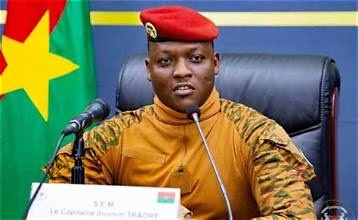
When Ibrahim Traoré came to power in Burkina Faso in September 2022, he inherited a country battling a brutal insurgency, a struggling economy and deep public frustration with the political establishment.
Three years later, the country is still fighting armed groups and remains under military rule, but there are tangible projects and policy changes that have given his government a distinct direction.
That is what makes the Burkina Faso comparison uncomfortable for Nigeria.
Traoré’s government has placed control of the country’s natural resources at the centre of its economic policy. In September 2026, Burkina Faso opened its first national gold refinery in Ouagadougou, with an initial theoretical refining capacity of 164 tonnes a year.
The government says the objective is to process more of the country’s gold domestically and retain greater value from its mineral wealth.
The point is not that a gold refinery, by itself, proves that Burkina Faso has been transformed. It is that within a relatively short period, Traoré’s government has pursued a clearly identifiable economic direction: greater state control of resources, domestic processing and reduced dependence on the traditional model of exporting raw materials.
Burkina Faso’s economy has also continued to grow.
The IMF reported that real GDP growth reached 5.3 per cent in 2025, compared with 4.8 per cent in 2024. That performance does not erase the country’s enormous security and humanitarian problems, but it does complicate the argument that major changes in policy must necessarily take many years before Nigerians can begin asking what has actually been achieved.
And that is where the Nigerian question begins.
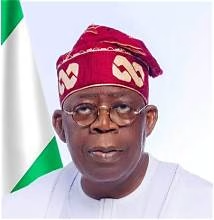
Tinubu assumed office in May 2023 and will have been in power for almost four years by the time Nigerians approach the 2027 election. His administration has repeatedly defended its economic reforms, particularly the removal of the petrol subsidy, exchange-rate reforms, increased government revenues, investments in infrastructure and measures intended to strengthen domestic production.
Tinubu has argued that Nigerians had to endure the immediate pain because the reforms were designed to correct problems that had accumulated over decades. In his October 2026 Independence Day address, he said the country had moved through the emergency phase of the reforms and was entering a period in which the priority should be shared prosperity and lower living costs.
There are economic indicators supporting part of that argument.
The IMF estimates that Nigeria’s economy grew by 4 per cent in 2025 and projects growth of about 4.1 per cent in 2026. It also says the reforms have improved some macroeconomic outcomes and strengthened resilience.
But there is another side to the numbers, and it is the side ordinary Nigerians are more likely to notice.
The same IMF assessment says poverty had reached 63 per cent at the national poverty line and that about 27 million Nigerians faced food insecurity in late 2025. The Fund also warned that higher food and fuel prices could worsen poverty and food insecurity.
So the argument is no longer simply about whether Nigeria’s GDP is growing.
It is about what that growth is doing for the person who buys food every morning, the worker paying transport fares, the family paying rent, the small business owner struggling with electricity and the young Nigerian looking for work.
This is why the phrase “be patient” has become politically difficult.
There is nothing unusual about economic reforms taking time. No serious analysis can reasonably suggest that a country as large and complicated as Nigeria can repair every structural problem in three years. Burkina Faso itself remains deeply troubled. Armed groups continue to threaten communities, and Traoré’s government has faced serious criticism over political freedoms and alleged human rights abuses. The military government has also moved further away from democratic competition.
Those facts matter.
But they do not completely answer the question Nigerians are asking: how long should citizens wait before demanding measurable results from the government they elected?
Traoré’s Burkina Faso provides an interesting counterexample because his administration has not asked the population to wait for a distant, undefined future before announcing what it wants to do. Its economic nationalism has been visible in policies around mining, agriculture, local production and infrastructure, whether or not one agrees with the political system through which those policies are being implemented.
That future is now being demanded in the present tense.
Nigeria cannot remain trapped permanently between “the reforms are working” and “give them more time.” At some point, the government must be judged not only by the policies it announces, but by whether those policies translate into cheaper food, reliable electricity, productive jobs, safer communities, functioning public services and higher purchasing power.
Burkina Faso has not become a model without problems. Traoré has not solved terrorism, poverty or governance overnight. But in less than four years, his government has given Burkinabè a series of concrete projects and a clearly defined political and economic direction that can be measured and debated.
That is the real challenge the comparison presents to Tinubu.
The question is no longer whether Nigerians should understand that reforms take time. They do. The question is how much time a government can reasonably ask citizens to endure hardship before the promised benefits become visible in their everyday lives.

Leave a Reply