
By Benedict AGBO (Rev. Fr.)
A. PREAMBLE
History often repeats itself, but the greatest tragedy of history is that human beings seldom learn from it.
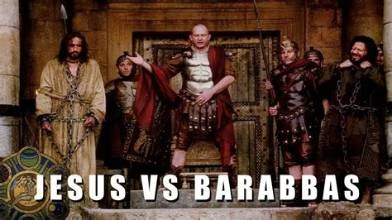
One of the greatest dangers to democracy is the ignorance of the masses. As Plato warned, the greatest danger to democracy lies in the uninformed and easily manipulated majority. Fulton J. Sheen similarly reminds us that the majority is not necessarily always right. If the majority were always right, then the Jewish crowd would never have demanded the release of Barabbas and the crucifixion of Jesus Christ about two thousand years ago.
The Barabbas tragedy therefore remains one of the most frightening biblical illustrations of how a people can collectively make a disastrous political choice. The crowd had a choice between Christ, the innocent one, and Barabbas, a convicted criminal. Yet, manipulated by political and religious interests, they chose Barabbas.
The question confronting Nigeria today is painfully simple: Are we preparing to repeat the Barabbas tragedy in 2027?
B. THE CHOICE OF BARABBAS
The 2027 Nigerian election is gradually becoming a potential replay of the Barabbas drama.
Whether the various FBI reports are eventually released or not, Nigerians have had three years of direct experience of the government that took over the helm of affairs in 2023. They have also had ample opportunity to observe the character, competence, weaknesses, strengths, promises and political strategies of the major opposition contenders.
Beyond the propaganda of desperate politicians, Nigerians cannot easily deny the testimony of their own stomachs, pockets and daily experiences. Poverty is not a theory to the hungry. Insecurity is not a statistic to the family whose breadwinner has been kidnapped. Unemployment is not a political slogan to the graduate who has remained jobless for years. And inflation is not a macroeconomic abstraction to the mother who can no longer afford the food she bought comfortably three years ago.
This is where the attempt by politicians to superimpose macroeconomic hopes over microeconomic hardships becomes problematic. You cannot continuously tell the suffering masses that the economy is improving when their daily experience tells them otherwise.
Nigeria has witnessed controversial budgets, questionable government agencies, broken promises and policies whose benefits appear increasingly distant from the ordinary citizen. The controversy surrounding fuel-subsidy removal and the distribution of its consequences has further deepened public distrust. At the subnational level, the alleged appropriation and control of both State and Local Government resources by political structures have continued to raise serious questions about the health of Nigerian federalism and grassroots development.
The fundamental issue, therefore, is not merely which political party wins in 2027. The deeper question is:
Will Nigerians vote according to their informed assessment of leadership, or will they once again allow poverty, propaganda, religion, ethnicity, vote-buying and political manipulation to determine their collective destiny?
That is the real Barabbas question.
C. A WARNING TO PRIESTS AND RELIGIOUS LEADERS
The warning of Hosea 4:6 is particularly relevant to Nigeria: “My people are destroyed for lack of knowledge.”
Nigeria is an intensely religious society. Churches and Mosques exercise enormous influence over the political consciousness and electoral behaviour of millions of Nigerians. This gives religious leaders an enormous responsibility—and an equally enormous temptation.
We are once again approaching an era of vote buying and the triumph of selfish political interests. But there is a disturbing moral question that religious leaders must confront:
If political corruption begins at the altar, how can we condemn it at the polling unit?
How can a priest, bishop or Imam collect hundreds of thousands of naira from politicians under questionable circumstances and then stand before a poor villager at the polling unit to condemn the acceptance of ₦3,000 for a vote?
The moral contradiction is simply too glaring.
If the shepherd sells his conscience, what moral authority remains for him to condemn the sheep for selling theirs?
The danger is that political corruption can trickle down from the powerful to the powerless. When religious leaders normalize the acceptance of political inducements, the poor citizen who accepts a few thousand naira may no longer feel morally guilty. He may simply conclude: “If the rich and powerful can sell their conscience for millions, why should I reject the crumbs offered to me?”
This is how a nation gradually loses its moral compass.
The political machinery available to incumbent governments is also not an unknown phenomenon. The experiences surrounding recent elections in Nigeria have raised serious concerns about vote buying, the alleged manipulation of electoral structures, the partisan deployment of state resources, intimidation of opposition supporters, and controversies surrounding the credibility of electoral processes.
Concerns about the independence and integrity of electoral personnel, adherence to the provisions of the Bimodal Voter Accreditation System (BVAS), and the protection of the sanctity of votes must therefore be taken seriously.
The political battlefield is already showing signs of intense manoeuvring. We have witnessed attempts to penetrate, divide and weaken opposition structures. We have witnessed splits within opposition parties and increasingly granular political fragmentation.
But there is another possibility.
The same fragmentation that weakens the opposition can also produce an unexpected unity.
When political actors and citizens discover a common existential concern, hatred of a particular political order—or, more constructively, a common determination to restore political accountability—can become a powerful unifying force.
The beauty of multiparty democracy is precisely this: the people can change their political direction peacefully through the ballot box.
But there is one condition:
THE VOTE MUST BE ALLOWED TO COUNT.
D. THE POWER OF THE PEOPLE
In all these political calculations, one fundamental truth remains: power ultimately belongs to the people.
But people who remain politically ignorant can become instruments of their own oppression.
There is a powerful Igbo proverb:
“Onye vu igu ka ewu na eso.”
It literally means that the goat follows the person carrying its fodder.
Yes—the goat.
The tragedy, however, is when the goat follows the person carrying the fodder straight into the slaughterhouse.
A hungry people can be bribed with peanuts. An ignorant people can be manipulated with propaganda. A divided people can be conquered by ethnic and religious sentiments. And a frightened people can be intimidated into surrendering their democratic rights.
But none of these conditions is inevitable.
The people can choose differently.
Only a politically unconscious majority will collect peanuts today and willingly vote tomorrow for the political structures that keep them poor.
This is why Town Hall Meetings should become an essential part of Nigeria’s democratic preparation for 2027, particularly at the grassroots and parish levels.
Every parish should, where possible, provide a neutral civic platform where political contestants can present their programmes and be questioned, examined and assessed by the people—without financial inducement, religious manipulation, ethnic intimidation or political hypnotism.
Candidates should be made to answer simple but fundamental questions:
What have you done? What are you promising? How will you achieve it? Where will the money come from? What is your record? What will you do differently? And why should we trust you with our collective future?
I have consistently maintained, as a Catholic priest, that supporting credible candidates and identifying incompetent or corrupt candidates is not partisan politics. It is political enlightenment.
The Church should not become the campaign headquarters of any political party. Neither should the Mosque.
But religious leaders have a moral duty to educate citizens on the principles of good governance, political accountability, responsible citizenship and the moral responsibility of voting.
That is not partisan politics.
That is moral citizenship.
It is precisely here that religious leaders must demonstrate the discipline of political objectivity and moral probity.
The critical hour is approaching again.
Some religious leaders will merely talk.
Some will keep quiet.
Some will compromise.
Some will collect political gifts and baptize them with religious language.
Some will jet away during the elections and return after the deed has been done—when the votes have been manipulated, when the wrong leaders have been imposed, and when the damage can no longer be undone.
But history will judge us.
And 2027 may once again place Nigeria before the ancient question of Jerusalem:
WHOM WILL YOU CHOOSE?
Christ or Barabbas?
Truth or propaganda?
Competence or mediocrity?
Accountability or impunity?
Good governance or political patronage?
The future of Nigeria may depend on the answer.
The Barabbas tragedy is not merely a story from two thousand years ago.
It is a warning.
And if Nigerians refuse to learn from history, they may once again discover that the greatest tragedy of democracy is not that the people have power—but that an ignorant people can use their power to choose the very forces that keep them in bondage.
The choice is coming.
The people must be enlightened before they vote.
They must be courageous before they vote.
And above all, they must refuse to sell their tomorrow for the price of today’s political crumbs.
Benedict AGBO (Rev. Fr.) is a Priest of the Catholic Diocese of Nsukka, a political activist, Associate Professor, and Head of Department of Music, University of Nigeria, Nsukka.
03: 09: 26

Leave a Reply