
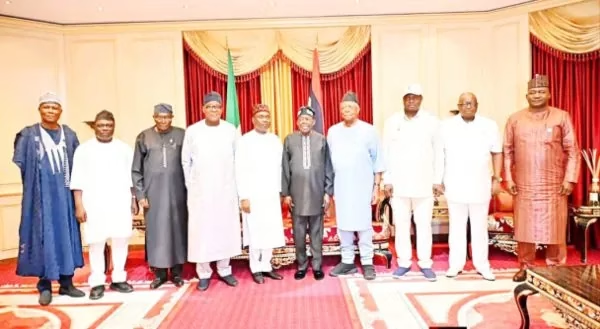
Concerns have been raised over the composition of the leaders of Nigeria’s Middle Belt region that met with President Bola Ahmed Tinubu in Abuja on Friday.
The concerns raised center around the observations that the composition of the delegation did not reflect representations from all the states that make up the middle Belt and was not sensitive to the dominant faiths in the region as all the members of the delegation are Christians.
Several analysts have pointed out the exclusion of prominent Middle Belt politicians like former and serving governors, prominent members of the National Assembly and other retired top civil servants and public officials who, from indications, must have been excluded on account of faith.
The meeting according to informed sources, focused mainly on the region’s political alliance ahead the 2027 elections.
The delegation led by former minister of defence, Gen Theophilus Yakubu Danjuma, comprised other leaders from the region that included the Plateau State governor Caleb Mutfwang, Taraba State governor Agbu Kefas; former Speaker of the House of Representatives, Yakubu Dogara, former Chief of Army Staff General Ishaya Bamaiyi, Defence Minister General Christopher Musa, businessman Thomas Etuh and President of the Middle Belt Forum, Dr Poju Bitrus.
Members of the delegation are known to have openly shown support for the reelection of President Tinubu in 2027 which seems to reflect the idea behind the meeting with the President.
Attempts to speak with some of the leaders in the delegation like former Speaker Yakubu Dogara and Senator Sunday Marshal Katung or their media aides were not successful as they were not answering their calls.
TY urges voters to reelect Tinubu
General Theophilus Danjuma in reinforcement of his position has charged the Nigerian public to re-elect President Bola Tinubu in the forthcoming 2027 general elections saying it is for consolidation of meaningful projects his administration has started already.
General Danjuma gave the charge at the twentieth-year anniversary and fundraising ceremony of the Adamawa state Government House chapel held in Yola on Saturday stressed that the first tenure of President Bola Tinubu’s government wouldn’t be enough for his to conclude laudable programmes and projects with direct bearing on Nigerians.
Represented by former military chief of Army staff, General Ishaya Bamaiyi, Danjuma said that Tinubu has appointed many Christians in positions of government which shows his fairness and tolerance among diverse people in the country urging Nigerians especially the middle belt to vote for his re-election massively come Presidential election in January 2027.
A source in the Middle Belt Forum however explained that the delegation that visited Tinubu were handpicked solely by TY Danjuma and did not have the input of the forum hence the group cannot explain the religious tilt.
Spokesman of the Middle Belt Forum, Luka Binniyat, when contacted confirmed that the forum’s president, Bitrus Pogu was only invited to join the meeting but did not partake in the selection of those to attend.
He said, “the visit of TY Danjuma and some of the leaders of the Middle Belt was not something that was planned by the Middle Belt Forum itself,” explaining that General Danjuma is the chairman board of trustees of the Middle Belt Forum but he has his own circle that he is confident with. “We do not know why Muslims are not among them. But the Muslims are integral part of the Middle Belt Forum. For example, our national vice president, Al-Hajji Idi Waziri, is a Muslim from Wase in Plateau state and our women leader, Hajja Amina Saidu is a Muslim from Nasarawa.”
He added that the MBF President only notified them a few hours to that meeting.
“If ethnicity were to be represented, there should have been more than 300 people representing the various ethnic groups. And if you are visiting the number one man in the villa, I don’t think it’s easy to accommodate that kind of crowd. But we believe that no matter what decision they took there, covers the interests of every ethnic nationality of the Middle Belt.”
He said what was presented to the President include a charter of demand that includes all the interests of the ethnic nationalities of the Middle Belt which includes issues like security, escalating cost of living and decline in agricultural production.
“And then also, we encouraged him to restructure, restructure Nigeria based on the 2014 CONFAB. We had a very robust presentation there, which was adopted by the CONFAB as the Middle Belt groups.
Recall there was a Convocation of Middle Belt Nations, held in Kafanchan, Kaduna State, from October 15 to 17, 2026 where participants called for regional restructuring, additional states, improved security, stronger political representation and greater accountability from elected officials.
They also urged political parties seeking their support ahead of the 2027 elections to present clear programmes addressing insecurity, education, healthcare, infrastructure and economic development.
ACF: The representation leans towards a certain persuasion
The Arewa Consultative Forum in its response said while it is within the rights of people to associate, such gathering, must when viewed within the context of the coming elections in 2027, should have been broader in composition.
Spokesman of the ACF, Prof Tukur Baba, explained that the it is the tendency of the current administration to meet with various groups separately.
“Now, if we check the composition, it looks like these are people who are already politicians in one way or another, and represent certain interests in one way or another.
“Now, while welcoming and admitting the rights of such people to gather and advocate, it is very interesting to know that, although the areas they spoke of, they said parts of the Northeast, the Middle Belt, or the North Central Region, whatever you want to see, it’s also a diverse community, ethnically, religiously, and so on.
“But there is something that cannot be missed, no matter how much one wants to be optimistic about the composition of the country, of the group, that is to say, it leans towards people of its persuasion, and if I may say, Christian persuasion, which itself is not bad, you know, because it is a fundamental human right.
“But one is worried about the implications for the Nigerian political economy as a whole. Is this a manifestation of a religious divide, and is it being promoted, advanced, and used to compound already issues
“Otherwise, all the issues they canvassed for economic development, educational development, security in particular, agriculture, and other infrastructure inclusion in the Federal Republic are similar.
“The performance of the economy transcends religious and other primordial sentiments. One would hope and one would prefer a situation where such a gathering, no matter who they represent, also represents those areas of common ground, those areas that are of importance to each and every Nigerian, irrespective of tribe, religion, or other demographic or other persuasions.”
He said one of the major problems of Nigeria is elite consensus. “And you’ll find that there are divergent interests among the elites. So I will not be worried. I will not be too worried. I will be concerned.”
The visit is divisive – JIBWIS
Jama’atu Izalatil Bid’a Wa’ikamatis Sunnah (JIBWIS), has described the visit by some of leaders of the region as divisive and has tendency to divide the region along ethnoreligious line.
Sheik Ahmad Ashir, National Publicity Secretary of the group said this while reacting to the recent visit by the leaders.
According to the group, “Nigerian and the north central in particular is composed of both Muslims and Christians. So, it was surprising to hear or see some leaders from the North Central who would visit the president as leaders from the north central without Muslims from the region.
Just we have Christians in the region, we equally have Muslims. We condemn the actions.
“The region belongs to all irrespective of ethnoreligious affiliation. If is is visit for Christian leaders, that is understood but them to mention that they are from the north central, they are not just to us as Muslims. we call on all people from the region to speak with one voice to achieve the sustainable development, “ he added.
Middle Belt Visit to Tinubu may deepen religious divisions – Analyst
A political analyst and lecturer at Bayero University Kano (BUK), Dr Sa’idu Ahmad Dukawa, has cautioned that the recent visit by some Middle Belt leaders to President Bola Ahmed Tinubu could deepen religious and political divisions if the delegation did not broadly represent the region.
He said the implications of the visit would depend largely on how the delegation presented itself to the president.
According to him, if the visitors identified themselves as Christian leaders from the Middle Belt, there would be nothing wrong with the meeting, noting that Muslim leaders from the region could also seek a similar engagement with the president.
“I think there is need to find out the details of how the leaders of the Middle Belt presented themselves to President Tinubu. If they presented themselves as Christian leaders from the Middle Belt, I think there is nothing wrong about it, in which case Muslim leaders from the Middle Belt can also pay similar visit,” he said.
The university lecturer, however, expressed concern that if the delegation claimed to represent the entire Middle Belt despite lacking Muslim representation, it could fuel suspicion and revive religious sentiments in the country’s politics.
“But if they introduced themselves as just leaders of the Middle Belt generally, and there is not a single Muslim amongst them, then it raises lots of concern and it gives room for suspicion that the religion card is going to be played once again,” he added.
Dukawa recalled the controversies that surrounded the Muslim-Muslim presidential ticket in the 2023 elections, arguing that religious considerations played a significant role in shaping political alignments at the time.
He said opposition to the ticket by some Christian groups eventually led many Muslims to rally behind Tinubu, turning the election into what he described as a contest to demonstrate political strength.
“When they made it a religious card, then that pushed Muslims to rally behind Tinubu and it became a contest of show of number. Muslims wanted to prove that there is nothing that can stop a Muslim-Muslim ticket in Nigeria from scaling through,” he said.
The analyst warned that a similar situation could emerge ahead of the 2027 elections if the president is perceived as identifying exclusively with one religious bloc.
“If Tinubu allows himself to identify only with Christians, then that will push Muslims away from him and to other candidates that can cost him his ambition of the 2027 re-election,” he said.
He stressed that Nigerians needed clarity on the nature of the delegation and the constituency it claimed to represent.
Dukawa maintained that religious groups have the right to organise and engage political leaders, but said problems would arise if a delegation claimed to speak for a diverse region without reflecting its religious composition.
“It is when they claim representation and yet the representation is not broad-based, it is not inclusive, then that is where lots of questions will be raised,” he stated.
He further warned that such developments could deepen divisions within the North and across the country.
”Certainly, it can amount to further dividing the North and, as a matter of fact, dividing Nigeria along religious lines, because Christians elsewhere will rally behind them and Muslims everywhere will distance themselves from that representation,” he said.
Dukawa described the prospect as dangerous for Nigeria, arguing that the country’s progress depends on strengthening national unity rather than reinforcing religious identities.
“Other countries are trying to unite their people irrespective of religious differences. Nigeria will really be left behind if it continues to be divided along religious lines,” he said.

Leave a Reply