
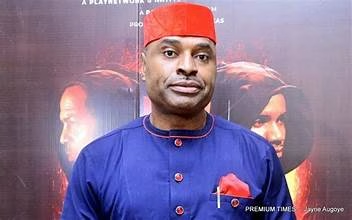
Kenneth Okonkwo came armed with colourful phrases and usual propaganda lines. But once the rhetoric is stripped away, several claims need serious qualification.
FALLING INFLATION WHILE PRICES RISE = VOODOO ECONOMICS.”
Wrong. Falling inflation means prices are rising more slowly. Falling prices are deflation. A car slowing from 120km/h to 60km/h is still moving forward.
- “₦15.8TN SAVED” MEANS TINUBU GOT ₦15.8TN.
No. The scorecard attributes roughly ₦5.43tn to the Federal Government; states and LGAs received the larger combined share- 10.8 tn.
- “YOU SAVED ₦15.8TN BUT STILL BORROWED—WHERE IS THE MONEY?”
Bad accounting. Saving on subsidy does not abolish wages, debt service, infrastructure, power support and other obligations. A family can reduce one expense and still have a mortgage.
- “DEBT ROSE FROM ₦77TN TO ₦159TN, SO TINUBU BORROWED ₦82TN.”
Misleading. Debt stock is not the same as fresh borrowing. Buhari-era Ways and Means securitisation- about 30tn entered the stock, while naira depreciation dramatically increased the naira value of existing foreign debt.
- “₦34TN WAS GIVEN TO TINUBU’S RICH FRIENDS.”
That is a huge leap. Customs said nearly 60% of the import-duty exemption approvals concerned military hardware; others covered CNG, vehicles, medical equipment, manufacturing inputs and food interventions. Scrutinise the waivers—but don’t rename the entire figure “money for Tinubu’s friends.”
- “IT’S OUR CRUDE—JUST SELL IT CHEAPER.”
Fine. But sell an $80 barrel for $60 and Nigeria sacrifices $20. THE BILL MOVED. IT DIDN’T VANISH.
- HE COULDN’T GIVE ATIKU’S PETROL PRICE.
The seun repeatedly pushed: WHAT PUMP PRICE? Kenneth answered with “affordability.”
But affordability is an adjective. It is not a number. He could just confess that it is still all a guessing game. ATIKU HAS ANNOUNCED THE PROMISE. HE HAS ONLY JUST BEGUN THINKING THE POLICY THROUGH. - DOMESTIC CRUDE CAN ESCAPE WORLD PRICES.
No. Government can deliberately sell below international value—but that foregone value is precisely the economic cost of the intervention. Call it whatever you like. Somebody pays. Kenneth’s argument suggests he has never met a basic economic concept called opportunity cost.
- “DANGOTE IMPORTS BECAUSE TINUBU DOESN’T SUPPLY CRUDE.”
Overstated. Dangote DOES receive Nigerian crude. NUPRC says the refinery required 63 million barrels in Q2 2026—about[b] 692,000[/b] barrels per day—but actually accepted 52.6 million barrels, roughly 578,000 bpd.
The real argument is therefore about the adequacy, pricing and commercial availability of domestic crude, not that Tinubu gives Dangote no crude at all. BIG LIE!
10[b]. IMPROVING MACRO NUMBERS ARE “PAPER ECONOMICS[/b].”
Hardship is real. But FX availability, letters of credit, investor confidence and macro stability are not imaginary. You cannot fix the living room while ignoring the foundation.
A HUNGRY FAMILY NEEDS FOOD TODAY—BUT BURNING DOWN THE KITCHEN WON’T FEED THEM TOMORROW.
- HIGHER STATE ALLOCATIONS MEAN LITTLE BECAUSE OF INFLATION.
Inflation erodes purchasing power, certainly. But that doesn’t automatically erase substantial increases in state revenues and budgets.
The better question is:GOVERNORS, WHAT DID YOU DO WITH THE MONEY?
- AND THEN CAME THE ECONOMIST.
Kenneth’s argument pointed heavily towards reversal. Muda Yusuf’s position was more nuanced: the reforms have serious shortcomings; improve cushioning and implementation—but don’t simply reverse the reform trajectory and recreate the old distortions.

Leave a Reply