
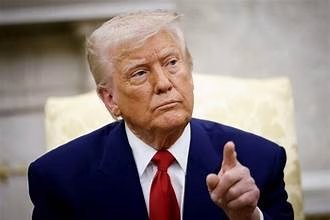
The United States Secretary of State, Marco Rubio, has reportedly declined to personally receive a high-level Nigerian delegation led by National Security Adviser Nuhu Ribadu and Minister of Foreign Affairs Bianca Odumegwu-Ojukwu in Washington.
The development comes days after the US Department of State faulted Nigeria for failing to meet minimum fiscal transparency requirements, raising fresh questions over the state of diplomatic relations between Washington and Abuja.
The delegation, which included senior Nigerian officials, was in Washington for high-level discussions with American officials on security and other areas of bilateral cooperation.
However, according to a report by the Washington-based lobbying firm Von Batten-Montague-York, Rubio was absent from the meeting despite the presence of Nigeria’s Foreign Minister.
The firm said the Nigerian delegation was instead received by a US Under Secretary of State, Allison Hooker.
In a post on X, the firm contrasted the Nigerian meeting with other diplomatic engagements in which a country’s foreign minister is present, arguing that established protocol ordinarily provides for the US Secretary of State to host such a meeting.
Tinubu
Bola Tinubu
The firm wrote: “Foreign delegations when the Foreign Minister of a country is present for a meeting at State Department. Official protocol: Secretary of State (SecRubio) hosts.”
It then contrasted that with the Nigerian delegation, stating that Rubio was absent despite Ojukwu being present, while an Under Secretary hosted the meeting.
The firm further urged Tinubu to use his official authority to demand that Rubio meet with Ojukwu, alleging that such a step was necessary to secure the level of diplomatic respect expected for an official Nigerian envoy.
The development comes shortly after the US Department of State released its 2026 Fiscal Transparency Report, which placed Nigeria among 67 governments that failed to meet minimum fiscal transparency requirements.
The report, which reviewed Nigeria’s performance between January 1 and December 31, 2025, said the country made no significant progress in addressing the deficiencies identified in its public financial management and disclosure practices.
According to the assessment, Nigeria’s budget documents did not provide a substantially complete picture of government revenues and expenditures, while actual revenues and expenditures did not reasonably correspond with those contained in the enacted budget.
The US also raised concerns about the independence of Nigeria’s supreme audit institution and said accessible information on public procurement contracts was not being published.

Leave a Reply