
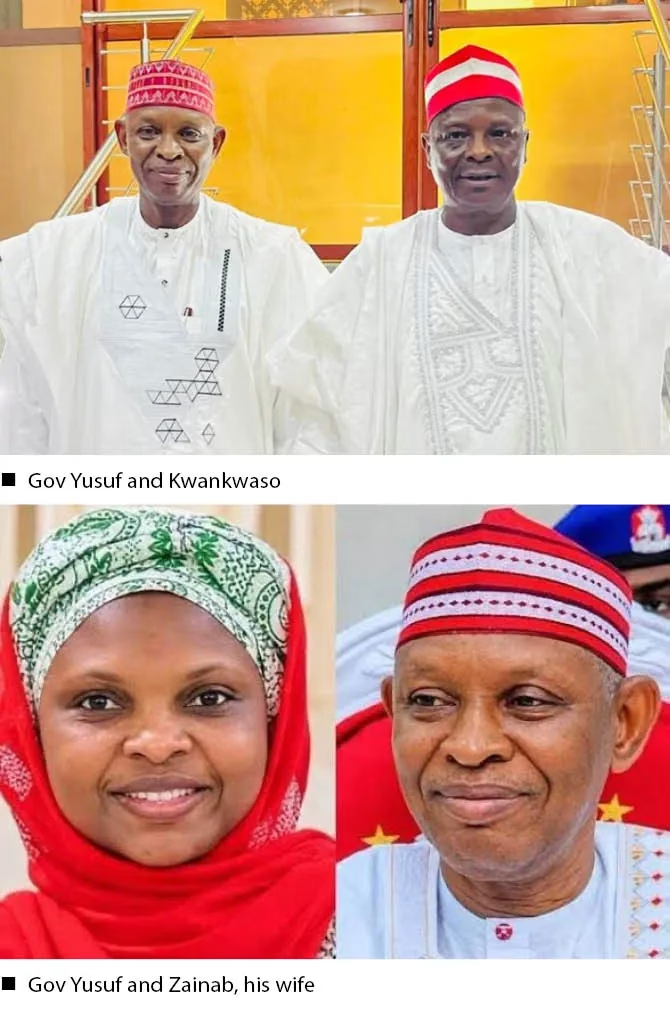
For nearly two decades, the marriage between Abba Kabir Yusuf, Governor of Kano State, and Zainab Musa Kwankwaso, his second wife and member of one of Kano’s most influential political families, appeared insulated from public scrutiny.
While the governor rose through the ranks of the Kwankwasiyya Movement from trusted aide to state governor, the woman who shared much of that journey remained largely outside the public spotlight, making only limited public appearances despite occupying the position of the state’s first family.
That carefully guarded private life has now spilled into the public arena following a divorce suit filed by Zainab before an Upper Area Court in Gudu, Abuja, seeking the dissolution of a marriage contracted on July 29, 2006, and blessed with six children.
In the court documents, she alleged a lack of love, care, affection and emotional connection, while indicating a willingness to refund the dowry as required under a Khul’i divorce proceeding in Islamic law.
The development has generated public interest not merely because it concerns a sitting governor, but because it unfolds against the backdrop of a widely discussed political estrangement between Yusuf and his longtime political benefactor, Rabiu Musa Kwankwaso, whose family is directly linked to the marriage.
The marital dispute emerged amid strains in the political relationship between the two men, although the court filings themselves reportedly focus on personal and marital issues rather than politics.
The governor publicly acknowledged the separation on Monday, telling supporters that he had effectively moved from having two wives to one, while indicating that the dissolution process had been accepted.
Zainab’s prayer before court
According to reports, Zainab asked the court to dissolve the marriage through Khul’i, an Islamic Sharia term that provides for a wife who is tired of the relationship to ask for dissolution by refunding the dowry he paid to her or an agreed amount.
Once the husband accepts the offer, it is assumed that he has accepted the divorce and she cease to be his wife.
The matter came up on Tuesday before Justice Ado Muktar.
At the proceedings, the Kano State Commissioner for Information, Sanusi Bature, appeared on behalf of the governor.
Bature informed the court that although he had received the court documents, he had not yet briefed the governor on the matter and requested additional time.
The request was not opposed by counsel for the petitioner. Consequently, the court adjourned proceedings until December 15 for hearing.
The marriage between Governor Yusuf and Zainab was contracted on July 29, 2006, at a time when he was still building his political career within the Kwankwasiyya political structure, and when Kwankwaso was serving as Nigeria’s Minister of Defence under former President Olusegun Obasanjo.
The union produced six children.
Throughout Yusuf’s rise from political aide and loyal associate of the Kwankwaso family to Governor of Kano State, little was publicly known about the internal dynamics of the marriage.
The first publicly reported indication that something was amiss emerged only weeks before the divorce proceedings became public.
Zainab reportedly left the Kano Government House and relocated to her family residence before travelling to Abuja.
The departure occurred weeks before the divorce petition was filed in court, suggesting that efforts at reconciliation may either have failed or had not produced a resolution.
Even before substantive hearing of the suit, the governor publicly acknowledged the breakdown of the marriage.
Speaking in Kano, Yusuf indicated that the dissolution had been accepted and used humour to describe his reduced status from having two wives to one. He also suggested that he remained open to remarrying in the future.
He further called on residents to pray that he finds a suitable spouse, saying he was happy with the decision and asking Allah to guide him towards good people.
While the divorce petition publicly cites marital issues, sources familiar with the family dynamics argue that the crisis cannot be viewed entirely outside the political fallout between Governor Yusuf and Kwankwaso.
According to a source close to the family who spoke on condition of anonymity because of the sensitivity of the matter, challenges within the marriage may have existed earlier but became significantly more pronounced after the relationship between the governor and his political benefactor deteriorated.
“The issues did not start overnight. But after the governor and Kwankwaso parted ways politically, everything changed. She found it increasingly difficult to cope with what she saw as attacks and humiliation directed at her father from within political circles around the government.
“In her view, the situation became more painful because it was happening around her husband’s administration, sometimes right inside Government House, and she felt he was not doing enough to stop it,” the source said.
The source further claimed that the growing political divide placed enormous pressure on family relationships, creating an environment in which existing marital strains became harder to manage.
These claims, however, could not be independently verified, and neither Yusuf, Zainab, nor representatives of the Kwankwaso family have publicly confirmed that politics played a direct role in the breakdown of the marriage or even agreed to talk about it.
Publicly available court filings instead focus on personal and marital grievances.
‘Divorce should come after exhausting all reconciliation options’
Weighing in on the controversy surrounding the marital crisis, the Chief Imam of Inuwa Dutse Jumu’at Mosque in Sallari, Kano, Sheikh Awwal Al-Sudais, said Islamic teachings place reconciliation above divorce and require couples to exhaust all avenues for peace before separation.
Al-Sudais said that as a public leader, Governor Yusuf should have explored every avenue for reconciliation, just as the wife also bears a responsibility to pursue peaceful resolution where possible.
“Only when all efforts at reconciliation fail, and in order not to continue harming or hurting one another, can separation become the appropriate option,” the cleric said.
Citing Chapter 4, Verse 128 of the Qur’an, Al-Sudais noted that Islam strongly encourages couples to seek peace and mutual understanding whenever marital disputes arise.
The Islamic scholar further pointed to another Qur’anic injunction which recommends the involvement of respected elders and mediators from both families in resolving marital disputes.
Such intervention, he said, often helps prevent conflicts from escalating and enables both parties to reach amicable solutions without unnecessary public spectacle.
Given the prominence of the individuals involved, Al-Sudais said the couple had an even greater responsibility to demonstrate patience, restraint and adherence to Islamic principles in handling their disagreements.
The cleric ultimately urged both the governor and his wife to manage their marital affairs in accordance with Islamic teachings, warning against allowing private family matters to become subjects of prolonged public debate.
Marriage should not be dragged into politics – Sociologist
A Kano-based sociologist and lecturer at Bayero University Kano (BUK), Dr Maikano Madaki, said the divorce controversy should be treated as a personal family matter rather than a political issue.
According to him, while the parties involved are prominent public figures, the breakdown of a marriage remains a deeply private affair that should not be exploited for political gains or used as a tool in ongoing political disagreements.
He cautioned against attempts to interpret every development in the couple’s relationship through a political lens, arguing that doing so risks overshadowing the human and emotional dimensions of the situation.
Dr Madaki described marriage as a sacred institution that deserves respect and protection, regardless of the social status of those involved.
“Marriage is sacred. Personally, I am not happy with this development, and I believe people should avoid dragging a personal family matter into the political arena,” he added.
Residents express mixed reactions
Among Kano residents, reactions to the divorce controversy have been mixed, with many expressing sympathy for the family while calling for restraint in how the matter is discussed publicly.
Habiba Sunusi said the former wife has been patient enough for a long time, enduring constant mockery of her father, while she helplessly looks on.
“Any time I see how those TikTokers and politicians insult her father in the presence of her husband in the name of politics, I feel sorry for her. I can’t endure this for so long.
Another resident, Yakubu Aminu, said he was saddened by the development, particularly because the couple had spent many years together and built a family.
“Divorce is never something people celebrate, especially when children are involved. Whether they are politicians or not, they remain human beings and deserve privacy. My prayer is that whatever is best for the family prevails,” he said.
However, Nura Maiwanki argued that because the individuals involved are public figures, public interest in the matter was inevitable.
“The governor and his family are public personalities, so people will naturally discuss it. But discussions should be respectful and avoid spreading rumours or making the situation worse,” he noted.
Similarly, Fatima Yunusa, another Kano resident, said the controversy should serve as a reminder that marital difficulties can affect anyone regardless of social status or political influence.
“Many people see leaders as larger than life, but situations like this remind us that they face family challenges like everyone else. Instead of mocking them, society should encourage reconciliation and understanding,” she said.

Leave a Reply