
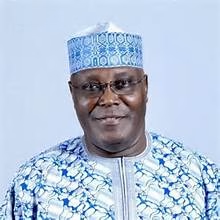
Former Vice President and African Democratic Congress (ADC) presidential candidate, Atiku Abubakar, has questioned the credibility of the 2026 Appropriation Act following reports that the Federal Cooperative College, Oji River, Enugu State, was allocated ₦1.08 trillion to execute 2,791 capital projects across Nigeria’s 36 states and the Federal Capital Territory.
In a statement issued on Tuesday in Abuja by his Senior Special Assistant on Public Communication, Phrank Shaibu, Atiku said the findings, based on an independent analysis of the 2026 budget by Tracka, raise serious concerns about transparency and fiscal accountability under the President Bola Tinubu administration.
He commended Tracka for what he described as exposing a major distortion in the implementation framework of the national budget, arguing that the allocation contradicts the administration’s claims of prudent economic management.
According to Atiku, it is difficult to justify assigning thousands of nationwide capital projects to an institution established primarily for cooperative education.
He noted that the projects reportedly include roads, drainage systems, solar streetlights, markets, football pitches, dialysis centres, ambulances, water schemes, recycling plants and empowerment programmes, despite the college’s statutory mandate.
The former vice president questioned the legal and administrative basis for the arrangement, asking who authorised the college to serve as an implementing agency for such a vast number of projects, who nominated and approved the projects, and which institutions would be responsible for monitoring and ensuring accountability.
He argued that the reported allocation undermines the government’s repeated assurances of fiscal discipline, especially at a time when Nigerians are facing higher taxes, the removal of fuel subsidies and increased public borrowing.
Atiku further alleged that the development reflects weaknesses in the country’s public financial management system, insisting that public funds should be managed transparently and in accordance with constitutional and statutory provisions.
“A government that says there is no money, removes fuel subsidy, raises taxes, accumulates unprecedented debt and demands endless sacrifices from Nigerians cannot simultaneously operate a budget that appears designed to hide public spending behind institutions with neither the statutory mandate nor the institutional capacity to execute projects of this magnitude,” he said.
He maintained that if the reported figures are accurate, the allocation raises fundamental questions about accountability in the implementation of the 2026 budget and warrants public scrutiny.

Leave a Reply