
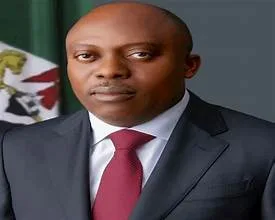
When the name Akinwunmi Ambode is mentioned, what comes to mind is not just politics or governance. It brings to mind a one-term system. Sir Siminalayi Fubara rose to power as Governor of oil-rich Rivers State through the help and machinery of a political godfather, just as Ambode did.
For Ambode, he and his godfather and benefactor, President Bola Ahmed Tinubu, maintained their alliance for about three years before falling out. Their rift did not result in an ostentatious public façade or the loud political drama that defined Governor Fubara’s fallout with Nyesom Wike. Yet the end game for both has been the same: no second term.
Ambode, despite his considerable achievements as Governor, failed to return because he refused to carry his godfather and benefactor along. Things were initially rosy between the two at the start of their political alliance, until the incumbent decided he wanted to be his own man. In trying to achieve that, he attempted to dismantle the structure that brought him to power. Ambode alienated those who worked for his ascension and deviated from the Lagos master plan.
His decision to replace the waste management agency responsible for keeping Lagos State clean with the unsuccessful Lagos Clean Initiative, CLI, proved to be the final nail in his coffin. This led to the decision to deny him a second-term ticket.
Ambode mistook political backing and structural strength for public support. While he had the public’s support because of his achievements, he failed to maintain rapport with Lagos State House of Assembly members and the key decision-makers behind the scenes.
Fubara, quite differently, entered into a fiasco with the FCT Minister, Nyesom Wike, as early as three months into his tenure. According to the Governor, the fallout was due to unreasonable and overbearing demands from Wike. The Governor claimed he was ordered to settle his benefactor with monthly payments of about N3 billion, had no say in the appointment of commissioners and other state appointees, and was restricted from making key decisions such as awarding contracts.
Unlike the Ambode situation, where President Bola Ahmed Tinubu waited for elections to approach before moving against him, Nyesom Wike, in his loud and impatient style, wanted Fubara impeached as early as five months into the administration. The battle line was drawn in October 2023 when the Governor could no longer bear it and publicly stated that he could no longer tolerate the intimidation. The Assembly complex was bombed and later bulldozed on the Governor’s orders.
Twenty-seven lawmakers loyal to the FCT Minister stood in solidarity to remove the Governor, and the President had to intervene by giving Fubara an eight-point peace plan. Fubara reneged on it. With the defection case against the 27 lawmakers, it seemed the Governor had gained an advantage—until the Supreme Court ruled in their favor and a six-month emergency rule was declared by the President to restore peace to the state, suspending both sides.
During the six-month suspension, agreements were reached. The most important were that the Governor would not seek re-election, would not defect to the APC without approval from the FCT Minister, and would pay the Assembly members their entitlements, which he had withheld during the conflict.
The six months elapsed, and Vice Admiral Ibok-Ete Ibas stepped aside for Governor Fubara to return. It looked like peace had returned. The Governor then reneged on the agreement and entered into a shady deal with the Chairman of the APC Governors’ Forum, Hope Uzodinma of Imo State, to defect to the APC—a move that triggered his erstwhile godfather, Nyesom Wike.
Impeachment proceedings resumed, and Fubara and his deputy, Prof. Ngozi Nma Odu, found themselves in a fresh battle. The President intervened again and asked the Governor to honor his agreement from the emergency rule. As the nation amended its Electoral Act to mandate direct primaries, it became clear that Fubara, like Ambode, was a political loser. Reports emerged that the Governor was planning to contest by proxy, but he was not screened, and neither were his loyalists. Seeing that his fate was sealed and his loyalists disqualified, he conceded by stepping down a few hours before the primaries.


Leave a Reply