
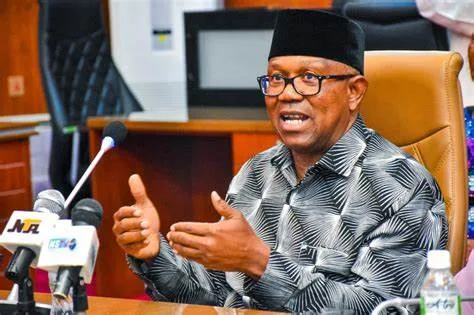
Nigeria’s opposition politics is once again entering a turbulent and defining phase ahead of the 2027 general election. The latest political drama surrounding Peter Obi’s reported exit from the African Democratic Congress (ADC) and alignment with the Nigeria Democratic Congress (NDC) has triggered intense debate across the country.
To some Nigerians, especially Obi’s loyal supporters, the move represents strategic political thinking. To others, it is yet another opposition miscalculation capable of deepening division and indirectly strengthening President Bola Tinubu’s reelection chances. Both arguments carry weight. However, when examined within the realities of Nigeria’s political environment, Obi’s decision appears less emotional and more like a calculated political survival strategy.
Politics in Nigeria is rarely driven by ideology. It is driven by structure, survival, timing and access to power. In such an environment, politicians are forced to constantly evaluate not only their popularity but also the stability and credibility of the platforms they operate from. That is precisely where the ADC’s problems begin.
Although the Supreme Court recently affirmed the David Mark-led leadership of the ADC, the crisis within the party remains unresolved. Beneath the temporary appearance of unity are deep tensions over leadership control, zoning arrangements, presidential ambition and the future direction of the opposition coalition gathered around the platform.
More importantly, recent legal developments have raised fresh uncertainty about the future of smaller political parties in Nigeria.
Only days ago, the Attorney-General of the Federation and Minister of Justice, Lateef Fagbemi (SAN), reportedly argued before a Federal High Court in Abuja that political parties without significant electoral victories should not continue to exist.
Whether or not such legal arguments ultimately succeed is beside the point. The message is clear: smaller opposition parties may increasingly face legal and institutional pressure ahead of 2027. For a politician like Peter Obi, who remains one of the country’s most visible opposition figures, such uncertainty is difficult to ignore.
Elections in Nigeria are not won by popularity alone. They are won through nationwide structures, legal preparedness, financial capacity, party cohesion and effective coalition management. A platform constantly distracted by internal disputes and legal vulnerabilities can easily become a political liability.
Time is also a crucial factor. With less than two years before the next presidential election cycle fully intensifies, serious contenders are already positioning themselves, consolidating structures and preparing for primaries. The opposition does not have the luxury of endless negotiations and unresolved crises.
Beyond the legal concerns surrounding the ADC lies another sensitive issue that continues to shape Nigerian politics — zoning.
Whether many politicians publicly admit it or not, power rotation remains one of the few informal arrangements holding together Nigeria’s fragile political balance. Since 1999, calculations around North-South power rotation have heavily influenced presidential contests.
After eight years of Muhammadu Buhari from the North, many Nigerians believed power should remain in the South for another eight years under Bola Tinubu. Even among opposition supporters, there remains significant sentiment that the South should complete its turn before power rotates back to the North.
This is where the opposition coalition faces a difficult dilemma.
Former Vice-President Atiku Abubakar remains interested in contesting for the presidency again. His political ambition is well known, and historically he has never hidden his determination to pursue the office. However, many southern politicians and voters believe another northern candidacy in 2027 could fracture the opposition and weaken its moral argument on fairness and inclusion.
The ADC leadership has so far failed to provide clarity on zoning. Silence on such a critical issue naturally breeds suspicion and uncertainty among aspirants and supporters alike.
Atiku himself recently boasted publicly that he has never failed to secure a presidential ticket whenever he sought one.
Statements like that inevitably raise concerns among rival camps about whether any future primary contest would truly be free, fair and competitive.
Peter Obi may not necessarily fear primaries, but Nigerian politics is rarely an ideal democratic contest. Delegates, financial influence, elite bargaining and entrenched party structures often determine outcomes long before ballots are cast.
This is one reason many Obi supporters fear that a heavily monetised primary process could favour older establishment politicians with deeper political networks and stronger financial machinery. Whether one agrees with that concern or not, it reflects the reality of how party politics often operates in Nigeria.
From Obi’s perspective, therefore, remaining in a platform where zoning remains uncertain, leadership tensions persist and powerful interests appear dominant may simply be politically risky.
Another major development is Obi’s reported alignment with the Nigeria Democratic Congress (NDC), a relatively new political platform that is now attracting key opposition figures dissatisfied with the ADC crisis. Alongside former Kano governor Rabiu Kwankwaso, Obi appears to be repositioning himself within a platform that promises clearer leadership direction and fewer internal battles ahead of 2027.
If Kwankwaso eventually emerges as Obi’s running mate, the political implications could be significant.
Kwankwaso remains one of the most influential northern politicians, particularly in Kano and parts of the North-West where his Kwankwasiyya movement commands a loyal grassroots base. In the 2023 election, despite contesting under the NNPP, he secured millions of votes largely from Kano State alone.
A possible Obi-Kwankwaso ticket could therefore create a powerful regional balance — combining Obi’s strong support among urban youths, southern voters and the middle class with Kwankwaso’s deep northern grassroots appeal. Such an alliance may also help reduce the regional and ethnic divisions that weakened the opposition in 2023.
However, such an alliance would not come without political complications.
Interestingly, during the 2023 election cycle, Kwankwaso openly dismissed suggestions that he could serve as Obi’s running mate. He argued at the time that, based on his political experience and achievements, he was more qualified to lead a presidential ticket.
Kwankwaso pointed to his years as governor of Kano State, senator, minister of defence and long-standing national political influence as evidence that he had achieved more politically than Obi. Those disagreements reportedly contributed to the collapse of alliance talks between the Labour Party and the NNPP before the 2023 election.
That history makes any potential reunion politically significant. If both men eventually agree to work together under a single platform ahead of 2027, it would signal a major shift in opposition strategy and an acknowledgment that personal ambition may need to give way to broader coalition-building.
For many Nigerians, the key question is no longer who is politically superior between Obi and Kwankwaso, but whether opposition leaders can finally put aside ego, regional rivalry and personal calculations long enough to build a united front capable of challenging the ruling APC.
Still, Obi’s decision is not without risks.
The greatest challenge facing Nigeria’s opposition today remains fragmentation. Tinubu’s strongest political advantage may not necessarily be APC’s popularity but rather the inability of opposition figures to unite behind a single coherent platform.
Every division within the opposition increases the ruling party’s chances of retaining power.
Nigerians frustrated by economic hardship, insecurity and governance failures are desperately searching for a credible alternative. But credibility requires unity, discipline, strategic compromise and long-term planning — qualities opposition parties have consistently struggled to sustain.
Ultimately, Obi’s reported exit from the ADC appears less like political cowardice and more like strategic repositioning. In a political climate defined by uncertainty, internal crises and elite power struggles, politicians naturally seek platforms that offer stability, clarity and survival.
Whether the move proves to be a smart strategy or a dangerous political gamble will depend largely on what happens next: the opposition’s approach to zoning, the transparency of future primaries and the willingness of political actors to subordinate personal ambition to collective national strategy.
For now, Nigerians can only watch as another chapter in the country’s complicated opposition politics unfolds.
Akinsuyi, former group politics editor of the Daily Independent, writes from the United Kingdom. He can be reached at shabydayo@gmail.com

Leave a Reply