
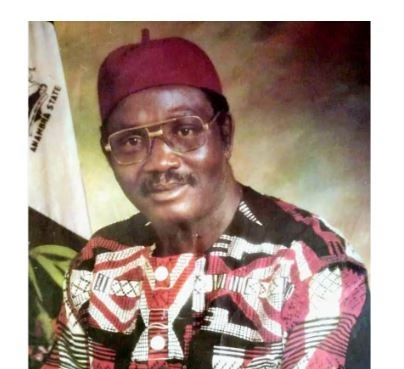
A fearless son of Enugu-Ngwo who fought for the Waawa people all his life and that struggle eventually led to the creation of Enugu State in 1991.
His courage, his voice and his legacy all live on.
Rest in Peace, Chief. 🕊️
#CCOnoh #Enugu #Ngwo #Waawa #Legend
Chief Christian Chukwuma “C.C.” Onoh was a well known Nigerian lawyer, businessman and politician who was Governor of the old Anambra State from October to December 1983.
He was from Enugu Ngwo and a major player in Eastern Nigerian politics, a man who was very much at the forefront of the Wawa people’s affairs.
Born in Enugu Ngwo, Onoh studied law in the UK and obtained his degree from the University of Wales in 1957.
He was elected to the Federal House of Representatives in 1958 prior to his appointment as Governor.
He was the first indigenous Chairman of the Nigerian Coal Corporation and served as Administrator of the Enugu Capital Territory.
He was also a major player in the real estate game, having acquired a huge amount of property in Enugu. He lived in the family stone palace in Ngwo which his father, Chief Gabriel Onoh, built between 1919 and 1923.
Onoh was running on the platform of the National Party of Nigeria (NPN) when he won the fiercely contested gubernatorial election of 1983 against the sitting Governor Jim Nwobodo.
His time in office was only three months before the Second Republic was overthrown in the December 31st 1983 military coup. Onoh was a very determined campaigner for the creation of a “Wawa” state to redress the perceived neglect of the northern Igbo subgroup and that effort eventually led to the creation of Enugu State in 1991.
After the Supreme Court had confirmed his 1983 election victory, it was reported that Onoh celebrated on the steps of the Court by eating okpa (the Bambara nut pudding) with tea.
That act went a long way to removing the stigma that okpa had previously carried (it had been regarded by some as a “poor man’s food’) and it was from that point on that okpa became a national dish.
Married to Caroline Onoh he was the father of a number of notable people including the former Nigerian Ambassador and Minister of State for Foreign Affairs (widow of Biafran leader Chukwuemeka Odumegwu Ojukwu) Bianca Odumegwu-Ojukwu, diplomat Lilian Onoh and politician Josef Onoh.
Chief C.C. Onoh’s life was one of fierce grassroots populism, a long series of legal and political wrangles on the part of the Wawa people, and a rather complicated relationship with the political class in Nigeria.
He was the Okaa Ome 1 of Ngwo and the “Lion of Wawa Land”.
His influence was enormous and his tenure as Governor was very brief indeed.
Born in 1927, Onoh lost his father, Chief Gabriel Onoh, when he was only eight years old and was brought up by his cousin Donald Oji.
Prior to going into law he was a contractor, a produce inspector and a livestock trader in the late 1940s and it was from the proceeds of those various activities that he was able to fund his own education in the UK at the University of Wales, Aberystwyth.
He was Administrator of the Enugu Capital Territory during the Civil War and upon the war’s conclusion in 1970 he didn’t immediately go into politics.
He went back to Ogbete Market in Enugu to re-establish himself as a timber and plank merchant.
He was a pioneer in the extractive industries and served as the first indigenous Chairman of the Nigerian Coal Corporation (1959–1965) and subsequently Chairman of the Nigerian Mining Corporation (1979) and Associated Ore Mines (1982).
Onoh was a founding member of Club 13 in the late 1970s which became the Nigerian People’s Party (NPP) under Dr. Nnamdi Azikiwe. Onoh split with the NPP leadership and went over to the NPN (the northern party) on the grounds that the NPP leadership was not going to allow for the creation of a state for the Wawa (the northern Igbo) people.
After losing to Jim Nwobodo of the NPP in 1979 Onoh ran again in August 1983.
The election was very much in dispute with allegations of rigging and violence.
A five judge election tribunal initially annulled Onoh’s victory 3-2, declaring Nwobodo the winner. Onoh appealed to the Federal Court of Appeal (which overturned the tribunal) and ultimately won the now famous Supreme Court judgement of October 1983 in Nwobodo v. Onoh which laid down the legal test that would have to be met in order to prove electoral falsification in Nigeria.
He went on to write about these political struggles in his 1988 book Thorny Road to Government House.
Onoh was a man of uncompromising, populist methods. Former Supreme Court Justice Anthony Aniogulu said of him: “Christian Onoh… was always and is always fighting injustice.
But he would not mind using unjust methods to fight injustice”. His long campaign at last succeeded in August 1991 when General Ibrahim Babangida created Enugu State.
His family compound at Enugwu Ngwo (the massive stone and brick house with the arched windows, built by his father with British engineers and local labourers between 1919 and 1923) is still one of the most iconic colonial era buildings in Eastern Nigeria.
In his later years he pulled back from the partisan politics and became an outspoken elder statesman.
He lived to see his lifelong dream for the Wawa people actually come to fruition before he died in May 2009.
His time as governor was only three months but his later years cemented his status as the uncompromising patriarch of Enugu politics.
Following the coup of December 31st 1983 by Major General Buhari, Onoh was arrested and detained along with a number of other politicians of the Second Republic.
He had only been in office for 90 days (during which he famously refused to draw a salary or move into Government House, commuting from his Ngwo home) and was in detention for months before being cleared of all corruption charges.
His political campaign over the decades culminated in August 27th 1991 when General Ibrahim Babangida carved Enugu State out of the old Anambra State.
Having finally achieved political autonomy for the Wawa people, Onoh largely retired from the pursuit of elective office, though he remained a very vocal, very fearless commentator on Igbo matters, national politics and local government in Enugu.
The acrimonious public spat over the marriage of his daughter Bianca to Chukwuemeka Odumegwu Ojukwu was eventually mended.
He gave his blessing at their very public wedding in Abuja in 1994 and the two political giants remained close allies and friends for the rest of their lives.
After a period of ill health, Chief C.C. Onoh died on May 5, 2009 at the age of 82 in a hospital in Enugu.
His funeral at his famous stone palace in Enugwu Ngwo was attended by the highest echelons of Nigeria’s political, traditional and religious leadership.
- Today Onoh is remembered in Enugu not so much for the length of time he actually held power as for the sheer force with which he fought to get it.
His legacy endures through:
He is the Father of Wawa Liberation, the man who broke the political marginalisation of the Enugu and Nsukka indigenes.
o Major infrastructure in the coal city is named after him including the C.C. Onoh Memorial Drive and a number of community institutions in Ngwo.
His kids are still very much in the Nigerian diplomatic, political and literary scene and they’re the ones who are continuing the legacy of the “Lion of Wawa Land”.


Leave a Reply