
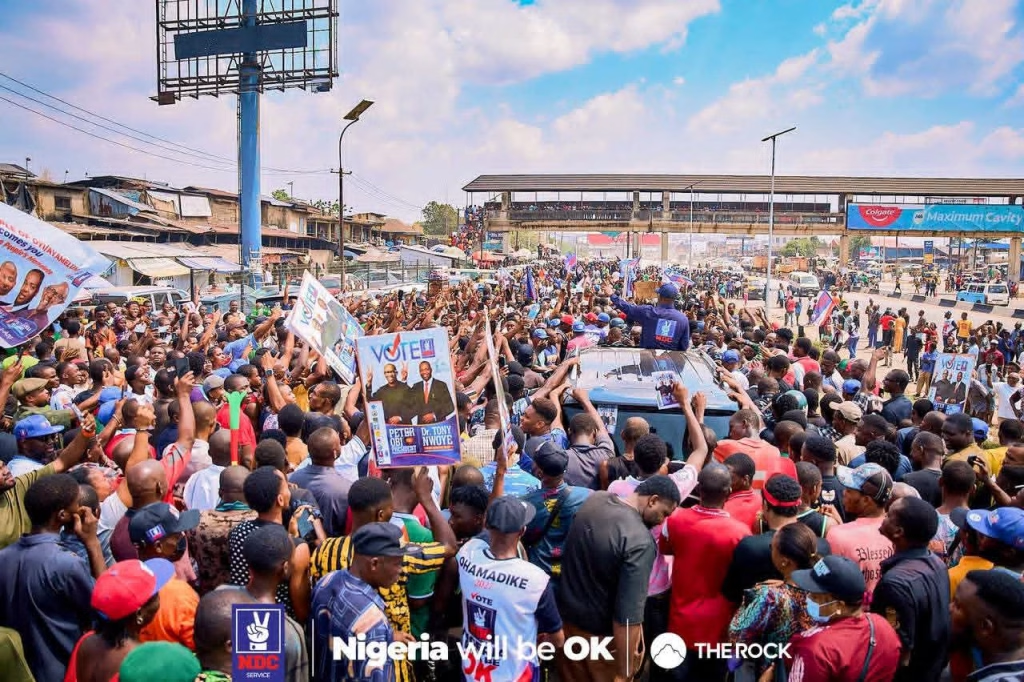
Amidst debates on the level of youth participation in Nigeria’s political process, the Independent National Electoral Commission (INEC) says only 9,324,349 young Nigerians registered to vote during the three phases of the Continuous Voter Registration (CVR) exercise recently conducted ahead of the 2027 general elections.
The demographic composition of the entire voters’ register analysed by Weekend Trust indicates that much has changed ahead of the 2027 elections as figures presented by INEC in October showed that voters aged between 18 and 34 number 29,777,576, representing 28.79 per cent of the 103,428,715 registered voters.
In contrast, those aged 35 to 49 now constitute the largest category, with 43,265,946 voters, representing 41.83 per cent of the register.
The INEC chairman, Prof Joash Amupitan, who disclosed the figure at an investiture of the commission’s Youth Ambassadors in Abuja, said the number underscored the importance of young Nigerians in the country’s democratic process.
The figure comes against the backdrop of the 2023 general elections when young people aged 18 to 34 constituted the largest demographic group on the voter register, with 37,060,399, representing 39.65 per cent of the 93,469,008 registered voters, according to INEC’s 2023 General Election Report.
The figures raise questions about the changing age composition of Nigeria’s electorate and the extent to which newly eligible young Nigerians are participating in voter registration and other aspects of the political process.
For the 2019 general elections, INEC recorded 42,938,458 voters aged 18 to 35, representing 51.11 per cent of the 84,004,084 registered voters, while another 25,176,144, representing 29.97 per cent, were aged 36 to 50.
However, the age classifications used in the 2019 report differ slightly from those of 2023 and 2026, making a direct comparison of the same age groups across the three registration periods difficult.
The figures highlight a changing demographic composition of the electorate, although the movement of voters from one age category to another as they grow older must also be considered when interpreting the trend.
Few young Nigerians seeking elective offices
While millions of young Nigerians have registered to vote ahead of the 2027 general elections, their representation among those seeking elective offices presents another dimension of youth participation in the political process.
An analysis of the Independent National Electoral Commission’s final lists of candidates for the presidential and National Assembly elections shows that 2,959 candidates fall within the 18 to 49 age bracket.
The House of Representatives has the highest number, with 2,348 candidates aged below 50, comprising 485 below 35 and 1,863 between 35 and 49.
For the Senate, 606 of the 1,303 candidates are aged between 35 and 49, while none is below 35, according to an analysis of the commission’s candidate lists.
At the presidential level, only five of the 18 candidates are between 35 and 49, with the youngest listed at 35 years.
In the 2019 general elections, INEC recorded 42,938,458 voters aged 18 to 35, representing 51.11 per cent of the 84,004,084 registered voters, while another 25,176,144, representing 29.97 per cent, were aged 36 to 50.
However, the age classifications used in the 2019 report differ slightly from those of 2023 and 2026, making a direct comparison of the same age groups across the three registration periods difficult.
The figures highlight a changing demographic composition of the electorate, although the movement of voters from one age category to another as they grow older must also be considered when interpreting the trend.
The figures show a difference between young Nigerians’ presence as electorates and their representation among candidates seeking national elective offices. However, they also indicate that the House of Representatives provides a larger entry point for candidates below 35 than the Senate or presidency.
The analysis excludes running mates and seven House of Representatives candidates whose ages were incorrectly printed in INEC’s lists. It also does not include governorship and State Houses of Assembly candidates.
Interventions for youths
Due to the unimpressive number of youth participation in the political process, some civil society organisations (CSOs) and other stakeholders at a time, called on the Independent National Electoral Commission to remove barriers discouraging young Nigerians from participating in the 2027 general elections.
They made the recommendations in a communiqué issued at the end of the Second Stakeholder Roundtable on Voter Education and Youth Participation, convened by Kimpact Development Initiative (KDI) under the Youth Electoral Reform Project (YERP-Naija), Phase IV in Abuja recently.
They identified difficulties in collecting permanent voter cards (PVCs), voter registration challenges, inadequate voter education, declining public confidence and electoral violence as major obstacles to youth participation.
Findings presented at the meeting showed that PVC collection was the most prominent concern raised by young Nigerians across the country, followed by voter registration challenges, vote buying and other barriers to participation.
Young, but not running
At every election cycle since 2018 when President Muhammadu Buhari signed the Not-Too-Young-To-Run bill into law, watchers of political events have been on the lookout to see the rate of impact on the polity.
The law reduced the age qualification for elective offices to enable more youths participate pegging that of president from 40 to 35; that of a governor from 35 to 30; senator from 35 to 30; House of Representatives membership from 30 to 25 and State House of Assembly membership from 30 to 25.
Ibrahim Mohammed Bello who represents Birnin-Kebbi/Kalgo/Bunza federal constituency in the House of Representatives is reported to be one of those to have taken advantage of the bill to run for the Reps seat and became a serving member of the current House at 27 years.
He won election into the House in the 2023 election on the platform of the Peoples Democratic Party (PDP) by defeating the candidate of the All Progressives Congress (APC), Professor Muktar Bunza.
During the last primary election, he was persuaded to join the APC because of the problems he was having in the PDP. He was denied the APC ticket for the Birnin-Kebbi/Kalgo/ Bunza federal constituency and the ticket was given to the former comptroller-general of the prison service, Ahmad Jafar Jega.
Omosede Gabriella Igbinedion is believed to be one of the youngest women elected into the House of Representatives.
Ali Saad Birnin-Kudu who assumed office in January 1992 as governor of Jigawa State took the oath of office at 32. He is known as one of Nigeria’s youngest governors of the period.
In the current dispensation, the youngest serving governor in Nigeria is said to be Ahmed Usman Ododo of Kogi State, who is 43 years old. He was born 7 February 1982, was elected governor of Kogi Staten in 2023.
Ironically, while it has become like a tall order for youths to contest elections these days, a scenario that happened in 1999 represented an enthusiasm by a particular young man to participate in the electoral process when Salisu Buhari from Nasarawa Federal Constituency contested for the House of Representatives seat before attaining age of qualification.
He was found to be only 29 when he assumed the position of the speaker of the house and had to be made vacate his seat when he confessed to not attaining age 30 as at then.
Enthusiasm, frustration as Kano youths prepare for 2027 elections
Young people in Kano expressed a mix of enthusiasm, skepticism and frustrations in their bid to participate fully in the elections.
For Fatima Musa, disappointment with previous election outcomes has dampened her willingness to participate in the next polls. She said she did not intend to vote in 2027 because she regretted supporting a candidate in the 2023 elections who, according to her, has failed to meet the expectations of many Nigerians.
Fatima also expressed concern about the limited opportunities available to young people in politics, arguing that the political system continues to favour older politicians at the expense of younger generations. While describing the forthcoming elections as likely to be highly competitive, she fears there could be attempts to manipulate the process. According to her, youths are yet to be given a fair chance to take up leadership positions.
Unlike Fatima, Mustapha Umar Bukar said he intended to participate in the 2027 elections, describing voting as both a civic responsibility and an opportunity to contribute to the country’s future. Though he has never voted before, Mustapha said he was eager to cast his ballot for the first time rather than leave important decisions to others.
He believes the elections would provide young Nigerians an opportunity to influence the country’s future if they actively participate in the process and support leaders who understand their challenges.
While he has no interest in holding political office, he said there were several other ways young people could contribute to national development outside elective politics.
For Abdullahi Aminu, however, the prevailing distrust in political leadership has discouraged participation. He said he had never voted and did not intend to do so in 2027, arguing that he does not want to be part of choosing leaders who may eventually disappoint the electorate.
Abdullahi identified lack of opportunities for youths in politics and economic hardship as major factors discouraging young people from participating in elections.
According to him, many youths are more concerned with earning a living and sustaining their businesses than investing time in a political process that often leaves them disillusioned.
Similarly, Muhammad Ibrahim believes the high financial costs remain one of the greatest barriers preventing young Nigerians from contesting political offices. He also highlighted the role of the social media in encouraging political discussions among youths, although he stressed that meaningful participation must go beyond online engagement.
For Zarah Abdullahi, the desire for better governance is what makes the 2027 elections important. She said many young Nigerians were eager to see changes in leadership and an end to what she described as poor governance.
Despite her interest in the elections, Zarah said she did not intend to vote because she believed her preferred candidate had little chance of winning.
Bauchi youths blame older politicians
In Bauch State, investigations revealed that the youth, both in urban and rural communities were being employed by major political players, particularly those contesting for various public positions. However, the youth are major targets for recruitment as thugs masquerading as local vigilantes holding various weapons in campaign rallies across political parties to intimidate passive opponents.
A youth in Bauchi, Rabiu Ishaq, 37, a resident of Dutsen Tashi area of Bauchi, said though the youths are fully engaged in political activities, including campaigns, party mobilisation and support across the 20 local government areas of Bauchi, their representation and participation in key political positions remained an issue concern.
Ishaq said, “Some of the major problems or obstacles include financial constraints, high nomination fees, political godfatherism, limited opportunities within political party structures and unemployment.
Another youth in Bauchi, Mu’awiya Ibrahim, 30, of Igbo Quarters, said he observed that in Nigeria, youths only suddenly become important during every election season.
“Politicians remember our names, wards, polling units and phone numbers. We are called “the leaders of tomorrow and the backbone of the nation” but after the election, tomorrow never comes.
“When youths are used and dumped, it breeds thuggery and violence and wastes talents,” Ibrahim said.
Similarly, Hauwa Alkali, a 24-year-old student of Baze University, Abuja, observed that repeated political disappointments, broken promises, electoral manipulation and corruption had discouraged many young Nigerians from participating actively in the political process.
She identified the high cost of obtaining nomination forms and running campaigns as major obstacles facing young people interested in contesting elections.
Musa Haruna said he was looking forward to the 2027 elections but wanted to see a departure from what he described as the usual political arrangement.
“I expect the 2027 elections to give Nigerians an opportunity to make their voices heard. But I don’t want another election where politicians make promises and disappear after winning. Young people need to be part of government, not just people who come out to vote every four years,” he said.
Usman Mohammed, a young business owner said: “I am ready to vote, but I also want to see young people contesting for positions. We cannot continue to say that the future belongs to the youth when we are not allowed to participate in shaping that future. If young people have ideas, they should be given the opportunity to bring them forward,” he said.
Alsor, John Miracle, who resides in Kubwa, said he had become discouraged by the political process, explaining that many young people no longer believe their participation would make a difference.
On the role of political parties, Christopher John, a youth organiser, said young people were often treated as campaign mobilisers rather than partners in political decision-making.
“During campaigns, they call us to mobilise our friends, organise rallies and distribute campaign materials. But when it is time to decide who gets what position, we are pushed aside. Political parties need to create genuine opportunities for young people to rise through their structures,” he said.
Meanwhile, Juliet Benson, a young professional baker who lives in Suleja, Niger State, said greater youth participation could introduce fresh ideas into governance and make elected officials more responsive to the needs of ordinary Nigerians.
She said young people understood the challenges facing their generation because they experienced them daily, including unemployment, poor education, insecurity and the rising cost of living.
Umar Sadiq, who hopes to vote for the first time in 2027, said the credibility of the electoral process would determine whether more young Nigerians would participate in the coming elections.
“I want to vote, but I also want to be sure that the process is transparent. INEC must ensure that votes are properly counted and people’s choices are respected. When people believe that their votes matter, they would have more reasons to come out and participate,” he said.
The respondents called on the government, political parties and INEC to intensify voter education, promote transparency and create an enabling environment for young people to participate in elections.
‘How best to include youth in electoral process’
A public affairs analyst and lecturer at the Abubakar Tafawa Balewa University (ATBU), Dr Aminu Makama Ilelah, said the participation of Nigerian youths in the 2027 general elections presented both an opportunity and a challenge for the country’s democratic development.
Ilelah said, “The prospects of their participation must be examined beyond their presence at political rallies and on the social media. While there are indications of continued youth interest in the electoral process, there are also concerns about voter apathy, declining confidence in political institutions and the perception that elections rarely translate into meaningful improvements in the lives of ordinary citizens.
“One of the major concerns about youth participation in Nigerian politics is the contradiction between their numerical importance and their limited influence in political decision-making. Politicians have continued to recognise young people as valuable instruments of electoral mobilisation, particularly during campaigns, rallies, political propaganda and grassroots mobilisation.
“Unfortunately, this recognition does not always translate into corresponding opportunities for political representation, appointments and involvement in governance. In many instances, young people are mobilised to defend political interests, confront opponents and sometimes engage in activities that expose them to violence and legal consequences, only to become irrelevant when political power is secured.”
He said when youth participation is driven by financial inducements, political manipulation, ethnic and religious sentiments, misinformation or violence, it could undermine rather than strengthen democratic development.
Ilelah explained that improving youth participation required a deliberate shift from mobilisation to inclusion; and political parties must open their internal structures to young people, provide them with opportunities to contest elective positions and involve them in policy formulation and decision-making.
“Equally, political leaders must understand that youth empowerment cannot be reduced to distributing motorcycles, sewing machines, cash or other forms of occasional political patronage. It must involve sustainable investment in education, employment, entrepreneurship, leadership and political representation.
“A democracy that mobilises its young population only when votes are needed but excludes them when decisions are being made risks deepening political alienation. The real measure of youth participation in 2027 should, therefore, not only be how many young people vote or campaign but how much influence they have in shaping the political future of Nigeria,” Ilelah added.
Cost bars youths from contesting — Prof Ojo
Speaking on the issue, a political scientist, Prof Gbade Ojo, identified the high cost of nomination forms, electoral violence and vote buying as major obstacles frustrating youth participation in politics ahead of the 2027 general elections.
Ojo said although the Not Too Young to Run act was introduced to encourage young people to seek elective offices, the financial demands of securing party tickets had continued to exclude many of them from the political process.
He said, “There is a limit to which the youth can participate. The cost of nomination forms must have put away the ability of youths to effectively participate in elections.”
He noted that aspiring candidates could be required to pay as much as N50 million for senatorial and governorship nomination forms, while presidential aspirants could pay up to N100 million.
“How do you expect youths to participate fully in politics at the level of gladiator?” he queried.
He called for a review of the financial requirements for contesting elective positions.
The professor also identified electoral violence as another major disincentive. He said attacks on political actors and disruption of campaign rallies had created an atmosphere of fear for young people seeking to participate in politics.
“If a youth wants to participate, you would be afraid of what could happen. People are being attacked, campaign rallies are being disrupted,” he said.
Ojo further condemned the monetisation of elections through vote buying, lamenting that some Nigerians are increasingly unwilling to vote without receiving financial inducements.
“The electoral process has been badly monetised. People are not ready to go out to vote until they are given money,” he said.
Citing the recent Osun governorship election, he alleged that voters were offered as much as N50,000 to secure votes.
Describing the development as unfortunate, Ojo said the combined effect of financial barriers, violence and vote buying was undermining efforts to encourage young people to participate meaningfully in the electoral process.
On how to improve the situation, he said the government must demonstrate genuine political will to enforce electoral laws and punish offenders.
“The problem is in our court as Nigerians. And much of the solution is in the government. You see, we run a weak state,” he said.
Also speaking on youth participation in the 2027 general elections, Dr. Ayinde Mosadi, another political scientist, said Nigeria’s young population was yet to translate into a meaningful political influence despite constituting more than 70 per cent of the country’s population.
Mosadi said young people remained largely excluded from the commanding heights of political power, including party structures, governorships, the National Assembly and the presidency despite their significant roles as voters, campaign mobilisers and political influencers.
He said the challenge ahead of 2027 was not simply getting young people involved in elections but ensuring that their participation translated into actual decision-making power.
“The real question is: Will youth participation in 2027 be merely numerical, or become consequential?” he asked.
He argued that active youth participation would strengthen electoral legitimacy and influence government’s policies, particularly on unemployment, education, technological innovation, affordable housing and security.
According to him, young people who organise themselves politically could challenge the influence of political godfathers and money politics.
But those without proper organisation and political consciousness, he noted, risked being exploited by established politicians.
“Organised and informed youths can break the monopoly of godfathers and money politics. Unorganised, hungry youths become cheap tools for vote buying, ballot-snatching and online propaganda,” he said.
Mosadi also warned that continued exclusion of young people from governance could threaten national stability as frustrated youths might resort to protests, separatist agitations and other forms of resistance.
He said political parties must move beyond mobilising young people during election periods by creating mentorship opportunities and giving them genuine representation in party leadership and decision-making structures.
He called for dedicated budgets for youth wings, meaningful positions in party executive committees and opportunities for young people to influence party policies rather than being confined to ceremonial roles.
He also advocated reduced nomination fees for aspirants below 35, noting that although the Not Too Young to Run act had created opportunities for young people to contest elections, the high cost of nomination forms, campaigns and delegate mobilisation continued to restrict their participation.
He further called for sustained civic education by the Independent National Electoral Commission, National Orientation Agency, civil society organisations and the media, stressing that young voters need a better understanding of the responsibilities of elected officials and the electoral process.
“Youths who only show up every four years will always be used. Youths who stay engaged between elections will be respected,” he said.
He warned that the 2027 elections should not become another exercise in which young Nigerians would be recognised for their numerical strength but denied meaningful influence over political decisions.

Leave a Reply