
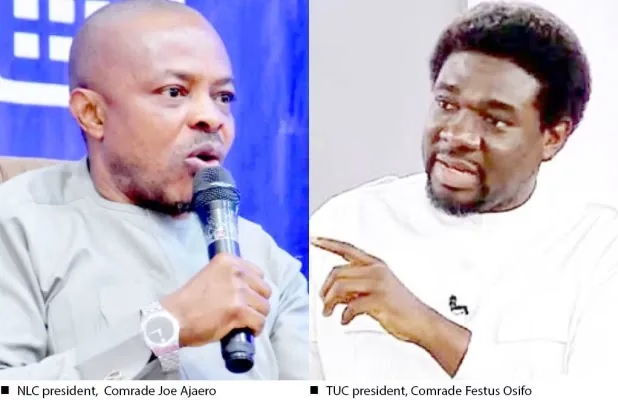
There are clear indications that the discussions regarding the fresh negotiation on minimum wage, which has already started, may have faltered following deep divisions between the leaderships of both the Nigeria Labour Congress (NLC) and Trade Union Congress (TUC),
It was gathered that workers in different sectors, particularly those in the civil service, were beginning to express worries about the implications such sharp disagreement over N70,000 transport allowance for workers could cause for the organised labour movement.
Checks showed that both labour centres have started instigating their respective affiliated unions against each other, with some unions loyal to the NLC supporting the allowance while other unions affiliated to the TUC have continued to reject the offer.
On Sunday, the Joint National Public Service Negotiating Council (JNPSNC) threw its weight behind the NLC against TUC, saying the N70,000 acceptance was in order.
National Secretary of JNPSNC, Comrade Gbenga Olowoyo, said in a circular to affiliate unions and state councils that the agreement leading to approval of the allowance was the product of constructive engagement and exhaustive negotiation.
Olowoyo said the meeting was presided over by Minister of Labour and Employment, Dr Muhammad Maigari Dingyadi, and attended by a labour team led by the NLC President, with the participation of the leadership of JNPSNC and Joint Health Sector Union (JOHESU).
According to the circular, the meeting lasted more than six hours before both sides reached the terms.
Olowoyo said the N70,000 monthly transportation allowance to be paid for the next six months to public servants, starting November 2026, was to subsidise transportation costs being experienced by workers.
A few hours later, the Senior Staff Association of Statutory Corporations and Government-Owned Companies (SSASCGOC); Senior Staff Association of Universities, Teaching Hospitals, Research Institutes and Associated Institutions (SSAUTHRIAI) and the Nigerian Union of Allied Health Professionals (NUAHP) declared their support for TUC’s position.
Workers express worry
A cross-section of workers, who spoke to our correspondent via telephone interviews, cautioned both the NLC and TUC presidents, Joe Ajaero and Festus Osifo respectively, not to fall for the antics of the government to weaken the movement.
A civil servant, who simply identified herself as Mrs Anabel, queried what could have led to the bickering between the two labour leaders, saying that the interests of workers should be the utmost priority of the labour movement.
“If care is not taken, this bickering that is getting messier day by day between the two labour leaders has great implications on workers, who have always believed that organised labour would protect their interests,” the senior civil servant said.
Another senior civil servant, who is a member of SSASCGOC, identified as Bernard, alleged that the federal government has decided to join the movement by sowing “seeds of discord”.
“We (workers) may likely suffer this brouhaha. There is a clear indication the government is the one fueling this. The implication is that, if two elephants fight, the grass suffers,” he said.
How it all started
The NLC had, on October 8, issued a two-week ultimatum, demanding that the Federal Government reduce petrol prices to the levels when the current minimum wage was signed into law in 2024, begin negotiations for a new minimum wage before the end of October, and resolve outstanding labour agreements.
Specifically, the ultimatum expired on October 22, but the leadership of the organised labour subsequently extended the deadline to October 27, warning that they could embark on nationwide action if the negotiations failed.
Checks showed that a major point of disagreement was when negotiations should begin to replace the N70,000 monthly minimum wage introduced in 2024.
The Federal Government has insisted that the current wage is due for review on June 1, 2027, arguing that the National Minimum Wage Act, 2019, as amended in 2024, provides for a three-year review cycle.
In a letter dated October 12, the Minister of Labour and Employment, Dr Muhammad Dingyadi, described negotiations for another review barely two years into the implementation of the current wage as “premature and potentially disruptive” to industrial relations.
But the NLC disagreed in a letter dated October 13 and signed by the NLC president, Ajaero, arguing that the preparations for a new wage review should begin immediately and that the timetable under the original 2019 legislation remained relevant despite the 2024 amendment.
The forth-and-back
However, last Tuesday, shortly after the meeting, the Federal Government approved a N70,000 monthly transport allowance for public servants for six months, beginning in November, to cushion the impact of rising living costs.
The approval was one of the resolutions reached at a conciliation meeting between the government and the NLC following renewed pressure from organised labour over workers’ welfare, the rising cost of living and outstanding agreements.
But the leadership of the TUC on Wednesday rejected the proposed allowance, describing the government’s plan as “haphazard measures” of cushioning the effects of fuel subsidy removal, while demanding immediate salary increment for workers.
However, Ajaero chided the TUC President for his rejection, insisting the NLC had made it clear from the beginning that it was negotiating independently of the TUC, making the latter’s opposition to the outcome surprising.
The disagreement continued on Friday as Osifo accused Ajaero of shortchanging Nigerian workers during negotiations with the Federal Government following the removal of fuel subsidy in 2023.
While appearing on Channels Television, Osifo alleged that Ajaero rushed into negotiations with the government and was about to sign a watered-down two-point proposal despite the TUC having earlier submitted a 10-point demand.
He said the TUC had presented its demands to the Federal Government, explaining the rationale behind each of the proposals, but Ajaero moved ahead with negotiations without consulting the Congress.
We can negotiate alone, NLC insists
On Monday, Ajaero insisted that NLC has the authority to negotiate alone on labour matters, countering the position of Osifo that both labour centres must participate in such negotiations.
Ajaero said the TUC could negotiate alongside the NLC but could not independently negotiate with labour authorities, citing what he described as the principle of workers’ representatives under the International Labour Organisation.
“TUC sent their negotiation alone ahead of the ILO conference, but they returned it, and I had to minute on it.
“They have to send their list here for me to forward it; that is the position of the ILO. NLC determines how TUC participates,” he said.
He added that the Ministry of Labour and other labour authorities would not engage with the TUC independently on workers’ welfare negotiations.
“TUC can’t negotiate alone. I don’t think the Ministry of Labour or the labour authority will allow that to happen.”
Responding to Osifo’s claim that the TUC had a significant number of workers in the federal civil service, Ajaero cited the Trade Union Amendment Act 2005 and the 1999 Constitution, arguing that workers had the right to choose their unions.
“Section 40 of the Nigerian 1999 Constitution as amended was clear that every Nigerian worker has the right to belong to any trade union, political or religious institution of his choice, which gives every worker the latitude to belong to any union of their choice,” he said.
Productivity expert calls for caution
A retired director at National Productivity Centre (NPC), Dr Gbenga Bamiduro, called for caution, saying this is not the time for bickering.
He said, “Most times, when you see unions working at a crossroads, the government is usually involved. You can cross-check; it is the government that creates extra unions so that they won’t be united to fight.
“The implication is that, when the two elephants fight, it is the grass that suffers. Already, there is a trust deficit. Workers don’t even trust NLC and TUC anymore.
“If NLC and TUC are not united, workers will suffer. This means that it will be difficult to realise the minimum wage negotiation and other palliatives.”


Leave a Reply