
Before the 2023 general elections were held, the Independent National Electoral Commission, INEC, boasted that electronic transmission of election results from the polling units to the INEC Result Viewing Portal, IReV, was going to be a game changer.
But despite the colossal amount that was invested in it, the game changer failed to change the game with the resultant technical glitches that truncated the process which INEC has been unable to explain till date.
We are now three months away from another general election, fixed for January 2027. Election fever does not appear to have gripped the populace.
The billboards across the country are yearning for the candidates’ posters. The political parties are yet to hit the streets with their campaigns. What we have are reports of political elites threatening their opponents and residents alike with fire and brimstone.
The electoral umpire, on its part, has been trying to keep faith with the schedule of activities on the election timetable even with the spirit of 2023 technical glitches still hovering over its head.
However, there are indications that we are going to witness interesting times in the next election.
According to an English proverb, once bitten, twice shy. The presidential candidate of the Nigeria Democratic Congress, NDC, in the 2027 election, Mr Peter Obi contested the 2023 presidential election under the platform of the Labour Party. He is still claiming he won that election but his mandate was stolen when INEC abandoned electronic transmission of results midway and opted for manual collation. This time around, some opposition parties said they would set up an independent system to transmit results from polling units to their situation rooms which would operate alongside INEC’s official transmission process to ensure that votes counted and recorded at polling units were accurately transmitted.
Against the background of plans by political parties to set up situation rooms to collate results that have been announced by electoral officials at the polling units, the INEC has therefore warned media organisations not to publish privately collated election results. INEC Chairman, Prof. Joash Amupitan, gave the warning on Thursday September 24, 2026 while speaking at the 24th All Nigeria Editors Conference (ANEC 2026), organised by the Nigerian Guild of Editors in Enugu. He said the media should resist the temptation to publish election results generated by political actors or other private organisations before the commission makes official declarations.
The INEC chairman repeated the warning on Tuesday, October 6, 2026 in Abuja at a national stakeholders’ meeting convened to mark 100 days to the 2027 general election arguing that under the Electoral Act, the authority to declare results rests exclusively with the commission.
The commission’s warning has therefore provoked reactions from Nigerians who expect their votes to count during the election and look forward to the commission to conduct credible, transparent and fair general elections. Meeting this expectation therefore requires the establishment of transparent processes through which they can independently examine electoral records.
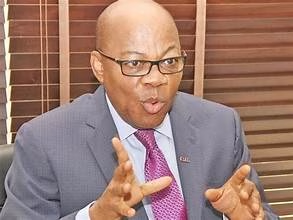
In a letter dated October 12, 2026 addressed to the INEC chairman, the former president of the Nigerian Bar Association, NBA, Dr Olisa Agbakoba, SAN, said the commission’s exclusive authority to declare election results formally should not be interpreted as a restriction on the public’s right to report results already announced at polling units or contained in authentic electoral records.
Dr Agbakoba drew a distinction between declaration of final election results by INEC and announcement of preliminary results by media organisations.
According to him, “While INEC retains its exclusive statutory responsibility for the formal declaration of results, nothing in that responsibility should be understood as prohibiting citizens or the media from reporting results that have been publicly announced at polling units or from publishing information contained in authentic INEC electoral records (Forms EC8A – EC8E), provided that such reporting is accurate and does not misrepresent the official records.
“Where polling-unit result sheets are uploaded and made accessible through IReV, citizens, journalists, political parties and observers can view those records, assess them and communicate their contents accurately, while clearly identifying the source and status of the information”.
He argued that Section 25 of the Electoral Act, 2026, which governs the relevant functions of electoral officers, must be read alongside other applicable provisions of the Act and “Section 39(1) of the Constitution of the Federal Republic of Nigeria 1999, as amended, which guarantees the right to freedom of expression, including the freedom to hold opinions and to receive and impart ideas and information without interference. This constitutional protection is central to the question of whether citizens and the media may communicate information about electoral results that are already publicly available”.
Dr Agbakoba then cited the 1984 judgment delivered by Justice Candide Johnson of the High Court of Lagos State in a case between the Nigeria Union of Journalists and the Inspector General of Police where the court declared as unlawful and unconstitutional, the directive by Federal Electoral Commission, FEDECO, (now INEC) warning the media not to publish election results that had not been officially released by it.
He therefore urged the Commission to understand the clear distinction between the formal declaration of results and the lawful publication or projection of electoral outcomes based on verifiable records and guarantee the citizens and the media the right to publish and analyse election results from authentic polling unit records ahead of the 2027 general elections.
Dr Agbakoba also appeared on Arise News television programme, The Morning Show, last Wednesday to share his perspective on INEC’s warning against the media or the citizens publishing election results.
During the programme, he was asked how the public can ensure accuracy of the results announced by the citizens which are already in the public domain and if he intended to take any consequential steps to defend his position.
His response:
“No, I don’t intend to take any consequential steps because already in 1984, Mr Justice Candide Johnson, in the case concerning NUJ and FEDECO, (now INEC), decided exactly what I’m saying; that journalists have a right to publish results. I think the confusion is that we confuse the declaration of results. That’s the only power that INEC has exclusively, to declare the results.
But as you know, the electoral record in terms of voting goes from the polling unit to the ward, to the local government, to the state, to the national collation and to the final announcement. That is the process. If I’m standing at the polling unit and the presiding officer reads the results, I can broadcast it because he has read it. And I can tell you that political parties are going to set up AI processes whereby they’ll be able to pick results from the IReV, because the IReV is simply a compilation of all the results coming from the polling units.
“So, this time I predict we’re going to see speed. But the question is whether I’m holding all the results in my hand, authenticated, because Section 124 of the Act warns against publishing fake results and prescribes punishment for it. So, that tells us that if the Act anticipates that you can publish a fake result, it also means that you can publish the results. The real confusion is the doctrinal problem of what INEC can do, which is simply to declare the results. The fact that I have announced the result doesn’t mean that, that is the result.
“Remember that even with the famous 1993 free and fairest election in Nigeria, there was no declaration. It was on the board that people saw the results that had been written and it was from there that it was projected that Abiola won. There’s no question that the media, particularly, are entitled to publish results. In any event, the matter has been decided which has not been appealed, and the case is NUJ versus FEDECO, now INEC. And I think that is the decision that binds everybody including INEC.
How people trust AI-generated election results
“It’s up to the citizens if they wish to set up an AI collation process. The only restriction is that you must publish the results based on what the IReV has set. That’s all. You must source your results. You must say, ‘based on IReV, I hereby project this candidate as the winner of the election. You cannot say, ‘I’m projecting this candidate as a winner’ without attributing it.
There must be attribution. If you watch international media, when CNN projected Obama, it went to the board and said, ‘we project Obama as the winner based on the outcomes’. The key here is that you can’t go on a frolic of your own and say, ‘here are the results.’ The results must be results obtained from the process, and the INEC has a source of information flowing from form EC8A up to EC8E.
Admissibility of IReV results in court
There have been arguments that the Electoral Act should be revisited on the ground that since IReV can be used to authenticate results based on what has been taken from different polling units, should it then not be admissible as evidence in court for post-election matters?
Agbakoba agreed with this proposition and went ahead to blame political parties for being lazy in the prosecution of their post-election cases
“You’re absolutely right. And here, let me just say political parties have been very lazy. What they do is, they go to court, apply to the justices and say, ‘INEC, can you please release the results?’ But you have the results. Don’t forget that you have party agents that signed EC8A at the polling units. So any political party that is unable to monitor its results is not qualified to be on the ballot. It is your responsibility by law to have polling agents putting your results together. So, when these parties go to court and say, ‘My Lord, can I have results from INEC?’ I think it’s lazy. We ought not to depend only on INEC. So, this point about being able to publish and announce results can be stretched to the issue of proving cases in court”.
At this point, one of the anchors of the programme, Mr Rufai Oseni was overwhelmed by Dr Agbakoba’s submissions and poured encomiums on him. He said, “Dr Agbakoba, God bless you, and I say this ad infinitum, God bless you a million times. Because what you have just done is to provide clarity and shame the devil. You have no idea what you have done today, sir. I’m sorry I’ve been theatrical. You see, it’s because people are criminals, that’s why they will never accept the thoughts you are putting forward. They’re criminal in nature and I’ll tell you why. The reason why they keep saying the onus falls on INEC to declare the results is because of their criminal intent of changing the results with INEC.
“We saw what happened in Rivers State, that somebody won on the IReV, but what was announced by INEC was different. In the case of America you are talking about, CNN does not even have IReV, they project the result with the exit polls, which is not even an accurate measurement like our own live results. We even have a portal where we have live results but they project with exit polls. So when people say we can’t publish the result, it’s a criminal mindset, and it’s because we have allowed this criminality to continue. INEC wants to be the arbiter, that’s why they’re doing this. My question for you is, how can we stop this level of criminality, that when people win on IReV, INEC would declare something else and say this is what we declared.
How to stop the level of criminality
In his response, Agbakoba said, “These political parties, I don’t know what’s wrong with them. I don’t know whether they even read the Electoral Act. They have a lot of responsibilities to be able to challenge INEC’s results. But what then happens is that everyone is waiting for INEC to deliver trucks and trucks of results.
What you just said is absolutely correct. If the political parties have structures and they are spread around all the polling units, they should be able to, in a matter of hours, have authenticated results. So they don’t need to depend on INEC in court. All they need to show is, here are the results produced from the portals of INEC. I don’t see that a court will say no. But in all of the presidential petitions, this has never been done. Now that I hear that some political parties are organizing to do this, I’m just hoping that that will happen. But the big thing is this; if INEC knows it’s being watched, it will be careful. It will know that somebody is putting together an alternative credible result from the same INEC source. And I hope that would make INEC to be a lot more credible, to deliver what is accurate and not to create what you call criminal results. So we’re hoping that 2027 will be the departure from the past”.
Political parties’ lack of structure
There are also arguments that many political parties may be unable to challenge whatever result INEC has declared for lack of capacity as some of the parties won’t be able to even recruit enough polling agents.
According to the former NBA president, “If you stand for an election on the platform of a particular party for the presidency and you don’t have the structure, then why are you on the ballot? You must have the structures to defend your mandate, which includes the results. So any party that does not have the capacity to even gather its results, that’s its problem. Then you go and depend on INEC’s results and you will have no reason to question the presumption of regularity. But if the party that has the equipment and the wherewithal to have its electoral records intact, present it to the court, then the presumption of regularity that flows in favor of INEC is rebuttable. The court will say, “Oh, we can see something else that is coming from the same source.”
So the bottom line is, parties need to be prepared. If you’re not ready to monitor the elections right across Nigeria, don’t go on the ballot or don’t complain.




Leave a Reply