
It was about the goriest spectacle I had ever witnessed before that time. The body – pulled out from an iron drawer – lay on the table like an already cleaned animal ready for the butcher’s knife. Somewhere within the tiny crowd of about 10 men, a sudden sound broke the loud silence.
It was Nwabueze Ugwu, then newly elected member of the Enugu State House of Assembly. It was a somewhat kind of groan or grunt – the type I imagine could come have come from the torture chamber of the dreaded Adolf Hitler Germany or the slaughterhouse, from animals on the throes of death.
Strange and rather unhuman, it embodied the full weight of anguish, sorrow and pain. The body on the table was that of Sunday Ugwu, his elder brother. It was a kind of introduction to the scenario of the next few minutes, as the room was suddenly enveloped in all manner of emotional displays – some dropping a tear or two – others joining the lawmaker, who had by now broken into open and endless wailing – while others watched in stoic silence.
In that room was Jim Nwobodo, former Governor of old Anambra State and the alter ego of Enugu State. I had joined him on that trip as a reporter of The Guardian, to see for myself that grisly event that announced the state as one of the killing fields that parts of Nigeria suffered in the early years of the return to democracy in 1999.
The event I have just described happened few months at a mortuary in Agbani, a suburb with the Enugu state capital. It was the first major case that positioned the state centrally and prominently in the unenviable list of states with high-profile killings – which, in the main were interpreted as political killings.
Yes, political killings, because Ugwu’s kinsmen, never took their eyes off the Lion Building, the seat of power in Enugu. In fact, Nwabueze, for the rest of his years in the Assembly, and even beyond, had a running battle with Chimaroke Nnamani, Governor of the State at that time.
Indeed, the Ugwu murder was to be followed with other high-profile cases of prominent citizens dying in questionable circumstances, with many eyes gazing, like the lawmaker, in the same direction – the government house. Prominent among them were Chimere Ikoku, former Vice Chancellor of the University of Nigeria, Nsukka (UNN), who was murdered in his Independent Layout home in Enugu, in 2022 and Victor Nwankwo, younger brother to Arthur Nwankwo, who like his brother, was also a fiery social critic.
Even the death of Daniel Anyogo, former commissioner of Police in Enugu State came with the nuances of the suspicion surrounding the state at the time. Many believe that the sudden death after allegedly visiting the government house the previous night, had more than an ordinary meaning of natural causes.
Of course, Enugu was not alone. The entire country was on the broil at the time with political killings. The list includes Chief Bola Ige, former Attorney General of the Federation and Minister of Justice (AGF-MoJ), Harry Marshall, former National Vice Chairman (South-South) of the All Nigeria Peoples Party (ANPP), Aminasori Alfred Dikibo Vice Chairman of the Peoples Democratic Party (PDP) in the South South zone.
There were also Funsho Williams, in Lagos, Ayo Daramola and Dapo Dina in Ogun. There were Ogbnnaya Uche a prominent politician in Imo and Andrew Agom, a Benue political bigwig – all cases linked to political assassinations.
In fact, even though the neighbouring Anambra, which presented a worse case of political violence including the record of being the only state where a sitting governor – Chris Ngige – was pulled from his desk by police officers sponsored by political opponents ahead of what later became a botched abduction, still fell short of the Enugu profile.
It also included practically razing down of both the Government House in Awka and Governor’s Lodge in Amawbia, and the brutal murder of Barnabas Igwe former state chairman of the Nigeria Bar Association (NBA) together with Abigail, his wife, said to be pregnant at that time, among other cases.
But even in all these cases which occupied their individual rightful places in the list of the ugly developments, the Enugu situation, still remained extraordinary, not only by the sheer number but by choice of the targets, including the fact that many of the victims were not politicians per se.
This is why the signals coming from the state in recent months have become troubling. Don’t forget the case of Oyibo Chukwu, candidate of the Labour Party (LP) for the Enugu East senatorial seat, who was brutally murdered on February 22, 2023, few days to the National Assembly elections on February 25.
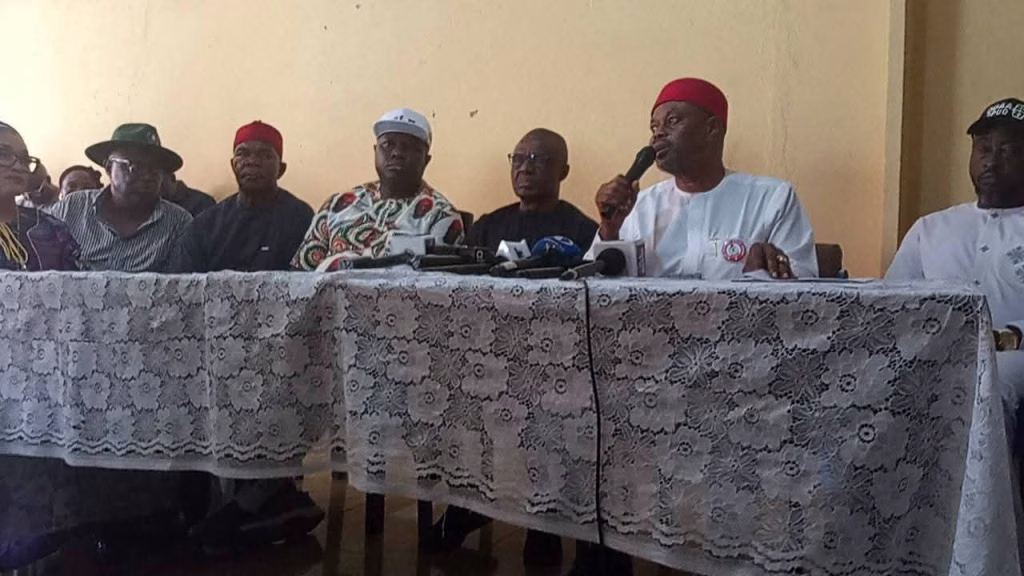
I watched Chidi Onyia, Secretary to the State Government (SSG), in the state put up a spirited defence of the government – all but putting the blame for the alleged attack on the contingent of the Nigeria Democratic Congress (NDC) – who were at the Enugu Airport to welcome Chinyeaka Oha, the party’s 2027 governorship candidate to the state on Saturday.
I heard him say that the NDC crowd at the airport was dispersed because they did not obtain the permission of the authorities to gather. I also heard another version that it was actually the factions of the party that were attacking themselves, and that the opposition party was only trying to blackmail the government by alleging that they were the sponsors.
This was in sharp contrast to the account of the opposition party, which claimed that members saw officials of the state government conducting the attack alongside the police, which clearly took sides in the matter and the lamentation of Peter Obi, the NDC candidate in next year’s election, who bewailed the development.
Now, much as the government would clapback and push back the allegation, the choice of who or what to believe still lies in the thinking public and not to retards or imbeciles, especially when the development seems to have become a kind of pattern, with similar attacks on opposition parties being reported in other states.
Only recently, a traditional ruler in the same state was reportedly suspended from office on the orders of Peter Mba, Governor of the state. His offence was said to be his audacity in welcoming Obi to his palace, even though the same government explained the action away by claiming that the monarch was not living up to expectation.
Now, Onyia, Professor of Education, for many outsiders, is just the super SSG that is the engine room of the government of the Mba government – some even suggest that he is the Alternate Governor, for the power he exudes. But for others, who know him closely, he is a high-octane, intellectual powerhouse and consummate scholar, but a humanist with knack for excellence.
I actually had the privilege of sitting in the same office with him for more than two years, in Abuja, where I first watched him put in practice his prowess as leader of men and materials and I’m definitely not surprised that Mba relies on him so much. Given this much therefore, I don’t see him engaging into any anti-human escapades that would demean or undermine these fine qualities.
But politics – especially the Nigerian variant – is believed to be some kind of an opium. After all, Nnamani, the man who left the lion building in 2007 for his successors, including the incumbent was a highly-priced academic too – a faetal surgeon – a rare branch of medicine, involving pulling an unborn baby out of the mother’s womb, conducting a procedure and returning it.
Yet, today he is not smelling roses. Of course, it wasn’t that any court in Nigeria found him culpable in those series of high-profile deaths that happened under his nose – but by the vicarious responsibility of being the governor in charge at the time and even worse that he was accused directly of having a hand in them.
So, it wouldn’t be enough for Mba or his lieutenants to explain away every accusation of malfeasance or official impunity. Nnamani and his men did same. Rather their policies and conducts must prove their inviolability inculpability.
This has become even more fitting with the loud whispers that is going round now that this same Mba, was one the Chief of Staff to the same Nnamani. The best news so far is the account of the government that nobody actually died – the man that was thought dead, actually lived. Nobody should die.
Now, I won’t end without the curtain fall! There is this story around the All-Powerful Nnamani. When the EFCC picked him, as they did many of his colleagues, he had to suffer some extra weeks in detention even after he was granted bail? Why? Wait for it – there was nobody to take him on surety. Imagine that! Lessons? I won’t say more!
_The Tiny Voice!

Leave a Reply