
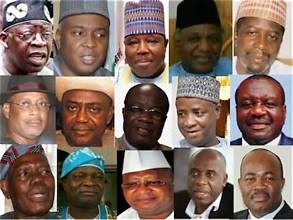
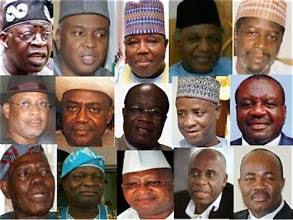
When Nigeria returned to democratic rule on May 29, 1999 after years of military rule, 36 men took the oath of office as the first elected governors of the Fourth Republic. They came from different political backgrounds and parties, but collectively became known as the “Class of ’99”.
Twenty-seven years later, their political journeys tell a remarkable story of Nigeria’s democratic evolution. Some rose from state government houses to the presidency, Senate, ministerial offices and national party leadership. Others withdrew quietly from public life, while several died after leaving office. A few also became entangled in corruption cases and spent time in prison.
At the centre of the story is Bola Ahmed Tinubu, who was the governor of Lagos State. Unlike most of his colleagues, Tinubu remained continuously relevant in national politics after leaving office in 2007. He helped drive the formation of the All Progressives Congress (APC), became its presidential candidate in 2023 and was elected the president of Nigeria.
Another member of the group who attained the presidency was Umaru Musa Yar’adua of Katsina State. After serving as governor for eight years, Yar’adua succeeded Olusegun Obasanjo as president in 2007. His presidency, however, was cut short by ill health and he died in office on May 5, 2010.
Inside the rice price dispute
I tried; Idoma cannot be governor in Benue – Steven Lawani
Other members of the Class of 1999 who died were Diepreye Alamieyeseigha of Bayelsa, Mala Kachalla of Borno, Mohammed Lawal of Kwara, Adebayo Adefarati of Ondo, Lam Adesina of Oyo, Abdulkadir Kure of Niger, Abubakar Audu of Kogi, Abubakar Habu Hashidu of Gombe, Chinwoke Mbadinuju of Anambra and Bukar Abba Ibrahim of Yobe.
Akume: The Benue politician who stayed relevant
A member of the class who remains active in his political career is George Akume of Benue. After leaving the Benue Government House in 2007, he became a senator and later served as a minister under President Muhammadu Buhari. He subsequently became Secretary to the Government of the Federation under President Tinubu.
Senator Akume led Benue State as governor between 1999 and 2007 and has remained in government since he first assumed the state’s highest political office nearly 27 years ago.
Currently the Secretary to the Government of the Federation (SGF), Akume is regarded as a political leader. He is popularly referred to as the ‘godfather’ of Benue politics and has continued to remain relevant.
He also represented Benue North-West senatorial district in the National Assembly for three consecutive terms, serving for 12 years, between 2007 and 2019.
Akume was appointed minister under the administration of former President Buhari in 2019 and served until 2023 when the administration of President Tinubu appointed him as SGF.
No doubt, the SGF commands a large followership of party supporters, which today cuts across various political party leanings, particularly in coordinating support for the reelection bid of President Tinubu.
Uzor Kalu: From government house to senate
Orji Uzor Kalu moved from the Abia State Government House to the National Assembly as a senator representing Abia North. He was the governor of Abia State from 1999 to 2007 and currently the senator representing Abia North on the platform of the APC. He contested the 2007 presidential election under the defunct Progressive Peoples Alliance (PPA) but lost. After then, he returned to his private business.
In 2019, he resurfaced in the political space. He served as the Chief Whip of the Senate between 2019 and 2023.
He was re-elected as senator in 2023, where he sought his colleagues support to become the president of the 10th Senate, but Senator Godswill Akpabio later emerged.
He is currently the chairman of the Senate Committee on Privatisation, and recently, chairman of Senate Committee on South-East Development Commission (SEDC).
Udenwa lives quiet life Chief Achike Udenwa, a chieftain of the Nigeria Democratic Congress (NDC), governed Imo State from 1999 to 2007. After his tenure, he was appointed by the late President Umaru Musa Yar’adua as Minister of Commerce and Industry. He served from 2008 to 2010. Since then, he has not held any public office.
Enugu’s Nnamani returns to medical practice
Dr Chimaroke Nnamani was the governor of Enugu State from 1999 to 2007. After his tenure, he served as senator for Enugu East between 2019 and 2023. He lost his re-election bid to the Senate to the Labour Party candidate and has since returned to his medical practice.
Kwankwaso still in politics
Rabiu Musa Kwankwaso of Kano State moved into national politics, serving as senator and becoming a prominent presidential candidate. The former governor and vice presidential candidate of the New Nigeria People’s Party (NNPP) remains one of the most influential political figures to have emerged from the class of governors elected in 1999.
He served as minister of defence between 2003 and 2007 under the administration of former President Olusegun Obasanjo and later returned to Kano politics, winning a second term as governor in 2011 on the platform of the Peoples Democratic Party (PDP). He has remained deeply involved in national and Kano politics.
His second tenure, which ended in 2015, further strengthened his political base and gave rise to what later became known as Kwankwasiyya movement, characterised by the red cap associated with his supporters.
In 2015, Kwankwaso moved to the Senate, where he represented Kano Central.
His growing national profile eventually culminated in his emergence as the presidential candidate of the NNPP for the 2023 general elections. Although he did not win the presidency, the former governor secured a strong showing, particularly in Kano and parts of northern Nigeria, finishing fourth behind Bola Ahmed Tinubu, Atiku Abubakar and Peter Obi.
Since the 2023 elections, Kwankwaso has remained at the centre of opposition politics and political realignments ahead of the 2027 general elections. His political influence has remained particularly strong in Kano, where the Kwankwasiyya movement continues to attract a significant following.
Makarfi remains active in PDP politics
Ahmed Mohammed Makarfi of Kaduna State served as senator and later became the chairman of the PDP Caretaker Committee during one of the party’s major crises. He has remained active in PDP politics despite retirement from elective office.
Senator Makarfi served as the governor of Kaduna State from 1999 to 2007. After completing his two terms in office, he was elected to the Senate, where he also served for two terms before deciding not to seek re-election.
Makarfi later served as the national chairman of the PDP and remains an elder statesman within the party. He has continued to participate actively in party politics at both the state and national levels.
Abdullahi Adamu still visible in Nasarawa politics
The first civilian governor of Nasarawa State, Senator Abdullahi Adamu, served between 1999 and 2007 before returning to manage his farm in Keffi, Nasarawa State. After leaving office, Adamu stayed away from active politics until 2011 when he contested and won the Nasarawa West senatorial seat, a position he held for three consecutive terms.
He left the Senate in 2022 following his emergence as the national chairman of the APC, where he led the party to victory in both national and state elections in 2023.
Shortly after President Bola Ahmed Tinubu assumed office, Adamu was replaced as APC national chairman with a former Kano State governor, Dr Abdullahi Umar Ganduje in 2023. On December 16, 2023, the former governor announced his retirement from active politics, declaring that he had developed an “allergy”. It was observed that he still attended some political meetings, but his participation has drastically reduced compared to his previous active involvement.
Adamu, who celebrated his 80th birthday on July 23, 2023, is said to be spending most of his time in Keffi receiving visitors at his residence and travelling out only when necessary.
In the South-West, Olusegun Osoba of Ogun State and Bisi Akande of Osun emerged as elder statesmen within the political family that eventually produced the APC.
Also, Niyi Adebayo of Ekiti went into federal politics and served as Minister of Industry, Trade and Investment under Buhari.
The careers of these former governors demonstrate how the political structures created around the Alliance for Democracy and later opposition coalitions eventually fed into the APC.
The South-South produced some of the most recognisable figures from the class. James Ibori of Delta remained a major political figure after leaving office, while Donald Duke of Cross River became one of the most nationally recognised former governor. He later sought the presidency. Peter Odili of Rivers returned largely to his professional and private interests after completing his two terms. Victor Attah of Akwa Ibom also withdrew considerably from frontline politics after leaving office.
Donald Duke eyes presidency for third time
Mr Donald Duke, now 65 years old, was one of the governors in 1999 when democracy returned to Nigeria. He served for two terms, which elapsed in 2007.
Same year, he immediately sought to become Nigeria’s president on the platform of the PDP but lost to Umaru Musa Yar’adua, who eventually won the presidential election.
In 2019, he became the presidential flag-bearer of the Social Democratic Party (SDP). He is currently the presidential candidate for the People’s Redemption Party (PRP), having won the candidacy in May 2026. So far, Duke has made three attempts at Nigeria’s presidency.
Outside election time, he engages in show business and tourism promotion. He spends much of his time in Lagos State, from where he launched out to become governor in 1999.
Furthermore, Sam Egwu of Ebonyi State moved into federal politics, becoming a senator and minister, while Lucky Nosakhare Igbinedion of Edo has gradually receded from the political scene
Chief Igbinedion was among the governors elected on the platform of the Peoples Democratic Party in 1999. He served from 1999 to 2007.
He was once a strong force in Edo politics but has gradually receded from the political scene, both at the state and national levels.
However, observers believe he has remained relevant in state politics after leaving office, but gradually took a back seat in the political terrain after the PDP lost the 2016 governorship election to former Governor Godwin Obaseki, who contested on the platform of the All Progressives Congress.
Some political observers attributed Igbinedion’s reduced political visibility to PDP’s defeat in the presidential and governorship elections in the state. However, the reasons for his withdrawal from active politics have not been publicly established.
Igbinedion now lives a relatively quiet life away from the publicity associated with active politics. He is involved in hospitality and other business interests.
As heir apparent to Chief Gabriel Igbinedion’s business empire, Lucky is the Deputy Chancellor of Igbinedion University, Okada, where he coordinates the activities of the university on behalf of his father.
He also owns hospitality and entertainment businesses in Benin City, including Kada Plaza, as well as Cinema and Otis Hotel, among other business interests.
Odili focuses on education, health, philanthropy
Upon the return of democracy in 1999, Dr Peter Odili became the governor of Rivers State on the platform of the PDP. He won re-election in 2003 and ruled the state for eight years. After his tenure in 2007, Odili returned to private life, running some life-touching projects in education, health and philanthropy.
The former governor, who currently stays in Port Harcourt, the Rivers State capital, is a prominent political leader. He supported all the governments after him and played advisory role to governors after him.
During the Chief Nyesom Wike administration, Odili was a strong supporter of the governor, especially as his party, the PDP became an opposition at the national.
After his tenure, Odili founded the Pamo University of Medical Sciences in Port Harcourt and serves as its pro-chancellor. The institution has continued to train medical personnel, mostly from the state. He also runs Pamo Educational Foundation, which constructs and donates public health facilities like the comprehensive primary health centre in Ndoni community. He is also into the medical profession, especially at his Pamo University Teaching Hospital.
He is an influential figure in Rivers State politics who mentors politicians; hence he is recognised as a political leader.
Although he is quiet about which candidate and party he is supporting ahead of the 2027 general elections, Odili remains a strong political pillar in the state.
Muazu into business, farming
A former Bauchi State governor, Ahmadu Adamu Muazu, returned to his professional career as quantity surveyor, businessman and farmer after leaving office. He became a PDP national chairman and later served as Nigeria’s ambassador to Australia.
Muazu has been active in his personal businesses, agriculture, philanthropic interventions in education and health. Although he is currently not active in political party politics, his house has become a centre-stage where governorship candidates and heavyweight politicians from different political parties are visiting and seeking for his blessings and guidance.
The former governor, who lives in Abuja, frequently visits Bauchi for his personal businesses, farming activities, meetings and community services, especially philanthropic interventions.
Speaking on the life of the former governor after his tenure, his personal assistant, Dr Kabiru Ilelah said, “After leaving office as the national chairman of the Peoples Democratic Party, he went back into business and his professional practice of quantity surveying. He has an active firm of quantity surveying, as well as a property development company.
“Muazu is into agriculture and agro-allied processing. He also ventured into blending fertiliser and animal husbandry, as well as fishing in Bauchi. The traditional titleholder of Walin Bauchi is a philanthropist who is seriously concerned on issues of education development, particularly children of the less privileged.”
Also, Saminu Turaki of Jigawa and Attahiru Bafarawa of Sokoto have remained political figures in their respective states and regions.
Some members of the class experienced difficult post-office journeys.
For example, Joshua Dariye, who governed Plateau State from 1999 to 2007, was convicted over corruption allegations and sentenced to prison before subsequently receiving a presidential pardon. Jolly Nyame of Taraba similarly served a prison sentence following a corruption conviction before being pardoned.
But Ahmed Sani Yerima of Zamfara moved from the Government House to the Senate and has remained active in national politics. Boni Haruna of Adamawa, Achike Udenwa of Imo, Chimaroke Nnamani of Enugu and Adamu Aliero of Kebbi all pursued different paths after leaving their respective state governments. Aliero later served as senator and federal minister.
Victor Attah, Segun Osoba, Bisi Akande and some of their colleagues have also increasingly occupied the role of elder statesmen rather than frontline politicians. Their influence, however, has not necessarily disappeared.
The continued consultations involving former governors demonstrate that political relevance in Nigeria does not always depend on holding elective office.
Adebayo: A political godfather in Ekiti politics
Otunba Niyi Adebayo was the governor of EKiti State between 1999 and 2003. He is currently the Asiwaju of Iyin Kingdom in his country home, Iyin-Ekiti. He is based in Lagos State but visits home at intervals. He is regarded as a political godfather in Ekiti politics.
He served as the Minister of Industry, Trade and Investment during the administration of Muhammadu Buhari between August 21, 2019 and May 29, 2023.
Boni Haruna in quiet and modest life
Haruna, who served as governor of Adamawa State from 1999 to 2007, is said to have left lasting legacies for which the people of the state will always remember his eight-year administration.
He was elected as deputy governor to Atiku Abubakar, who was the flag -bearer of the Peoples Democratic Party in the 1999 elections, but was picked by former President Olusegun Obasanjo as his vice president, a situation that gave him (Haruna) the constitutional latitude to become the governor of the state.
Haruna has been among the prominent politicians of the Fourth Republic in the state, recording significant achievements.
He was appointed as minister of state for youth development by former President Goodluck Ebele Jonathan in March 2014, a position he held up to November 2015.
He has, however, maintained a quiet life after the expiration of his two terms in office but remains connected to his people.
Presently, the former governor is based in the Federal Capital Territory with his immediate family, facing his personal endeavours out of public space.
Aliero prominenet in Kebbi politics
Senator Muhammadu Adamu Aliero is also a member of the Class of 1999 Governors. He served two terms before leaving office in 2007.
After leaving office as governor, Senator Aliero has been involved in both state and national politics. He won a Senate seat in 2007 but did not stay long in the National Assembly because the late President Yar’adua appointed him as the Minister of the Federal Capital Territory (FCT).
Shortly after Yar’ adua’s death, he contested the Senate on the platform of the Congress for Progressive Change (CPC) against Abubakar Atiku Bagudu of the APC and lost in 2012.
After he lost to Bagudu, he became passive in Kebbi politics until Buhari came up with the merger, which metamorphosed to the APC in 2014. From 2015 till date, Aliero has consistently won the Kebbi Central senatorial seat.
Aliero, amid his politics in Kebbi State, established a rice factory in Birnin Kebbi, the state capital. Today, he is considered the godfather of Kebbi politics with a formidable political structure.
Jolly Nyame still in Taraba politics
Jolly Nyame, a former governor of Taraba State, has been in politics since leaving office in 2007.
He served as governor from 1999 to 2007 on the platform of the Peoples Democratic Party.
Nyame served a jail term in the Kuje Correctional Centre in Abuja after leaving office. But he continued with his political activities after his jail term.
He contested for a senatorial seat to represent Taraba on the platform of the Action Congress of Nigeria (ACN) in 2011 but was defeated by the late Hajiya Jummai Allassan, who contested and won on the platform of the PDP.
Nyame went back to the PDP and attempted to contest for the senatorial position again but could not secure the ticket.
The former governor is now in the APC and a member of President Bola Tinubu and Governor Agbu Kefas 2027 campaign councils.
In 2026, his political camp became involved in fresh opposition realignments as politicians seeking to challenge the ruling APC explored different platforms ahead of the 2027 elections.
Twenty-seven years after they took office, their story also reflects the changing nature of Nigerian politics. Governors who began their careers under the PDP, AD or APP have subsequently appeared in the APC, PDP, ADC and other political formations. Some became presidential candidates, some became party chairmen, ministers or senators; others became political elders, while others have passed away.

Leave a Reply