
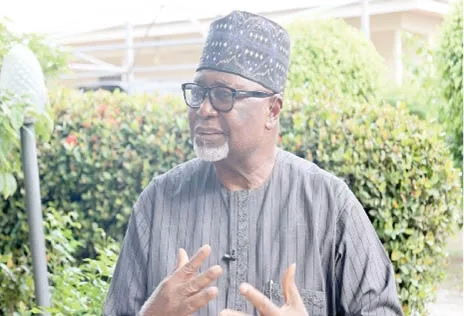
Chief Steven Lawani, administrator, businessman and politician, started his career in the Nigerian Hotels Board. He later became the chairman of the board and held a string of other positions in the private sector, including the chairmanship of Savannah Bank and Manny Merchant Bank, before he veered into politics.
He served as the deputy governor of Benue State between 2007 and 2011. He was also a senator for a short while on the platform of the United Nigerian Party. He is still very active in politics, both nationally and in Benue State.
I believe you are from the Idoma part of Benue State. Can you tell us a little about growing up?
That’s right. I am from the Otukpa district of Benue State. I was born to a soldier who served in Burma. My early life was in Abeokuta, Enugu, Kaduna, wherever they were transferred to.
In various barracks?
In the barracks. I am a barracks boy. Then I went to St Michael Secondary School, Aliade. After leaving there in 1967, I went to Government College, Kaduna, for my sixth form. After two years in Kaduna, I went to the Ahmadu Bello University (ABU) and graduated in 1973.
You read Economics?
I read Economics. We were indeed the first set of the National Youth Service Corps (NYSC). I served in Maiduguri. I was quite close to the then military governor of the Northeastern State, Musa Usman.
As a young corps member, how did you become close to the governor?
At that time, youth service was a thing of pride. It was just beginning; and all the governors too. There were just 12 states in the country, so they took particular interest in the youth corps members.
After my youth service in Maiduguri, I joined the Nigerian Hotels Limited.
You didn’t stay in Maiduguri to work?
No; but I wouldn’t have minded because I took interest in hotel business and tourism. I got to know the manager of Lake Chad Hotel, Maiduguri, so I approached him as we were getting to the end of our service.
He said if I wanted to work in the industry he would recommend me to the head office of Nigerian Hotels in Lagos. So he spoke to the then managing director, Chief Alamutu, who asked him to send me down to Lagos. I went for a very interesting interview. I made it known to him that I had applied to Cornell University in New York for my MBA. He told me, “If you want the industry, work for us and we will send you abroad.” Interestingly, I didn’t even spend a year, after six months he called me and said they had admission for me in Manchester.
To read Hotel Management?
I did Hotel Management and Tourism at Hollings College, part of the University of Manchester. On my return, I was sent to Airport Hotel as an assistant manager. And later, in 1976 I was sent to Central Hotel, Kano as a resident manager. I stayed there till 1981 and was promoted general manager and sent to Ikoyi Hotel. While I was in Ikoyi Hotel, I handled banqueting. I looked after National Party of Nigeria (NPN) governors when they had their meetings in Ikoyi Hotel.
My governor then, Aper Aku, took an interest in me when he was told that the manager of the hotel was from Benue State. So he invited me to come and be the general manager of the hotels in Benue and I accepted. I think It was just about a year or so before the 1983 coup.
(General) Atom Kpera was sent here as military governor and one of the first things he did when he came to Benue was to dissolve all the parastatals, including the Benue Hotel Board.
So you lost your job?
No; I didn’t lose; I was seconded to the place, so I immediately informed Lagos and they told me, “Come back, we need you urgently.” So I went back to Nigerian Hotel. Interestingly, I had hoped that I would be the managing director, but I was made the chairman of the company.
What does it mean to be the chairman of the company, was( it) a part time job?
No. I was more or less an executive chairman. I had a managing director – Abbas Tafida.
The Emir of Muri?
Yeah.
We related with the ministry and did other things.
But that was a Lagos-based job?
Yeah. I served in that position until the second coup in 1985 – the Babangida coup.
Don’t forget that Nigerian Hotel was a parastatal of the Ministry of Trade. After that coup, the president asked if I was not tired of hotel business because he knew me when I was working as general manager. I told him that I would not mind if he had another job for me. That was when I was appointed the chairman of Savannah Bank.
That’s a big position for a non-banker, even though you are an economist.
Yeah. I held the position for six years. There was no big money then, but it taught me a lot that is helping me in my private business right now. Of course when I left there I veered into politics.
I noticed you also had other banking positions, such as the one in Manny Merchant Bank?
When I left Savannah Bank, I went to the Nigerian Industrial ( Development) Bank. I replaced Olu Falae as chairman. As I was there, I was approached by the Babangida administration when they were thinking of transition. There was the formation of two political parties: the National Republican Convention (NRC) and the Social Democratic Party (SDP).
They were beginning to think of how and who to hand over to when they left office. When these two parties came up, I was approached by elders like Mallam Adamu Ciroma and Bamanga Tukur. They asked me to join the new party and I did. In the very first election that was held, I contested and became the deputy national chairman of the NRC. My chairman was Chief Tom Ikimi, who later became a minister of foreign affairs. I was his deputy.
Of course, so much happened thereafter and I decided to go back to business with the experience I garnered from Savannah Bank and other places. Along with some friends, we invested in the then Manufacturers Merchant Bank. Later, we changed the name to Manny Bank and I was the chairman.
I ran this bank till 2005 when with Soludo as the governor of the Central Bank, there was this consolidation of banking in the country. So my bank – Mannh Bank – and one other – the National Savings Bank – merged into what is today known as Fidelity Bank and I became the director.
Are you still a director of Fidelity Bank?
When I was elected as deputy governor of Benue State, I had to resign.
Looking at all these business appointments – Hotels Board, Savannah Bank, Development Bank; at what point did you think of contesting for election?
The contest I made was into the Senate in 1997. At that time, it was under another party because the NRC and SDP had been dissolved. I joined the United Nigeria Congress Party (UNCP) and contested election to the Senate to represent Zone C; that is the Idoma-speaking people of Benue State. I won.
So that was your first foray into such contest?
Yes. But a week or so to the inauguration of the National Assembly, Abacha died. And that was also the end of politics briefly because when Abdulsalami Abubakar came on board, he dissolved all the parties. So we never really got initiated into the National Assembly. That was it.
When politics returned, there were the Peoples Democratic Party (PDP), All Nigeria Peoples Party (ANPP) and others; where did you find yourself?
I found myself in the PDP, through which I became a deputy governor in Benue State for two terms. After that, I went back to my business.
Did you want to contest for governorship? What was your experience as a deputy governor?
Actually, I contested for governorship but didn’t make it. Suswan was elected and he asked me to come on board as his running mate and I accepted.
Was it difficult for you to accept?
Of course, it was.
Why?
I wanted to be governor. I knew that I would be number one and make the decisions based on all the experiences I thought I had.
You would have known that the arithmetic was against you in terms of Benue configuration; what do you think?
At that time, I didn’t know. When I was asked to be deputy, quite honestly, it took a while. But ultimately, I accepted to serve in that position. And I had no problem at all with the person I deputised, Governor Suswam. We got on very well.
I know the question will be: With all the problems between governors and deputies, how did you survive? I think I had a good relationship with Governor Suswam. We really worked together.
You think it was exceptional?
I think so; very interesting. I will tell you a very interesting story. I had gone to Port Harcourt to close the annual National Sports festival. On my way back to Makurdi, I stopped in Enugu to see the deputy governor of that state.
When we got to the Government House, the deputy governor wanted to see the governor, but we were told that the governor went to Abuja for four days. And the deputy governor didn’t know. I wondered how that could be.
And you were not in that kind of relationship with Suswam?
No. He would tell me before leaving. I would even know a day before he would be going so that in case I had any plan to travel, I would know that the governor would not be around and adjust my plan.
Did he give you any specific power or assignments to do within the government?
No. We had quite interesting times. Well, I was in charge of local governments.
Were you a commissioner for local government?
I was not a commissioner. I was just his deputy. And I was busy throughout because we were in touch regularly. He consulted me, not that he had to. I hardly did anything without consulting him because of course he was the governor.
Look, if you are deputising for someone and the person trusts you so much as to give you a free hand, you would be a foolish man to abuse it. And if you don’t abuse that position you would be a happy person. I didn’t abuse my position.
For eight years, there was happiness on both sides. After that, I tried to be governor, but there was a question of where I come from. At the end of my tenure as deputy governor, there was the issue of succession.
What happened? The governor didn’t support you?
He didn’t. But it had to do with the major tribe in the state feeling unprepared to hand over to a minority tribe. That was simply the reason, not because I was considered incapable. They were simply not ready to hand power over to a minority tribe.
But you still contested in the primary election?
I contested. I even defeated the person who became governor and he went to another party and won.
It showed the power of his ethnic background?
That was it. I am sure you are not new to the politics of this place. The same factor remains still today.
Did you try to be governor again after that experience?
Yes; I tried in 2023.
In the APC?
Yes. And just a day to the primary, even while people were coming from all over the state to vote, there was an order. We practised indirect primary, but while people were coming from various parts of the state to vote, the authorities changed the rules and said it was direct primary. And when it is direct primary you know what it is.
The governor and the authorities were in charge and decided who would win. Direct primary simply means that the people in charge would decide who wins.
Because the governor could control the delegates?
Yes.
The governor has all the power?
All the power. However, in our last case, it was not the governor who was in charge because he came from a different party. The person in charge was not the governor, but they changed the rules.
Who was in charge?
Well, the leader of the APC in the state was Senator Akume, former governor. They changed the rules for reasons best known to them. Obviously, they had someone else in mind.
But there was supposed to be some kind of pre-consultation to gauge the mood of party stakeholders – whether they were ready for it or not; was that not done?
It was a case of changing the rule at the middle of the game. We all agreed that it was going to be an indirect primary. That was on the basis of which we all went to campaign for votes.
I was not alone. I and the likes of Senator Gemade and Aondoakaa, who was the attorney-general of the country, all consulted and everyone of us believed that we would win. I was confident that I would have won that election if it was an indirect primary.
When the order came on the day of voting that it was going to be a direct primary, I withdrew from the race.
I am wondering how crushing it would have been for you to lose that kind of opportunity; did it make you feel despondent for a long while?
Of course I left and said that enough was enough; I was not going to bother myself anymore as there was no chance for an Idoma man to be governor in Benue State. I hoped that someday, that notion would change; at least it was not for want of trying. If we didn’t try, our people would say: ‘How can you be governor if you did not try?’ So I tried and my people saw it all.
But you know this game – once you are in it, you stay in it. I was called upon to anchor the election of Tinubu in Benue State; and I did.
I guess Akume did that as the party leader in the state.
He did. He was the one who called me to help and I accepted. He was our leader. It is true that you were annoyed at what happened previously, but you cannot live with anger unless you want to kill yourself. So you have to let go and enjoy your life.
When I was called upon to come and help the APC win, I was in Dubai, so I had to come back. And for some months, I was in charge in this state.
Were you rewarded for that? This is because if you didn’t get it at the state level there would be a reward at the federal level.
It is interesting that they applied the same thing that happened in the state at the federal level – since they stopped me from becoming governor, I would not be minister. I told myself that for my peace of mind I would just leave it at that.
I was actually told that I would be made a minister and I looked forward to that and thanked the authorities. But three to four days to the announcement, again I was called and told that my name was not there. I said it was fine. I hold no malice against nobody. It was not happening to me for the first time.
Were you compensated with something else since you didn’t become a minister?
No. Well, I was told that the president said he was going to make me an ambassador to one of the key countries, but I said no. I was not begging to eat. I have a business and followership, so I kind of decided that I was not going to serve as an ambassador. When people serving as ambassadors came to my office, when they were going back I would give them money to go, so I didn’t want to be an ambassador. I am fine. And there was no arrogance.
There’s an election campaign going on; are you still active in politics?
Oh yes.
For the same ticket?
I am an APC stakeholder in Benue State, so to say. I work for my party, but not everything you worked for you get. I have not gotten how I worked for the party, but that doesn’t discourage me from continuing to be a good party man. So I am still doing my best.
Do you think your party has a good chance in Benue?
Yeah. We have the government of the state, and the governor is doing his best. I think we would put our house in order; and when we do that, I see no reason why we cannot come back.
What one senses is that nationally, there’s a lot of dissatisfaction with the APC; what do you think?
Of course it is difficult to satisfy a population of 250million Nigerians. What is there to share is not enough for everybody, so there’s going to be dissatisfaction.
If people who worked for the party for victory and are looking forward to certain things are unable to get, they will not be happy.
I am actually talking about ordinary people who have nothing to do with politics. What they want is a country where there is electricity and things are affordable.
It is of great concern to stakeholders of the party who ordinarily think we should win. I must admit that there are reasons that also make some of us fear that the party could be in trouble.
The other day, I was watching television and the social media and saw where President Tinubu told Nigerians not to vote for him if he did not give them electricity after four years. This president himself said that, so he will be (judged) on his promise. That’s just one area.
Following the removal of fuel subsidy, one would have thought that the price of fuel would have gone down. It hasn’t. What about the prices of foodstuff in the market? What the government is saying is not what the ordinary man is experiencing in the market. So the APC has a problem.
As a politician and community leader, does it worry you that the people are suffering; and insecurity is making the country very difficult for ordinary Nigerians to live in?
Yes. Insecurity is another big problem. For instance, farmers are unable to go to farm, so prices of foodstuff continue to go up.
Now, is the government doing something about it? Yes. I am in a position to know that government is doing something about it. I guess the government has come to the realisation that Abuja alone cannot control what is happening all over the country.
That’s why there’s creation of forest guards, which will probably be under state governments. There’s also a discussion on state police. These are things that could bring an end to insecurity in the country. That’s government’s way of tackling it.
But you see, the man who cannot transport his children, pay school fees, move from one part of the country to another, is anxious and desperate. He is not going to wait for all these policies of the government to take off. So the situation is worrisome. And if you are a stakeholder of our party and you are sincere, you have got to be worried.
I think the herders-farmers conflict in Benue began to get out of hand when you served as deputy to Suswam and there was an effort to control it through legislation. Did you do anything different from what subsequent governments have been doing to stop insecurity in the state?
We did our best. But inasmuch as what we did, including Ortom, did not receive national approval, we didn’t see much result.
As a journalist, you hear of corruption on the part of people who were supposed to deal with these bandits. You also hear of what is done to money voted by the government – how these huge sums filtered away, how even members of the armed forces were allegedly involved. And our borders are porous. It became worrisome because we had a president who was an army General.
That’s Buhari.
In fact, a large chunk of people who voted for him did so because they felt that as a former military officer he would deal decisively with the insecurity in the country. But he didn’t. When the current president was campaigning, in a number of fora he assured that he would smoke them out once he came to power. But nothing has happened.
Before my eyes, our friends are leaving the country. But I will not leave; I will go nowhere. I know people who are leaving.
To go where?
To go to Canada – wherever the door is open for immigrants.
People of your generation, not young people?
Even the old – people in my generation – are going, but mostly the young.
Sometimes we don’t understand when we hear that the Fulani have invaded communities and displaced people. I usually imagine how a small minority tribe would come from outside with cows and displace established communities where they are visitors. How possible is that?
Look my friend, because those people who are shown to the public are Fulani, everything done in the area of hostility and instability is said to be from that tribe. But quite honestly, our own people are also involved. It is not every or only Fulani that are doing this thing. Even thugs and other people who are coming from outside the country who are arrested cannot speak Hausa or Fulani. But once they are not from here or not Igbo or Yoruba, they immediately get the name, Fulani.
Now, if we do not diagnose the problem properly; if we have this hazy idea about who is doing what, how can we solve it? As a leader in Benue, what is your appreciation of the problem? How can we solve it?
To be honest, I get worried when you say Christians/Muslims. I do not agree with that because I have been to Sokoto, Zamfara and Kano and saw that these people are also receiving the treatment we are receiving.
As I mentioned earlier, honestly I was worried that our borders are porous. People come from Niger Republic and what have you on motorbikes. And you would wonder whether we had a government. This was happening particularly under the last president.
As someone who went to school and actively following what is happening, I see that the same problem we have here, they also have in Burkina Faso.
What about Mali?
Mali too. I think these people from Libya and the Sahel find better pasture here. So it is not something a state government can solve. There has to be a proper understanding of what is happening by the federal government so that they can set up the right policies and get the states to operate. I mentioned earlier that they started the idea of forest guard, state police and what have you, but Nigerians are becoming impatient. I wish the federal government could declare insecurity a national emergency.
I think you are a very successful businessman. I know politicians who rely only on politics, but you have a property company in Abuja. How has that helped you to deal with the inconsistencies in politics – you win today and lose tomorrow?
Well, mine is a small business. It allows me and my wife and family to kind of survive, pay our children’s fees and attend to our medical requirements. We also make sure that our members of staff are properly remunerated. It is not a big concern as such, but we are not indebted.
You are actually into property in Abuja?
Yes.
That’s something big, isn’t it?
Well, in business you can be said to have properties, but at the same time you may not be liquid sometimes.
Yes, in relation to politics, it simply means that I don’t have to borrow to talk to my people – the electorate. As I said, we are doing well, we are surviving.
Apart from properties, what else are you into?
I am also into pest control. In my company, Orkin, we have the first American franchise for Nigeria, in Africa actually, before similar franchises were given in Ghana, South Africa, Egypt and other places.
The first was in Nigeria and I am the first franchisee of Orkin, an American company based in Atlanta.
So you distribute pest products?
Yes. We are into pest control.
Across the country?
Yes. I have two offices: an Abuja office for the North and a Lagos office for the South.
Do you do franchises beyond Nigeria?
No; purely Nigeria.
Does this mean you really make enough money to be able to do politics the way it is done in Nigeria?
Yes. A number of people who are in politics are indebted. But I don’t have to sell my house or stop paying my children’s school fees. I have enough to take care of that, but I am not in the billionaires’ class.
You have tried politics and succeeded at one point. You have also succeeded in business. At this juncture of your life, what is your long-time vision?
Long-time vision? Well, I am not getting younger, so I was thinking of going near home. I am beginning to talk about setting up an oil palm plantation.
You are going into farming now?
Yeah.
You haven’t started farming all this time?
Of some sorts.
You want to go big?
A bigger scale. I am talking of oil palm, coconut, banana. These are things I have grown. I have the equatorial climate where I come from.
Otukpa?
Yeah. We are beginning to acquire land in that direction.
Does it mean going back home for retirement?
No. I don’t necessarily have to. I can still stay in Abuja and run the business.
Farming doesn’t work at a distance.
It depends.
Where does that leave you with politics?
I need to keep my brain busy. It helps me to survive.
And politics is the way you do that?
Yes.
You can’t do it in other businesses?
I just gave you an idea of what I am thinking of doing at home – trying to satisfy certain needs of my people.
Tell us about your family life. When did you settle down? What is the situation of your family?
I have four kids. And I am a proud grandfather of six children. I am happily married. It is not easy to live in Abuja; you have to have a house here. Then you have to have a place in your local community; I mean Otukpo, the headquarters of the Idoma nation.
You have another house there?
Of course. Then I have to have in the village, Otukpa.
Again?
Of course.
You run four homes?
It is not too bad.
Perhaps abroad?
Not abroad; just here.
I have met many senior citizens here in Benue who are married to three, four or five wives, even more than Muslims. You have only one wife; why is it so?
I wish I could, but I don’t think I have the energy for that.
I think it is more in the Tiv culture; am I right?
No; both Tiv and Idoma, even in the East. The Nigerian is polygamous.
In spite of Christianity? I thought Christianity restricts it much more.
Never mind. All those who have one wife also have others unknown. But I have one wife.
Known and unknown?
Known; just one.
You are still relatively a young person. Are you still active in social life? Do you have hobbies and stuff like that?
I engaged in sports while I was in college. I was a goalkeeper for ABU. I played for Northern Academicals. The current under-23 of Nigeria were called Junior Eagles and I was a member. I was a goalkeeper. I also played cricket for Nigeria – the one they play in India, Pakistan.
It is not very popular here in Nigeria.
It used to be in those days. It is expensive now. The equipment are quite expensive. I have grown above those games I played while at school. I also played lawn tennis or volleyball.
What type of exercise do you do now?
Just table tennis and walking; that’s all.
You don’t feel threatened by safety concerns while walking?
No. It is quite interesting. One day, I was walking alone and a car with tinted glasses stopped and was following me.
In Abuja or here?
Abuja. When I stopped, and as soon as my police orderly joined me, the car sped away. So I said it was something to be careful and watchful about. Since then I always go with my police, which the government has given me to use. They follow me in plain dress.
So this banditry is not only in the villages or farms, it is even in the cities.
What other social engagements do you have? What hobbies?
I attend parties, I must admit. In spite of my age, I like partying.

Leave a Reply