
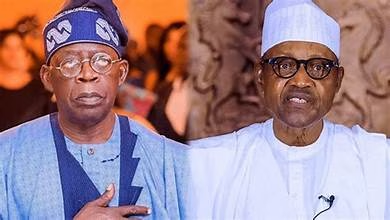
For eight long years under Muhammadu Buhari, and now nearly four under Bola Ahmed Tinubu, the All Progressives Congress has governed Nigeria as a serial borrower that leaves the people poorer, the infrastructure crumbling, and the future mortgaged. The numbers on the poster below are not mere propaganda; they crystallise a brutal reality that no amount of official spin can erase.
Buhari’s administration, operating under the expensive cover of fuel subsidy, piled up roughly ₦83 trillion in debt over eight years while petrol hovered around ₦197 per litre. That was already reckless. Yet Tinubu’s ok government, having loudly proclaimed the end of subsidy on day one, has managed to add a comparable or larger mountain of debt—figures circulating around ₦153 trillion and official totals now pushing past ₦166 trillion—in barely three years and 287 days. Petrol now sells at ₦1,400 a litre. The people pay the higher price at the pump “and” shoulder a heavier debt burden. Where is the development?
This is not fiscal reform. It is fiscal vandalism dressed up as courage.
Under Buhari the debt stock exploded from the relatively modest inheritance of the Jonathan years into the tens of trillions. External debt multiplied several times over; domestic debt ballooned even faster. Ways and Means advances from the Central Bank became a quiet addiction. The promised infrastructure boom never materialised at scale. Power remained epileptic. Roads remained death traps. Hospitals remained under-equipped. Schools remained overcrowded. The security situation deteriorated. Poverty deepened. The “change” mantra dissolved into more of the same elite consumption financed by tomorrow’s children.
Tinubu inherited that toxic legacy and accelerated it. Subsidy removal was sold as the hard but necessary medicine that would free resources for real investment. Instead, the government has continued borrowing at a ferocious pace while the naira collapsed, inflation soared, and the cost of living crushed households. Debt-service obligations now devour a scandalous share of revenue—often half or more—before a single naira reaches schools, clinics, or functional roads. The promised “dividends of reform” remain invisible to the ordinary Nigerian whose transport costs have multiplied, whose food prices have exploded, and whose real income has evaporated.
The defenders of the administration will claim that much of the naira increase is accounting—exchange-rate revaluation of existing external debt and the formal recognition of previous Ways and Means. Fine. Accounting does not build bridges. Accounting does not light homes. Accounting does not create job s. Even after stripping out pure FX effects, the volume of new obligations, the persistence of large fiscal deficits, and the failure to deliver tangible public goods remain damning. A government that removes subsidy, claims higher revenues, and still cannot stop the debt clock from racing is not reforming; it is failing.
Where are the transformative projects commensurate with these borrowings? Where is the reliable electricity that every serious economy takes for granted? Where is the modern rail network, the world-class hospitals, the functional primary healthcare centres in every local government, the quality public schools, the industrial parks that actually employ people? Instead we see selective photo-ops, endless announcements, and a growing army of young Nigerians whose only realistic option is to leave.
The pattern is consistent across both APC presidencies: borrow heavily, spend heavily on recurrent costs and elite priorities, under-deliver on capital projects that would raise productivity, and leave the masses to absorb the pain through higher taxes, higher fuel prices, higher food prices, and a depreciating currency. Debt without corresponding productive capacity is not investment; it is intergenerational theft.
Nigeria does not lack resources or talent. It lacks a governing class that treats public borrowing as a solemn responsibility rather than a political ATM. The APC has had more than a decade in power at the centre. The results—soaring debt, soaring fuel prices, and stagnant or declining living standards—are its indelible signature. History will not remember the slogans. It will remember the empty roads, the dark nights, the hungry homes, and the mountain of obligations left for those yet unborn.
Enough. The books must be opened, the projects audited, the priorities reset, and the cycle of debt without development broken. Anything less is continued betrayal of the Nigerian people. What a country, APC ….

Leave a Reply