
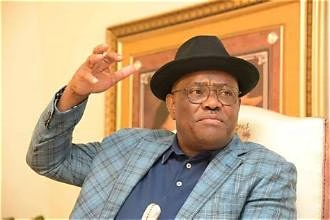
Did Chinua Achebe, the foremost African writer, have Nyesom Wike, the former governor of oil-rich Rivers State and now the Minister of the Federal Capital Territory (FCT), specifically in mind—or was he writing about politicians generally—when he wrote his famous book, A Man of the People?
The question arises not because of Achebe’s devastating portrayal of corruption among the political elite, but from his portrayal of Josiah, the petty thief whose unbridled greed ultimately became his greatest undoing.
Wike is not a petty thief; the connection between him and Josiah would soon be made.
Josiah had spent many years getting away with his shenanigans. He stole, deceived and exploited others with remarkable impunity.
But then he crossed the red line, stealing a blind man’s walking stick, an outrageous act that finally provoked the community into action.
Josiah had not suddenly become a thief; he had simply overreached himself. And in doing so, he learnt, sadly too late, a timeless political lesson that there is often a point at which audacity ceases to be tolerated and becomes the very thing that will provoke outrage and resistance.
The connection between Josiah and Wike is not that the Minister is a petty thief. Far from it. It is the pattern of conduct: the belief that political power can be exercised without caution, and that every boundary can be tested and overcome with greater force.
Josiah’s undoing, like Wike’s, is not that he had suddenly become more audacious; it is that his accumulated excesses eventually crossed a threshold that made continued tolerance impossible.
Clearly Wike’s political audacity has reached a breaking point where it has united the All Progressives Congress (APC) governors, who had hitherto tolerated his excesses, against him.
Since he was thrust into the national limelight, Wike has spent years taking on virtually everyone who crossed his path, including his benefactors.
He also played a significant role in the crisis that destroyed the Peoples Democratic Party (PDP), allegedly following his failure to secure its presidential ticket and Atiku Abubakar’s decision not to choose him as his running mate.
It is an open secret that part of his mandate as minister was to weaken the opposition parties, a task that he accomplished with missionary zeal and with great success.
In return, he was rewarded with enormous power over the political direction of Rivers State and strategically emboldened in his efforts to politically annihilate Governor Siminalayi Fubara, his successor with whom he was locked in a prolonged power struggle.
But, like nzia —the little bird that, after a heavy feast, became so emboldened that it challenged its chi (personal god) to a fight—Wike decided to venture beyond his political territory, meddling in the affairs of other states in ways he would never have tolerated.
While the APC governors had for long tolerated Wike and his trademark brashness, the emergence of his “Rainbow Coalition” appears to have ended what was always an uneasy political relationship.
What might previously have been dismissed as Wike’s familiar political swagger has become, in their view, a direct challenge to their own authority and control of the political structures in their respective states.
The coalition is a cross-party platform through which Wike says he is mobilising support for President Bola Tinubu’s re-election while backing candidates of other parties in governorship and legislative elections.
For the APC governors, however, that arrangement is totally unacceptable: they see support for the President at the presidential level while backing candidates outside the APC at other levels as a threat to the party and its candidates.
Their position, as expressed through the Progressive Governors Forum, led by Hope Uzodimma is that Wike’s support for President Tinubu must extend to APC candidates at the governorship and legislative levels.
It’s Governor Dauda Lawal of Zamfara State that has put the governors’ position very bluntly. “Be on one side. You can’t be on two sides,” he bluntly told Wike, insisting that if the minister was genuinely committed to supporting President Tinubu, he should join the APC and campaign for its candidates. Lawal went further: “It’s either he is in APC or he is out.”
He also promised to raise Wike’s political position with President Tinubu, making it clear that, from the perspective of the APC governors, Wike’s era of political ambiguity had reached its limit.
This is where the Wike matter is becoming particularly interesting. From every indication, his political usefulness that once gave him the considerable leverage appears to have largely diminished. His influence was closely tied to the dirty role he played in the internal crisis that destroyed the PDP, but the political landscape has since changed.
The PDP is no longer the threat that the APC feared; the party is now confronted with challenges from Atiku Abubakar and Peter Obi, whose political movements are the real threat to the party.
Consequently, the political value of keeping Wike within that old equation may no longer be what it once was.
Considering all of these, it is politically unwise for the all-knowing Wike to put President Bola Tinubu in a position where he has to choose between him and the 32 APC governors.
He ought to have backed down. As Governor Lawal has indicated, the matter will inevitably get to the President, and when it does, Wike may find himself asking Tinubu to choose between a political alliance built around him and the governors who control the political structures of their respective states.
That is a difficult position to put any President in, particularly when the dispute concerns the interests of his own party.
Wike may therefore discover that the political leverage he once enjoyed has limits when it comes up against the collective interests of the governors.
As a former governor, Wike ought to know the power that governors wield in Nigeria. Since the return to democratic rule in 1999, governors have gradually emerged as the most formidable political forces in the country.
The transformation of the Nigeria Governors’ Forum, particularly from 2003 onward, strengthened their capacity to act collectively and have their way.
There is ample evidence of the influence they have exercised. In 2010, for instance, the Governors’ Forum flexed its political muscle over the choice of a running mate for President Goodluck Jonathan, who eventually picked Namadi Sambo, then governor of Kaduna State. Even the powerful President Olusegun Obasanjo was not immune to the collective power of governors.
During his administration, governors organised themselves around issues of fiscal federalism and challenged the Presidency in court over the distribution of federal revenues. In one notable confrontation, they successfully challenged Obasanjo’s position on the implementation of constitutional revenue-sharing provisions.
This history is important because Wike is not an outsider when it comes to the powers of the governors. He has been on that same side of the table. He knows what it means for 32 governors to speak with one voice, and he knows that they control political structures, influence delegates, shape party machinery and command substantial grassroots networks across their states that the president would not want to toy with.
It is the consequence of arrogating too much political sagacity to himself and forgetting that he is now playing on a national stage, and not in Rivers State, where the political tradition has often been for an incumbent governor to run his predecessor out of town.
Wike appears to have carried that political style beyond Rivers, assuming that the same political brashness would continue to give him the upper hand. But the circumstances are different. He is no longer dealing with a single political opponent; he is confronting 32 governors who have both a direct stake in the outcome and the institutional and political structures to defend it.
If Fubara had succeeded in running Wike out of Rivers State, Nigeria might have been spared the Wike problem. But politics, as it often does, has apparently convinced Wike that he can continue to ride roughshod over everyone and dictate the terms of every political contest, even when he has clearly lost ground. What Fubara failed to accomplish, the APC governors now appear determined to do. The difference, however, is that Wike is dealing with a determined group of governors who have a common political interest in stopping his influence from extending into their states.
And when that political battle is finally over, Wike may discover, perhaps too late, that he had an exaggerated opinion of his importance.
The APC governors are clearly not in the mood to further indulge him. He poses not just an immediate danger, but a future danger in 2031 with his Rainbow Coalition, which threatens the governors’ control of their political structures and their interests in the 2031 elections.
Like Josiah, the question is not merely whether Wike crossed a line, but whether, in pushing his political influence beyond acceptable boundaries, he has finally crossed a red line that forced Governor Dauda Lawal to tell him: enough is enough. The question, whether Wike has realized that he is engaged in one battle that he stands no chance. Like Josiah, he has definitely reached the point where the accumulation of confrontations has begun to create a broader resistance to him.
Governor Dauda Lawal’s decision to draw a red line against Wike’s so-called Rainbow Coalition—with the apparent support of his fellow APC governors—shows that Wike may finally have encountered the political resistance his accumulated confrontations have been building towards. Like Josiah, the issue is no longer simply how far he can push the boundaries, but whether he has pushed them far enough to unite those who have the political capacity to resist him.
*Emmanuel Ado, a public affairs analyst, writes from Abuja.


Leave a Reply