
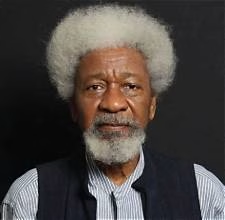
Nobel laureate Professor Wole Soyinka has rejected claims contained in former Head of State General Yakubu Gowon’s recently released memoir that he vowed not to criticise President Bola Tinubu until after the President’s first year in office and subsequently had “Nothing” to say about his administration.
Soyinka described the claim as false, insisting that he had publicly spoken on issues concerning the Tinubu administration and had never undertaken such a vow
He made the clarification in an open letter titled “An Open Letter To A Distressed Priest,” published on October 1, 2026.
Although Soyinka did not name Gowon in the letter, his references were to a recently published memoir which contains claims about him.
The memoir is Gowon’s My Life of Duty and Allegiance, which was publicly presented in Abuja in May 2026.
Bishop Matthew Hassan Kukah wrote the introduction to the memoir and reviewed the book at its presentation.
Soyinka’s letter was addressed to an unnamed “Reverend Aburo”, who, according to the Nobel laureate, had reached out to him and urged him to respond to recent commentaries surrounding his perceived silence on political developments in Nigeria.
Soyinka said he decided to respond through the open letter after concluding that he had already spoken publicly on issues for which he was being criticised.
“The problem is – I have already spoken, so I do not know exactly where their problem lies,” he wrote.
He added: “I repeat – I have already spoken, and clearly, only I remain inaudible, which is hardly surprising.”
According to Soyinka, his decision to speak when and how he chooses should not be interpreted as an obligation to satisfy people demanding his intervention on political matters.
He said he reserved the right to determine “what, when, how, and where” he disseminated his views, provided that they remained accessible to the public.
“I reserve for myself the fundamental right of judgement in choosing what, when, how, and where I disseminate my ideas, only ensuring their accessibility,” he wrote.
Soyinka said the circumstances surrounding different events could also determine the timing of his interventions.
“Even the difference between peace time and conflict, for instance, demands different tempi of reaction and/or initiating commentaries,” he said.
Soyinka Rejects ‘Nothing’ Claim
At the centre of the letter was a passage from the memoir which Soyinka reproduced in full.
The passage stated: “Yet he (Wole Soyinka) vowed not to critique Tinubu until after a year in office. The year has passed, and still, Nothing….”
Soyinka reacted sharply to the claim.
“Nothing? Repeated ad nauseam with smirking, magisterial variations!” he wrote.
He argued that his public record contained evidence that he had spoken on the administration and its actions.
“The contradicting ‘Nothing’ is however on record, widely reported, yet our ‘redeemed’ voice of the people clambers between the publishers’ impressive hard covers, festooned with narcissistic photo display to undermine, even evaporate reality as conveyed in abundance, through the same medium of ink, paper, and cyber, and in real time and details,” Soyinka wrote.
He said he was under no obligation to fulfil expectations created by others about his public interventions.
“Given the environment of Great Expectations, vows, pledges and non-fulfillment, it is necessary to make myself clear – I owe no one,” he said.
Soyinka also said that his silence on some issues should not automatically be interpreted as political endorsement or indifference.
He pointed to what he described as his involvement in the revival of the Public Complaints Commission as an example of work that had occupied his attention.
“You cannot consider a Silence as truly ‘silent’ where it has nonetheless returned VOICE – yes, Capital letters – to, and brought JUSTICE closer for, a large swathe of civil society,” he wrote.
He said such work was currently more in tune with his priorities than repeatedly engaging in political polemics.
“This happens to be attuned to my creative-productive Muse and energies at this stage, than singing the praises of a president, or revving up the old engine to condemn some real or contrived failures for thrill starved mouthers,” he wrote.
Soyinka Challenges Claim On Peter Obi
The Nobel laureate also challenged another claim attributed to him in the memoir concerning Labour Party presidential candidate Peter Obi.
Soyinka reproduced the passage which stated: “In December he declared that Peter Obi was unfit to lead the country and recently insisted that Obi must not run in 2007.”
He said the second part of the statement was false and challenged the author to provide the circumstances surrounding the alleged declaration.
“The lie, of course, is in the second part, set in bold. Kindly enquire of this author the time, place and context of this anti-democratic pronouncement,” Soyinka wrote.
He, however, distinguished between expressing an opinion about a political candidate and claiming that the candidate should be prevented from participating in an election.
Soyinka said he was prepared to explain why voters should support or reject particular candidates, describing such expression as an exercise of a fundamental human right.
He then reproduced another report which stated: “Soyinka was alleged to have said ‘Peter Obi should not be allowed to contest.’”
Soyinka questioned the meaning of the allegation.
“‘Alleged’ of course, the cowardly insurance certificate of fakers! Not be allowed? And who is supposed to stop him?” he asked.
He described the claim as a “transparent, insolent fable” and questioned whether it was connected to strategies surrounding the next election.
Soyinka Refers To Kukah’s Warning
Soyinka subsequently directed his reader to Bishop Kukah, who wrote the introduction to the memoir.
According to Soyinka, Kukah himself had cautioned readers about some of the claims contained in the book.
Soyinka quoted Kukah as writing: “The author (not his real name!)” makes some claims that are at variance with the truth.
Soyinka described the observation as a “priestly euphemism” but said it justified a sceptical examination of the claims attributed to him.
He said the issue went beyond an individual disagreement because, in his view, deliberate distortions of public facts could affect democratic discourse.
“Those who peddle deliberate, self-serving distortions, invent and falsely attribute at will, are conscious agents of imposition – they foreclose nation survival as democratic choice,” he wrote.
Soyinka said such individuals could contribute to division by deliberately distorting political information.
‘Republic Of Liars’
The Nobel laureate also used the letter to announce that he was working on a longer tract dealing with what he described as falsehood in public life.
He said the letter was only a preface to the forthcoming work and described the condition he wanted to address as a “disorder of moral deficiency”.
He wrote: “I urge you to devote some special time of aggressive intensity to a specific spiritual disorder that plagues the dwellers of this land-mass in a frighteningly disproportionate measure to all other nations I have ever visited, heard of, or studied in any depth.”
He then described the country as being at risk of becoming: “a Republic of Liars!”
Soyinka said the longer work would be titled, provisionally, “The Liars’ Progress,” a play on John Bunyan’s Pilgrim’s Progress.
He said the full work would examine what he called “individual fabricators” and the consequences of falsehood in public discourse.
He also criticised what he described as people constantly demanding that he comment on every major political development.
“I am bored stiff with my own voice,” he wrote, adding that repeatedly using the same approach while expecting different results reminded him of a saying attributed to Albert Einstein.
Historical Relationship With Gowon
Soyinka’s response comes against the background of his long and complicated history with Gowon dating back to the Nigerian Civil War.
In 1967, Soyinka secretly travelled to Enugu and met the then Eastern Region military governor, Chukwuemeka Odumegwu Ojukwu, in an effort to encourage dialogue and prevent the escalating conflict.
The Gowon-led federal military government subsequently arrested Soyinka after his return. He spent more than two years in detention without trial during the civil war, much of it in solitary confinement.
His experiences during detention became the basis of his prison memoir, The Man Died, which criticised military rule and state repression.
The two men have, however, subsequently reconciled.
Soyinka’s latest intervention therefore focuses not on reopening that historical dispute but on claims he says are contained in Gowon’s new memoir and the wider public discussion surrounding them.
Soyinka said he considered his October 1 letter only an “overture” to the more extensive work he plans to publish.
“So now, my dear priest, I have spoken – or at least struck some notes as overture,” he wrote.
He said the full work would be released at a later date and described it as a “Birthday Package” for Nigeria.
Soyinka ended his letter by invoking a statement attributed to former Kaduna State governor Nasir El-Rufai: “Silence is the best answer for fools.”
He then added: “Pity. He should have expanded it to read….and LIARS!”

Leave a Reply