
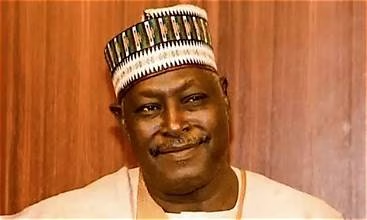
Though defections across political parties are rampant in Nigerian politics, the recent one by former Secretary to the Government of the Federation, SGF, Babachir Lawal, to the Nigeria Democratic Congress has again raised the issue about how politicians find it convenient to shift political bases at will.
Though Section 29(1) of the Electoral Act 2026 provides that political parties are required to submit particulars of their candidates not later than 120 days before an election, the Independent National Electoral Commission (INEC) directed political parties to submit their membership registers by May 10, 2026, ahead of the 2027 general elections which was later extended to September based on a court ruling.
Babachir Lawal had on Tuesday, less than four months to elections announced his membership of a new party.
Though he has been a political associate of Peter Obi since the 2023 elections, his alliance with other politicians on other platforms has made his decision to join the NDC at the time curious.
Pundits are at a loss on how his joining the NDC in Adamawa would play out given the cold war between him and the governorship candidate of the party.
The political differences between former Secretary to the Government of the Federation, Babachir Lawal, and Senator Aishatu Dahiru Ahmed, popularly known as Binani, became one of the issues that shaped developments within the African Democratic Congress (ADC) in Adamawa State.
Reports on the party’s internal affairs showed that the Adamawa chapter became divided into rival camps, with one faction associated with Lawal and another backed by Binani. The disagreement centred largely on the leadership and control of the party structure in the state.
Lawal, who served as the ADC North-East zonal vice-chairman, became a prominent figure in the party’s organisational structure in the region. His political association with former Vice President Atiku Abubakar also became an important feature of the political realignment that followed the formation of the ADC coalition. Atiku publicly supported the faction of the Adamawa ADC leadership associated with Lawal in 2025.
On the other side, Binani and her supporters backed a different leadership arrangement in the Adamawa chapter. The faction associated with her argued for greater adherence to the party’s constitution and called for reconciliation among the various stakeholders.
Binani had also established a significant political profile in Adamawa before joining the ADC. She was the APC governorship candidate in the 2023 election and had a substantial political following in the state. Her subsequent emergence as a leading figure in one of the ADC factions further underscored the competing political interests within the party.
The differences between the two camps eventually contributed to a deeper crisis in the Adamawa ADC. In April 2026, the Binani-aligned faction announced its withdrawal from the party, citing concerns over the conduct of congresses and what it described as a lack of internal democracy.
Commenting on the defections, Alhaji Tijjani Mustapha, a former chairman of the Legacy African Democratic Congress (ADC) in Kaduna State, described Babachir Lawal’s defection from the party as a relief, saying it would allow members to heave “a sigh of relief” within the ADC. He said Lawal had been raising issues and challenging developments within the party, alongside some other members of the coalition, although he stopped short of attributing any improper motive to his actions.
Mustapha said the development would enable the ADC to concentrate on strengthening its structures and pursuing its political objectives ahead of the 2027 general elections. He maintained that differences of opinion were part of democratic politics, but suggested that Lawal’s departure could reduce some of the internal disagreements that had characterised the party in recent times.
However, chairman of the Northern Christian Association (NCA), Rev. Joseph Hayab, said every citizen had a constitutional right to belong to any political party of his or her choice, stressing that political defection did not begin with Lawal. According to him, several frontline presidential aspirants in the 2027 general elections have changed political parties at different times since the return to democratic rule in 1999.
Hayab said defection could raise questions of political or moral judgment, but was not, in itself, a crime under Nigerian law or in democratic politics generally. Also reacting, a former Secretary-General of the Arewa Consultative Forum (ACF), Anthony Sani, described Lawal’s movement from one political party to another as a manifestation of what he called the typical Nigerian political experience.
He noted that former Vice President Atiku Abubakar and Peter Obi had also moved between political parties at different times, arguing that their experiences were not fundamentally different from Lawal’s in this respect.
Sani attributed the frequent movement of politicians between parties to what he described as the absence of clearly defined ideological differences among Nigeria’s major political parties. He argued that, as a result, many politicians tend to choose platforms they believe can provide a viable route to electoral success rather than making their choices primarily on the basis of which party they believe can deliver better governance.
Babachir is not a newcomer to Nigeria’s turbulent political landscape as he shot into national prominence as one of the politicians who helped build the political coalition that eventually produced the All Progressives Congress, APC in the build up to the 2015 elections.
He was associated with the Congress for Progressives Change, CPC, the platform on which Muhammadu Buhari contested the presidency, before becoming part of the APC coalition and served as the APC North-East Vice Chairman and became Secretary to the Government of the Federation when Muhammadu Buhari won the 2015 presidential election.
His tenure as SGF, however, ended in controversy as he was suspended in April 2017 following allegations concerning contracts under the Presidential Initiative for the North-East, PINE, and was eventually removed from office in October of that year though he denied wrongdoing.
Lawal’s political relationship with the APC subsequently became increasingly strained before the 2023 presidential election as he strongly opposed the decision of then APC presidential candidate, Bola Ahmed Tinubu, to select Kashim Shettima, also a Muslim, as his running mate.
Lawal described the Muslim-Muslim ticket as a serious political mistake and argued that it could deepen religious divisions.
He eventually left the APC and became one of the most prominent northern voices opposing the party’s direction.
Our correspondent notes that as activities for the 2027 elections commenced, he aligned with former vice president Atiku Abubakar who was then in the PDP.
When Atiku and other PDP big wigs moved to the ADC, Babachir moved with them in the new alliance giving him another platform from which to criticise the ruling party and participate in opposition politics. The romance with the ADC chieftains however did not last as he was said to be having it difficult putting up structures in his home state.
On June 1, 2026, Lawal resigned from the ADC following the party’s presidential primary that produced former Vice-President Atiku Abubakar as its candidate.
He openly declared in a television interview that he supported Mohammed Hayatudeen for the presidential ticket of the party.
In his resignation statement, he alleged that the primary process had been manipulated in favour of Atiku and his supporters, claiming that results had been altered and that, in some instances, declared winners were replaced.
Three months later, he has now joined the NDC and openly endorsed its presidential ticket of Peter Obi and Rabiu Kwankwaso for the 2027 election.
This time, Lawal gave a fairly clear explanation for his decision. He said his concern was the suffering of Nigerians, citing insecurity, economic deprivation, hunger, ignorance and disease. He argued that Nigerians genuinely concerned about the country’s condition should support the NDC ticket.
The NDC leadership, however, welcomed Lawal as an experienced political organiser and mobiliser. National Leader, Senator Seriake Dickson, said Lawal would play a leadership role in the party’s activities and campaigns in the North-East and assist with its operations in the North-Central zone.
Whether Nigerians ultimately regard these successive realignments as principled political choices or as another example of the fluidity of elite politics will depend largely on whether the positions he now espouses remain consistent when political circumstances change.

Leave a Reply