
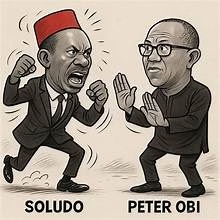
As controversy persists over former Anambra Governor Peter Obi’s claim that he left zero debt, stakeholders say inheriting liabilities alongside assets is a normal feature of governance.
Globally, public debt has become an important means of financing development. Other sources of funding, such as raising domestic revenue, improving spending efficiency, reducing corruption and creating a more conducive business environment, often take time to yield results and may still be inadequate to meet governments’ financing needs.
This explains why many governments borrow, particularly from multilateral financial institutions such as the World Bank and the International Monetary Fund (IMF). Such loans are often concessional, carrying relatively low interest rates and, in some cases, zero interest, making them an important source of funding for development projects.
However, public borrowing also comes with obligations.
When a state government is unable to service its debts, the burden may ultimately fall on the Federal Government where the loans are federally guaranteed.
But what happens when a government official considers debt an absurdity—or fails to disclose outstanding obligations?
That question has become central to the controversy surrounding the record of Peter Obi, presidential candidate of the Nigeria Democratic Congress (NDC) and former governor of Anambra State.
Obi, who governed the South-east state from March 17, 2006, to March 17, 2014, has been in the news over his claim that he left Anambra without debt at the end of his tenure.
His handover note showed a positive balance of more than N86 billion, but made no reference to outstanding loan obligations allegedly incurred by previous administrations.
The administration of Governor Chukwuma Soludo, however, has presented documents showing that Anambra had outstanding loans with a combined balance of $92.35 million, equivalent to N127.37 billion, as of June 30, 2026.
The state government said it was still servicing loans obtained by previous administrations, including those of Obi and his successor, Willie Obiano.
Obi’s camp has rejected the interpretation, arguing that the loans in question were multilateral, highly concessional development credits extended through institutions such as the World Bank’s International Development Association (IDA) and the International Fund for Agricultural Development (IFAD) to the Federal Government.
With both sides presenting different interpretations of what constitutes state indebtedness—and what should have been disclosed at the point of handover—the controversy has raised broader questions about public debt, transparency and fiscal responsibility.
To put the claims and counterclaims in proper perspective, experts were asked to examine the nature of the loans, who legally bears responsibility for them, and whether describing a government as having left “zero debt” is consistent with outstanding obligations of this nature.
DMO’s position/statistics
When contacted, Director-General Debt Management Office (DMO), Ms. Patience Oniha, said: “I am not validating your data.
If an external loan is facilitated by the FGN for a state, the debt will be included in the debt stock of the state.”
Her explanation followed enquiries on whether such concessionary loans should be classified as debt for receiving state.
According to Oniha, any loan facilitated by the Federal Government for a state will automatically form part of the state’s debt stock.
In a report on its website, the DMO said Nigeria has adopted international debt practices, with the Federal Executive Council approving Nigeria’s Medium-Term Debt Management Strategy (MTDS) for 2024 – 2027.
The MTDS is a tool developed by the World Bank and the IMF for managing public debt and is widely accepted.
The key objectives of the MTDS are to meet the government’s financing needs and payment obligations in the short to medium term, taking into consideration the costs and risks trade-offs in the debt portfolio; to achieve optimum composition of the public debt portfolio that ensures debt sustainability; and to further deepen the domestic securities market through the introduction of new products.
The preparation of the MTDS usually involves considering alternative funding strategies available to the government as it seeks to meet its financing needs, taking into account the cost of borrowing and associated risks while ensuring debt sustainability over the medium to long term.
In preparing the MTDS, the DMO collaborated with other stakeholders in the monetary and fiscal space.
The DMO also received technical support from the World Bank and the IMF.
Views from other experts
Managing Director, Economic Associates, Dr. Ayo Teriba, said state governments need federal guarantee to borrow from external bodies like the IMF, World Bank, Africa Development Bank, among others.
He said that before a state in Nigeria can go into major financial contract with external bodies, the Federal Government and all relevant agencies including the Ministry of Finance, Debt Management Office, the Central Bank of Nigeria, Securities and Exchange Commission will be involved.
He said all IMF, World Bank support for states are received through the Federal Government by the states.
The Federal Government then deducts the fund through FAAC allocations until the repayment is completed.
He said such loans are tagged Official Development Assistance or donor funds.
Other sources of funding for the country are foreign direct investment and foreign portfolio investment.
He said: “Federal Government can refuse accepting such loans, but state governments cannot refuse to take the loans; it can only refuse to draw down the funds.
But which state governor will refuse such loans meant to develop the state?
Teriba said that even letters of credit are guaranteed by the Federal Government for businesses, but that does not make such loans Federal Government loans.
The Federal Government only guarantees such loans in case of default. He reiterated that donor agencies usually follow their loans to ensure execution.
Former Registrar, Chartered Institute of Bankers of Nigeria (CIBN), Dr. Uju Ogubunka, said it is surprising for Obi to say he left no debt during his tenure as governor.
He explained that governance is a continuum, and it is wrong for Obi to say he left no debt.
“If someone is in a position of authority, he will one way or the other leave some debt unless such person is not sincere. It can also be a matter of communication gap between both parties.
Firstly, even as a private individual, you still have some debts. If you borrowed money, you have to pay provided they are genuine debts. It does not demand condemnation of denial.”
Ogubunka, further explained: “if one borrows money with 20 years tenor, and was in office for five years, and paid mandatory N100 million required per annum, until the end of his tenure, if he kept to the repayment terms, you can also say that you left no debts, but that does not mean that the state had no debts.”
He stated that everything remains politics, as both parties understood themselves but only feigning ignorance on the position of the other party.
In his X post, Dr. Yunusa Tanko published Obi’s handover note to former Governor Obiano, challenging other past governors to do same.
The handover report dated March 17, 2014 had over N86.6 billion in net balance.
But in a Facebook post, Anthony Ogedengbe explained that incurring a loan is not the same as embezzlement.
He wrote: “There is no crime in passing down liabilities to a successor alongside assets.
Dragging the EFCC into a routine handover of assets and liabilities is just a distraction. DMO is there to confirm it.
Debt is a standard outcome of administration, and boasting that you left zero debt behind is dishonest.”
Allegations against Obi
Anambra State Commissioner for Information & Value Reformation, Law Mefor, said the state government is focused 100 per cent on delivering dividends of democracy to the people of Anambra.
He said: “However, when a former governor of the state makes some outlandish claims about the state of public debt he left behind and especially when the present government has been spending billions of naira servicing the same debt, a responsible government owes the public a response in the interest of transparency and accountability. We have no time to join issues. We will simply state the facts here for the records.”
Mefor said that Obi spent about $4.05 billion (equivalent to N5.4 trillion at current exchange rate) in eight years and also contracted US$ 123.77 million in external debt alone which the present administration has so far paid billions of naira in service payments.
He said: “Let’s be clear: hardly any government in the world has zero debt stock. The issue is not whether or not borrowing is good: no business or government can scale significantly without some debt. Yes, we converted the audited and published expenditures using the average official exchange rates during the eight years of HE Peter Obi and they sum to about US$4.05 billion.
“At the current official exchange rate, it would sum to about N5.4 trillion and he surely governed to the best of his ability. Of course, no government will ever finish the work of development. HE Peter Obi still left a state without any functioning urban or rural water schemes; increasing insecurity and increased poverty, ostensibly dead public schools and dead public hospitals with grossly inadequate teachers and medical personnel (indeed 44 per cent of all communities in Anambra, 78 out of 179) did not and still do not have any public primary schools (and this administration is only beginning to close the gap), decrepit infrastructure with huge urban slums, etc. Only about 27 per cent of Anambra residents patronised public health institutions because of poor quality and non- functionality.
“As of June 30, 2026, the total balance of such loans left by HE Peter Obi at the official exchange rate stood at N127.4 billion.
The summary of latest report from the DMO on Anambra’s debt status (as of June 2026), indicates the dates the loans were signed and the balance remaining.
The loan summary showed that $9,467,700.00 Malaria Control Booster Project loan signed in 2007 has $4,482,405.27 outstanding as at June 30, 2026 (N6,182,062,526.38).
The $7,179,281.90 Third National Fadama Development Project signed in 2009 has $4,373,315.32 outstanding as at June 30, 2026 (N6,031,607,390.96).
The $4,124,992.56 Health System Development Project loan signed in 2009 has outstanding of $2,043,022.18 on June 30, 2026 (N2,817,703,910.91).
The $4,429,327.10 Malaria Control Booster Project loan signed in 2009 has $3,170,939.96 as at June 2026 (N4,373,310,291.98).
“The $48,333,333.00 State Education Programme Investment loan signed in 2013 with $37,343,825.28 (N51,504,013,793.74) pending.
The $4,842,500.00 Community And Social Development Project loan signed in 2009 with $3,702,152.85 (N5,105,950,716.70).
The $37,894,044.74 Nigeria Erosion And Watershed Mgt Project signed in 2013 has $34,862,521.14 (N48,081,838,328.45) outstanding.
The $7,500,000.00 Value Chain Development Project loan signed in 2013, with N2,375,000.00 (N3,275,562,475.00) outstanding. This brought the total loan position to $123,771,179.30 with $92,353,182 (N127,372,049,434.12) outstanding as at June 30, 2026.”
Mefor also said that Obi owed verified salaries, gratuity, and pension to retired teachers and staff of water corporation.
“HE Peter Obi made very strong statements about clearing all inherited arrears of pensions, salaries and gratuities.
That claim is patently false. We do not want to get into the debate between him and his predecessors regarding which arrears were paid by them or by him.
Our administration has cleared about N22 billion in inherited gratuity arrears of retired state and local government employees and teachers. However, there are still legacy arrears which have lingered since the time of HE Peter Obi.
“First, there are the arrears of salaries to staff of defunct water corporation, which lingered throughout HE Peter Obi’s tenure, culminating in court processes and judgments. It is this administration that has negotiated a settlement and already paid the first two instalments of the agreed three instalmental payments.
Second, there are arrears of salaries, pensions and gratuities owed to primary school teachers under the local government system during the Gov Mbadinuju’s tenure.
“The attention of our administration has recently been drawn to these lingering arrears.
We have been informed that the government of HE Peter Obi verified and certified the debt of 16 months of salary arrears and agreed to pay in tranches. It only paid five months and no more until today.
This administration has set up a committee headed by the Head of Service to finalise a new verification for us to pay.
Finally, we do not wish to be drawn into the nebulous creative accounting that generated the phantom N75 billion ‘savings’ or ‘investment’ which the previous administration has vigorously disputed,” he said.
In defence of Obi
When contacted, Obi’s media aide, Dr. Valentine Obienyem, said the state government’s attempts to weaponise DMO records by claiming that Anambra State inherited or left behind external debt obligations totaling $92,353,182.00 (or N127.37 billion as of 30 June 2026), while vaguely alleging cumulative borrowings.
What we witnessed is mischaracterising concessionary multilateral credits as reckless borrowing. He added: “Today, the former Director-General of the DMO, Dr. Abraham Nwankwo, will tell you that it was only Peter Obi who never visited him to lobby for state borrowings or bond issuances.
When you look at the astronomical sums borrowed by his contemporaries – many of whom achieved far less – the contrast leaves you completely perplexed.”
According to Obienyem, the former Managing Director of the Bank of Industry, Ms. Evelyn Oputu, can attest that Obi was the first governor who proactively visited her to discuss how the bank could support industrialists in the state, with many local entrepreneurs ultimately benefiting from that partnership.
Similarly, Dr. Ngozi Okonjo-Iweala will readily confirm that Obi was the lone governor who consistently championed fiscal savings and economic prudence during national meetings.
“The administration lists eight specific external borrowing programmes initiated under Peter Obi – including the Malaria Control Booster Project, Fadama III, Health System Development Project II, State Education Programme Investment Project (SEPIP), Community and Social Development Project (CSDP), NEWMAP, and the Value Chain Development Project – and paints them as reckless liabilities. Lumping multilateral development grants and concessionary credits together with commercial bonds or high-interest short-term loans is a fundamental category mistake.
“Let it be noted that, regarding three of the projects—State Education Programme Investment Project (SEPIP), Community and Social Development Project (CSDP), and NEWMAP – Obi did not draw down on them until after he left. Was it not under SEPIP that teachers and ministry staff were junketing all over the globe, including Singapore under Obiano. The drawdown was between Obiano and Soludo. I challenge him to print the details and make them public, how the funds were drawn.
“These eight programmes were not commercial loans strictly so called secured for overhead or political patronage. They were multilateral, highly concessionary development credits extended by global institutions like the World Bank/IDA and IFAD to the Federal Government, designed to inject vital developmental capital into critical human and infrastructure sectors. Furthermore, as official records prove, these agreements, many signed in late 2013, just months before Obi’s exit, were in their inception or upstream phases.
“Let’s take one example and see what happened. The political debate surrounding public debt in Anambra State has brought the Nigeria Erosion and Watershed Management Project (NEWMAP) to the forefront, exposing a glaring contradiction in Governor Charles Soludo’s narrative regarding former Governor Peter Obi.”
Continuing, he said characterising NEWMAP as a reckless commercial loan taken by Obi distorts the reality of how multilateral development financing works, given that the financing was structured as an International Development Association (IDA) sovereign credit extended to the Federal Government of Nigeria rather than an independent commercial loan acquired by the state government, carrying exceptionally favourable terms, including a long-term moratorium period before principal repayment began and near-zero interest rates.
“Public records should be allowed to speak for themselves.
If there are debts, let the specific debts be identified; if there are liabilities, let the dates, purposes, amounts and beneficiaries be stated; if there were unpaid obligations, let them be itemised and traced to the administration that incurred them.
Equally, if there were savings, investments, completed projects and development programmes, they should not be erased because they complicate a convenient political narrative,” he stated.

Leave a Reply