
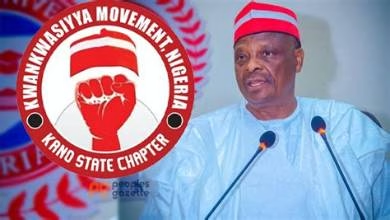
In recent times, only a few political movements in Nigeria have had the kind of mass appeal Kwankwasiyya had in Kano State. Borne out of the fiery popularity of a former governor of Kano State, Rabiu Musa Kwankwaso, the group, which later became synonymous with red cap as its trademark, once symbolised loyalty, discipline and grassroots mobilisation.
From the streets of Kano to the corridors of Abuja, Kwankwasiyya became more than a political brand; it metamorphosed into a movement promising to upend a perceived old order that did not sit well with the people.
But our correspondents report that since inception, the movement has not faced the kind of challenges it is currently facing. The challenges include wave of defections by some of its most prominent chieftains, including a sitting governor, serving senators and Rep members. Long‑time allies of the leader have raised questions on whether the movement can still command the kind of dominance that delivered nearly a million votes in Kano during the 2023 elections.
According to political watchers in Kano, as defections mount and alliances shift, the story of Kwankwasiyya may not be a recast of its past triumphs but how it adjusts to new realities
“It is about survival, reinvention and whether Kwankwaso himself can once again marshal the loyalty of Kano political base in the face of growing fragmentation,” a keen observer of the movement said.
Using the challenges as a basis, the All Progressives Congress (APC) in Kano openly declared that the end of an era for the popular political movement in the state was near. Its supporters, however, insist that their popularity is connected to voters, and has never been influenced by political positions.
Sani Adakawa, a Kano resident who is conversant with the development, believes the defections are a sign of fatigue within the movement, adding that it may affect its performance in 2027.
“Kwankwaso has been in politics for decades. Some of his people want to try their luck elsewhere. It is normal. But it will surely reduce his influence in Kano come 2027. There is no way he will lose such a number of big names and say it won’t affect him, no matter how little,” he observed.
But Yusuf Usman, another resident, downplayed the defections as opportunism “These politicians are only thinking of themselves. Kwankwaso gave them positions, but they have abandoned him. We, the ordinary people will not betray him like that. We will show them our anger in ballot box,” he said.
Meanwhile, Bashir Aliyu, a commercial driver, was more cautious when he said, “Kwankwaso is still strong in Kano, no doubt, but politics is about numbers and alliances. If he cannot keep his big men together, it may be hard to repeat what happened in 2023.”
Kabiru Adamu Kofar Ruwa, a founding member of Kwankwasiyya and close associate of the former governor for nearly 29 years, told our correspondent in an interview that the movement had lost its way, adding, “Even the Nigeria Democratic Congress (NDC) they now rely on is not a true opposition party. They don’t even have the guarantee to contest elections.”
Why many associates left Kwankwaso
The defections in the Kwankwasiyya camp in recent months did not come as a surprise to many. To analysts, they reflect a mix of personal ambitions, political calculation and frustration with Kwankwaso’s uncompromising style of leadership.
In 2023, the then Kwankwasiyya-led New Nigeria Peoples Party (NNPP) won the Kano governorship seat, two senatorial seats, 16 out of 24 House of Representatives seats, and more than two-third of the state House of Assembly seats.
But the governor, two senators and more than half of the federal and state lawmakers have left the movement for the All Progressives Congress (APC).
Governor Abba Kabir Yusuf, who was once Kwankwaso’s protégé, has increasingly sought to assert his independence in Kano’s political space.
His allies argue that the governor cannot continue to be seen merely as an extension of Kwankwaso’s political family, especially as he faces the realities of governance and the need to build his own coalition.
Senators like Rufai Hanga, Kawu Sumaila, Kabir Gaya and federal lawmakers like Abdulmumin Jibrin, Kabiru Alhassan Rurum, among many others, also left the movement, citing disagreements with Kwankwaso’s strategy and his alleged refusal to align with larger national parties.
For some, moving to platforms like the African Democratic Congress (ADC) and later, the NDC, is seen as limiting their political prospects.
Abdulmumin Jibrin, once a key mobiliser for Kwankwasiyya, similarly broke ranks, arguing that the movement had become too rigid and unable to accommodate diverse ambitions. At a recent function in his constituency, he even boasted that Kwankwasiyya would not make any impact in 2027 after losing most of its foot soldiers, saying the APC won’t leave even a seat to any party in the state.
Underlying these departures is a deeper tension: Kwankwaso’s insistence on maintaining Kwankwasiyya as a disciplined, almost cult‑like movement, which clashed with personal ambitions of his lieutenants.
Many of them believe that without integration into Nigeria’s dominant parties, their chances of securing national relevance are slim. Others complain that Kwankwaso’s style of leadership leaves little room for negotiation or compromise, making it difficult for allies to chart their own paths.
The defections have raised questions on whether Kwankwasiyya can survive as a cohesive force. While Kwankwaso’s grassroots appeal remains strong, the loss of high‑profile figures has weakened the movement’s reach in Abuja and beyond.
Balarabe Mairiga, a Kano resident who said he had been following political events in the state, however, dismissed claims that the movement had lost it, saying defections are not new in Nigerian politics.
“Politicians always move where their interests are protected. But Kwankwaso is different; people like us will follow him anywhere because he has helped the poor more than any other leader,” he insisted.
Another resident, Habiba Abdullahi, argued that the defections may weaken Kwankwasiyya’s structure but not its spirit.
“Most of the youths wear the red cap proudly. Even if big names leave, Kwankwaso still has the masses behind him as he has never used them to win elections,” she said.
The NDC VP ticket
When Kwankwaso turned down overtures from the APC after the 2023 elections, he did not retreat from the national stage; instead, he sought alternative platforms that would allow him to preserve the identity of Kwankwasiyya, while still projecting its influence beyond Kano.
His first stop was the African Democratic Congress, where he briefly tested the waters. One of his associates revealed that it was after sensing the looming leadership crisis in the party that he again moved to the Nigeria Democratic Congress.
It was within the NDC that Kwankwaso secured a vice presidential ticket with Peter Obi, a move that underscored his determination to remain relevant in national politics.
For his supporters, it is a proof that Kwankwaso could negotiate power outside Nigeria’s dominant parties. For his critics, however, it is a sign of political restlessness of a leader unwilling to compromise with the ruling establishment but also struggling to find a stable national platform.
The decision to align with the NDC gave Kwankwaso a fresh stage, but it has also deepened divisions within his camp, questioning whether the Kwankwasiyya movement’s future lies in smaller parties or needs to return to the mainstream political party.
The popular taunt among Governor Yusuf’s supporters is that Kwankwaso attended national congresses of three parties in just three months, a condition they said Yusuf’s migration to APC has prevented, arguing that they could not imagine a Kano governor approaching election without a definite platform in mind.
Can Kwankwasiyya repeat the 2023 feat?
Due to all the issues the 2027 elections have thrown up, Kwankwaso’s ability to reenact his 2023 feat in Kano is now under serious scrutiny.
The nearly one million votes he delivered under the NNPP were not just a reflection of his personal popularity but of a tightly knit Kwankwasiyya machine that mobilised across wards, cooperatives and youth networks. That cohesion is now fraying.
Without the structures and influence of Kwankwaso’s former lieutenants like Governor Yusuf, Abdulmumin Jibrin, Rufai Hanga, Kawu Sumaila, Kabiru Rurum and others, replicating the scale of mobilisation that stunned the APC and the Peoples Democratic Party (PDP) in 2023 becomes more difficult, as their movement has reportedly weakened the organisational backbone of the movement and Kwankwaso’s appeal.
However, analysts believe that Kwankwaso’s grassroots mystique remains intact. His red cap symbolism, his Talakawa rhetoric and his history of bouncing back from defeats continue to resonate with ordinary Kano voters.
The challenge is no longer whether he can inspire loyalty but whether he can translate that loyalty into votes without the full machinery of his former allies.
Analysts argue that Kwankwaso’s future strength depends on two factors: whether he can rebuild alliances beyond Kano to give Kwankwasiyya national relevance, and whether he can keep the movement disciplined enough to withstand fragmentation.
The numbers from past elections show resilience, but the defections reveal vulnerability. If Kwankwasiyya cannot reconcile these tensions, the 2023 landslide may prove to have been its high‑water mark rather than a foundation for future victories.
Expectations for the NDC alliance
The expectations when Kwankwaso joined the NDC and subsequently accepted to be the running mate to Peter Obi who had emerged as the party’s presidential candidate, was that he was going to come with the full complement of his political machine, the bulk of which were in the Kwakwasiyya Movement.
The calculation was that since the duo put up good showings in the 2023 general elections in what was their first outing as presidential candidates, bringing them together under one platform would harness such votes.
Obi had in the 2023 elections, running on the platform of the Labour party, polled 6,100,833 votes while Kwankwaso, then of the New Nigeria Peoples Party polled NNPP = 1,487,187against Bola Tinubu of the APC’s 8,805,655 votes while Atiku Abubakar of the PDP polled 6,984,285
The 2023 votes of Obi and Kwankwaso put together would have been 7, 588,020.
Added to that, Mr Obi won in Edo, Cross River, Delta, Lagos, FCT, Plateau, Imo, Ebonyi, Nasarawa, Anambra, Abia and Enugu states while Kwankwaso won in only Kano State.
But observers say the enthusiasm anticipated may be far from reality due to how Kwankwaso particularly is losing his henchmen to other parties and that so many other things may threaten that projection.
Despite defections, Kwankwaso still commands followership in Kano – Prof Fage
A Kano-based political analyst, Professor Kamilu Sani Fage, has cautioned against dismissing Kwankwaso’s influence in Kano despite the wave of defections from his Kwankwasiyya movement.
He argued that those leaving Kwankwaso to join the ruling party are driven largely by selfish political interests rather than ideological differences.
Fagge, who also lectures Political Science at Bayero University Kano (BUK), said it’s not unusual for Nigerian politicians to defect from one party to another in pursuit of personal ambitions and Kwankwasiyya loyalists are no exception.
He recalled that Kwankwaso himself had switched parties several times: from the PDP to APC, ADC, and now, the NDC, adding that the former governor masterminded APC’s defeat in Kano during the 2023 elections, producing the state governor, two senators and majority of federal and state lawmakers on the platform of the NNPP, which he only joined in 2022.
He, however, noted that Kwankwaso had since lost those allies, except a handful of lawmakers.
“Almost always, elected political officeholders and other politicians are motivated by personal interests rather than principles or ideologies,” Fage said, stressing that defections and betrayals are part of Nigeria’s political culture.
He, however, insisted that Kwankwaso’s political strength should not be underestimated, maintaining that despite defections, Kwankwaso still commands a cult‑like followership, particularly among youths who “would blindly follow him to his political destination without questions.”
He, however, acknowledged that the governor’s defection and the exit of other lawmakers had weakened Kwankwaso’s influence, while his current role as NDC’s vice presidential candidate may prove a liability given the difficulty of selling the party’s presidential flag-bearer to the wider electorate in the state.
How Kwankwasiyya started
Kwankwasiyya was borne out of Kwankwaso’s bid for political survival, but it later grew into one of the most formidable movements in Kano politics. From available records, its roots are traced to 2007 when the Peoples Democratic Party lost power in the state and many feared mass defection.
Kwankwaso’s close associates, including Dr Rabiu Sulaiman Bichi, who later became his Secretary to the State Government in 2011, and Prof Hafiz Abubakar, who later became Ganduje’s deputy in 2011, began to craft a strategy to keep his loyalists together.
From small meetings in homes and offices, the movement expanded rapidly, mobilising Kano’s youth as its backbone, with a template of promoting values of good governance, politics without bitterness and self‑reliance.
Over time, Kwankwasiyya’s grassroots appeal and populist message transformed it from a survival mechanism into a political brand that would dominate Kano’s electoral landscape for years to come till the red cap became synonymous with the movement and was adopted as a symbol of discipline, loyalty and solidarity, giving the group a visible identity and rallied supporters around Kwankwaso during his political isolation.
Drawing inspiration from the populist philosophy of Malam Aminu Kano, Kwankwasiyya positioned itself as a voice for the masses, with Kwankwaso promising to “make the son of nobody become somebody” through education, empowerment and social inclusion.
How the movement fared in 2019, 2023
Kwankwasiyya’s rise from a survival movement to a political powerhouse was most visible at the ballot box. From the declared results of various elections, the movement, then under the PDP, reclaimed Kano after an eight-year rule of the defunct All Nigeria People Party (ANPP), and saw the second coming of Kwankwaso as governor after an eight-year break. Same in 2015 when Abdullahi Ganduje, who was then with Kwankwaso, won Kano governorship under the APC with over a million votes.
In 2019, the red cap brigade also proved its strength when Kwankwaso’s loyalists rallied behind the PDP candidate, Abba Kabir Yusuf. The contest was fierce, with the APC deploying its full machinery to retain Kano.
Although the election ended in controversy, with the Kwankwasiyya-backed candidate, Yusuf, losing after a supplementary poll, the movement demonstrated its ability to mobilise hundreds of thousands of votes and shake the ruling party’s dominance in the state as it led the first poll before it lost out in the controversial rerun.
By 2023, the movement had matured into a formidable electoral force. Kwankwaso himself contested the presidential election under the New Nigeria People’s Party, and in Kano, he delivered one of the most stunning results of the season.
The NNPP swept the state with nearly a million votes, eclipsing the tallies of both the APC and PDP. Yusuf, Kwankwaso’s then protégé, rode on the wave of Kwankwasiyya’s grassroots mobilisation to clinch the governorship, cementing the movement’s grip on Kano politics.
The 2023 elections also revealed Kwankwaso’s national relevance. Courted by the APC in the build‑up to the polls, he resisted joining them, choosing instead to chart an independent course with the NNPP.
His decision underscored both his stubborn streak and his confidence in Kwankwasiyya’s capacity to deliver votes.
The feat of winning Kano by such a wide margin confirmed that the movement was not just a local faction but a political phenomenon capable of altering national calculations.
Kwankwaso’s electoral performance in Kano since 1999
Kwankwaso’s electoral journey in Kano has been marked by both triumphs and setbacks, each shaping the mystique of Kwankwasiyya.
He first burst onto the scene in 1999, winning the governorship under the PDP and cementing his reputation as a grassroots politician. Four years later, in 2003, he was swept aside by Ibrahim Shekarau of the ANPP, a defeat that forced him to rethink his strategy and rebuild his base.
By 2011, Kwankwaso staged a dramatic comeback, reclaiming the governorship with a narrow but decisive victory, a proof that his movement had matured into a formidable force.
Even when he was not on the ballot, Kwankwaso’s influence remained visible. In 2015, he moved to the APC and won a Senate seat, showing that his hold on Kano’s voters could be transferred to different platforms.
But with defections now narrowing his ranks, the question is whether he can still marshal the same grassroots energy that once delivered Kano by such a wide margin.
The history of his electoral record shows resilience and an ability to bounce back, but it also underscores the risk of fragmentation at a time his movement faces its sternest test.

Leave a Reply