
As campaigns for presidential and National Assembly elections commenced, major political parties have, as part of their strategies towards winning the 2027 elections, devised means of targeting key states that would give them the leverage in the January presidential election.
Nineteen parties are fielding candidates for the 2027 presidential election, but the All Progressives Congress (APC) is the first to unveil its presidential campaign council, which has a former governor of Zamfara State, Abdulaziz Yari as its director-general.
Although the party’s list is being ‘adjusted’, the initial composition reveals an attempt to capture the zones with the highest number of votes in the leadership of the council.
As the other parties are in the process of putting up their campaign structures, inside sources in many of the parties said the pattern might not be different from what the APC had done: bringing people from key states other than the ones the presidential candidates and their running mates hail from.
It’s a blessing being a Nigerian – Chief Isaac Shaahu
Subsidy: Between Tinubu, Atiku, Obi
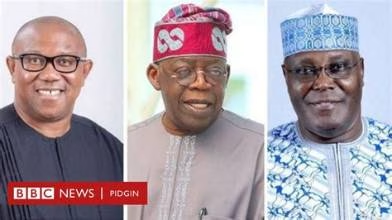
For the major parties, the APC has president Bola Ahmed Tinbu from Lagos State as its presidential candidate with Vice President Kashim Shettima from Borno as his running mate; the African Democratic Congress (ADC) has a former vice president, Atiku Abubakar from Adamawa as presidential candidate with Rotimi Amaechi from Rivers as his running mate. For the Nigeria Democratic Congress (NDC), a former Anambra State governor, Peter Obi, is the presidential candidate, pairing with a former governor of Kano State, Rabiu Musa Kwankwaso, while in the Social Democratic Party (SDP), it is Ademola Adewole from Ondo State. His running mate is Usman Bugaje from Katsina.
The Peoples Redemption Party (PRP) has a former governor of Cross River State governor, Donald Duke as presidential candidate and Buba Musa as the vice presidential candidate, while the Allied Peoples Movement (APM) has the governor of Oyo State, Seyi Makinde as its presidential candidate and former director-general of the Department of State Security, Lawal Daura from Katsina as his running mate.
There’s also Sandy Onor from Cross River as the presidential candidate of the Peoples Democratic Party (PDP), with Umaru Babangida from Adamawa as his running mate. Omoyele Sowore from Ondo has the presidential ticket of the African Action Congress (AAC), contesting with Magashi Haruna Garba from Kano as his running mate
The 19 presidential candidates are drawn from the six geopolitical zones in the country – six from the South-West, four from the North-West; four from the South-East; two from the South-South; three from the North-East and one from the North-Central.
INEC updated voters register indicates Lagos State as having 7,060,195 registered voters; Kano State, 5,921,370; Kaduna State, 4,335,208; Rivers State ,3,537,190 and Katsina State, 3,516,719.
A political analyst, Prof Atah Pine of the political Science Department of the Benue State University, Makurdi, however, said that in an election, every vote matters in a democracy; hence it is out of place for aspirants to be selective in the choice of where they concentrate their campaigns.
He said, “The greater interest of politicians should be to galvanise and mobilise supporters. But you can see that their major focus is basically on states that would give them larger numbers.”
Prof Pine explained that by the Nigerian constitution, a candidate must have two thirds of the votes of the whole country to be declared winner.
“Even if Rivers, Kano, Kaduna etc give you the numerical strength, if you don’t have the spread, the election does not meet the constitutional requirements. That is why I said it is misplaced to think that emphasis should be on states with numerical superiority of voters,” he stated.
The professor advised that the emphasis should be to mobilise the voters to come out en masse to vote for candidates based on the manifesto they are presenting because each manifesto matters and each vote matters. The majority of the voters in the 2026 election are going to be younger persons.
“The emphasis for anybody contesting the election should be how to garner as much support as possible so that one can get the spread across the 36 states of the federation and now win the general elections,” he said.
The Kaduna State governor, Uba Sani, said on Thursday that President Bola Ahmed Tinubu would win in his state as many things had changed since the last election. He said Tinubu’s votes would increase from 29 per cent to 70 to 80 per cent in 2027 because of the litany of political realignments that had altered the voting pattern in the state.
In the 2023 presidential election, former Vice President Atiku Abubakar defeated Tinubu in the state, polling 554,360 votes while Tinubu scored 399,293 votes.
“Kaduna is not like other states. We are highly educated. Our people do not believe in politicians coming to say, ‘I will do this, I will do that’ without explaining how they will do it,” Gov Uba Sani said.
Our correspondents who felt the pulse of the electorates across various states report on the factors that would determine who gets what in the key states in the presidential election.
Kano: NDC, APC to test might
Kano State is once again emerging as one of the most critical battlegrounds in the contest for northern votes. With its vast population, deep political traditions and history of swinging outcomes, the state is expected to play a decisive role in shaping the electoral map.
Kano’s importance lies not only in sheer number of electorate but also in its symbolic weight. The state has consistently delivered millions of votes in past elections, making it a prize every major party covets.
In 2019 and 2023, Kano was among the states that determined the overall trajectory of the presidential race. As 2027 approaches, the stakes are even higher, with parties and candidates already positioning themselves to capture the loyalty of Kano’s diverse electorate.
The political terrain in Kano in 2027 will clearly be a two-horse race. On one hand, the ruling All Progressives Congress will seek to consolidate its base, leveraging incumbency and federal presence. On the other hand, opposition parties, particularly the Nigeria Democratic Congress (NDC) will aim to exploit local grievances and build on Kwankwasiyya grassroots structures in the state.
The NDC, buoyed by the influence of former governor and vice presidential candidate of the party, Rabiu Musa Kwankwaso, remains a formidable force, especially in urban centres and among the youth.
On the other hand, parties such as the African Democratic Congress and the Peoples Democratic Party (PDP), though weakened in recent cycles, still retain pockets of support among some communities and among some people in the state.
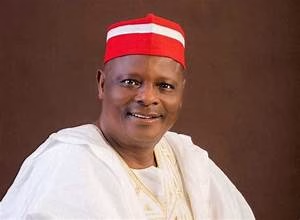
In 2023, Kwankwaso, who then contested under the New Nigeria People’s Party (NNPP), polled close to one million votes, while President Tinubu got over 500,000 votes. Many believed that Kwankwaso’s contest greatly affected Atiku Abubakar of the then PDP’s poor performance in the state, with many saying that in 2027, the battle is likely going to be hot among Tinubu, Peter Obi (due to Kwankwaso’s influence) and Atiku of the ADC.
However, beyond party structures, Kano’s electorate is influenced by religious leaders, traditional institutions and civil society groups.
The role of clerics and community leaders in mobilising opinion cannot be underestimated. In past elections, endorsements or subtle cues from influential figures swayed large blocs of voters.
As campaigns intensify, both ruling and opposition parties will seek to court these voices, knowing their impact on grassroots mobilisation.
Another factor is demographics. Kano’s youthful population, many of who are first‑time voters, represents both an opportunity and a challenge. While they are increasingly vocal about unemployment, education and economic opportunities, they are also likely to be influenced by popular opinion and social media campaigns.
Therefore, the battle for Kano’s votes in 2027 will be fierce, multi‑layered and unpredictable. It would not be decided solely by party manifestos but a combination of grassroots mobilisation, elite bargaining and the ability to address everyday concerns of ordinary citizens.
Katsina: Resolving internal crisis in APC matters
Katsina is also shaping up as one of the most important northern battlegrounds in the 2027 presidential election. The race for the presidency in the state is not yet formally settled as parties are still completing their processes and the campaign window has just begun.
However, major contenders can be assessed based on their 2023 performance, current party structures, endorsements, political alliances and the strength of political structures in the state.
According to Hashim Ibrahim of the Democratic Solutions Network, President Bola Ahmed Tinubu may have the strongest political structure in Katsin despite the internal crisis currently facing the All Progressives Congress over unresolved differences between the state governor and one of the president’s aides from Katsina.
Ibrahim explained that the APC controls the governorship and virtually the entire elected political structure in the state, adding that Governor Dikko Radda and Katsina APC stakeholders formally endorsed Tinubu for a second term in February 2026.
According to him, Tinubu presently has the advantage of Governor Radda’s political machinery, the Buhari-era APC networks and the state’s traditional APC grassroots structures. He, however, added that a caveat should be taken seriously: In 2023, Tinubu narrowly lost Katsina to Atiku, polling 482,283 votes against the former vice president’s 489,045.
Nonetheless, Atiku Abubakar is still regarded as a serious challenger to Tinubu, given that he won the state in 2023.
According to Ahmad Muhammad Wali of the African Peace Initiative Network, Atiku’s main evidence of strength in Katsina is his 2023 performance. He explained that Atiku also had a longstanding PDP network in the state and considerable northern political connections.
Wali explained that Atiku’s major problem for 2027 could be organisational weakness and opposition fragmentation within his party.
However, analysts in Katsina believe that despite Peter Obi’s move in picking Kwankwaso as running mate, his 2023 performance in the state was extremely weak. Peter Obi’s only 6,376 votes, compared with Atiku’s 489,045 and Tinubu’s 482,283 can’t turn the table.
Findings have shown that even with Kwankwaso’s 69,386 votes in 2023, their combined standing in Katsina remains weak. According to a Katsina-based political commentator, Malam Shehu Buhari Chake, an Obi/Kwankwaso ticket could still pull surprises if the party does the needful in the state, adding that as it stands, the party’s presence in Katsina is weak.
Information made available shows that there were 3.5 million registered voters in Katsina in 2023.
Kaduna: One of Atiku’s strongholds, but…
Kaduna State had 4.33 million registered voters in the last validated voters’ register, while 92,505 new registrants were recorded in the third phase of INEC’s 2025–2026 Continuous Voter Registration (CVR) exercise as at July 17, 2026.
Atiku Abubakar of the Peoples Democratic Party (PDP) won Kaduna State in the 2023 presidential election with 554,360 votes, ahead of Bola Ahmed Tinubu of the APC, who polled 399,293 votes, while Peter Obi of the Labour Party (LP) came third with 294,494 votes.
Haruna Ibrahim Nasarawa, a Kaduna-based political analyst, said there was a possibility that the ADC presidential candidate for the 2027 election, Atiku Abubakar, could repeat history by winning Kaduna State as he did in the 2023 general elections.
According to him, current political activities suggest that the former vice president may win the state due to several factors, particularly his recent move to promise the restoration of fuel subsidy, which he said made him more popular among residents.
“If you recall, in the 2023 general elections, the former vice president defeated the current president in Kaduna by a wide margin, especially in zones 1 and 2, where the majority of the residents are farmers.
“In Zone 3, the southern part of the state, Peter Obi, then the Labour Party presidential candidate, won. But there is a tendency that voters in Kajuru and Chikun local government, who voted for the LP, may turn to another party, especially the ADC due to some factors linked to tribe and religion.
“I think the ADC presidential candidate is likely to repeat history by winning the election because of the economic policies he has promised to restore. This could make most of the people in those communities, who are mostly farmers and poor want to support him because they are among those most affected by the removal of fuel subsidy,” he said.
Rivers: Obi, Tinubu to run neck and neck
As the presidential candidates of different political parties scheme to secure the votes of Rivers State, several developing factors may contribute to who would win the state.
The three dominant presidential candidates in the race frequently discussed by the people in the state are President Bola Tinubu of the APC, Peter Obi of the NDC and Atiku Abubakar of ADC.
Checks by our correspondent indicate that Peter Obi is very popular among the voters in the state, especially the younger population, who believe that the political structure of the state should be taken away from the grip of the Minister of the Federal Capital Territory (FCT), Nyesom Wike and his rainbow coalition, who are working for the re-election of President Tinubu.
Also, the ADC candidate, Atiku Abubakar, will also garner votes from the state, at least to meet up the 25 per cent spread, especially with his running mate and former governor, Rotimi Ameachi, who hails from the state.
Weekend Trust observed that Amaechi’s factor and ADC’s decision to zone governorship ticket to Ogoni tribe in the state would also boost the chances of the presidential candidate of the party.
An APC chieftain in the state who declined to be named told our correspondent that most Rivers people were against the overbearing influence of Nyesom Wike in the politics of the state, saying the party would still win all the elections in the state.
The total number of registered voters in the state during the 2023 general elections stood at 3,689,197.
During the 2023 presidential election, President Bola Tinubu won the state with a slight margin over Obi, who contested on the platform of Labour Party.
Tinubu polled 231,591 votes to defeat Obi, who polled 175,071 votes, Atiku scored 88,468 votes and Rabiu Musa Kwankwaso polled 1,322 votes.
A pro-democracy advocate and political analysts, Comrade David-West Beniwarie David, told Weekend Trust that the chances of the ruling APC in Rivers State may not be as high as they assume because of the changing landscape of politics of the state.
He said the contest between Obi and President Tinubu would be very strong as the people of the state are also suffering from the hardship experienced during the present government, adding that the declaration of state of emergency in the state may also work against President Tinubu’s chance.
He said: “The 2027 presidential election in Rivers State is not going to be as easy as the ruling party, the APC, thinks it is going to be. With all their paraphernalia of office and everything in their favour, I don’t think it would be very easy for them because Rivers people are considering to liberate themselves.
“The NDC, from what I observed, is also pulling a very big string. I don’t think the ADC would perform very well in Rivers State because of the zoning arrangement and the belief that power must remain in the South for the next four years. The NDC will give APC a very big challenge.
“It is going to be a very strong contention, particularly the presidential election. It will be very strong. And you will not rule away money, voter intimidation, inducement and harassment. Election has not started and we have started seeing where they are burning houses of opposition party members. It happened in Ikwerre Local Government Area. The house of one of ADC members was burnt and his properties destroyed for no reason.
“We have started hearing executive order here and there, to the extent that a local government chairman was telling some people that they would not hold a rally in his local government without paying N7 million. Those things are uncalled for. But that notwithstanding, Rivers people will take their decision. And I believe it would not just be a ‘carry go’ for the APC.
Rivers people are also suffering the same thing Nigerians are suffering, so it will not be easy for the Rainbow Coalition in Rivers State. People will also take into consideration the state of emergency he declared in Rivers State,” he said.
Lagos: Can 2023 repeat itself?
In the 2023 election, Labour Party’s Peter Obi caused an upset in Lagos State, defeating the then APC candidate and current president, Bola Tinubu on his home turf.
According to official results, Obi won Lagos with 582,454 votes. Tinubu came second with 572,606 votes. PDP’s Atiku Abubakar was third with 75,750 votes, while Rabiu Kwankwaso of the NNPP came fourth with 8,442 votes.
Obi’s win came as a surprise as the state is a stronghold of Tinubu, who was expected to easily win the state.
Tinubu is a former governor of Lagos State and is known as a political godfather and kingmaker in the state.
In the buildup to the election, Obi’s campaign attracted young and urban voters. However, many believe he won in Lagos because of what they called the “politics of ethnicity.”
A veteran journalist and Atiku’s loyalist, Dele Momodu, said Obi won Lagos State during the 2023 presidential election because of the ‘preponderance of Igbo people in Lagos.’
“The major factor was ethnic: the Labour Party was able to take over the APC behemoth because of the preponderance of Igbo people in Lagos. They are everywhere,” Momodu told Channels Television.
The 2023 general elections in Lagos State marked a high point of ethnic polarisation, transforming local contests into intense identity-based struggles, primarily between Yoruba and Igbo communities.
The political landscape shifted dramatically when the Labour Party presidential candidate defeated the ruling APC candidate in Lagos, galvanising non-indigenous voters, particularly residents of Igbo descent and shaking the long-standing political dominance of the incumbent establishment.
In 2024, the Kukah Centre (TKC), a Nigeria-based policy research institute, expressed concern at a forum organised to review the outcome of the 2023 election in Lagos – it was hugely defined by division and the politics of identity, especially in Lagos.
Ahead of the 2027 elections, analysts believe that ethnicity would also play a major role in the voting pattern in Lagos State.
Just as what played out in 2023, the major contenders for Lagos votes are Obi, who is now the presidential candidate of the NDC, and Tinubu, who is seeking re-election. Atiku, who is now the candidate of the ADC, is also expected to give a good fight. If the much-talked-about coalition against the incumbent comes to fruition, Lagos may again fall into the hands of an opposition party in the presidential election.
But keen watchers believe that it would be difficult for Tinubu as the incumbent president to lose in Lagos. A divided opposition is to the advantage of the president. If Obi, Atiku and other major opposition candidates run separately, anti-Tinubu votes could again be split. Nationally, analysts are already pointing to opposition fragmentation as a major advantage for Tinubu.
There are also allegations of the suppression of the Igbo group ahead of the next election in Lagos. In July, Igbo leaders under the auspices of the Igbo Leaders of Thought (ILT) condemned an alleged systematic suppression of the opposition ahead of the 2027 general elections.
The group, made up of southeastern Nigerian intellectuals, traditional rulers and stakeholders, warned that the clampdown on the opposition, if not urgently curbed, could derail plans for the upcoming general elections and seriously undermine the integrity of the poll’s outcome.
Meanwhile, the NDC has expressed confidence that the political circumstances that produced Obi’s victory in Lagos State during the 2023 presidential election could pave the way for another upset in 2027.
Bamofin Ladipo Johnson, the NDC senatorial candidate for Lagos Central, said the party was building structures across the state to consolidate the political momentum generated by Obi’s 2023 performance.
Johnson said the outcome demonstrated that Lagos voters were willing to move beyond traditional political loyalties when presented with an alternative they considered credible.
According to him, the NDC is seeking to build on that changing political consciousness ahead of the 2027 elections by establishing structures at the ward and polling-unit levels across the state.
He said the party had also sustained engagement with residents through community outreach, online town hall meetings and voter education, adding that the activities had helped the party understand the concerns of different groups.
Johnson said the party’s confidence was also driven by the economic challenges confronting Nigerians, including rising food prices, transportation costs, inflation and pressure on household incomes.
The NDC candidate said the state’s expanding population had produced a diverse electorate comprising young professionals, entrepreneurs, students, skilled workers and residents from different parts of the country.
He argued that many of these voters were less influenced by traditional patronage networks and more concerned about employment, infrastructure, transparency and accountability.
But the Presidency dismissed claims that Obi poses a political threat ahead of the 2027 general elections, insisting that the Tinubu administration is focused on governance and confident of victory.
The Special Adviser to the President on Media and Public Communications, Sunday Dare, made the remarks during an interview on the Mic On Podcast with Seun Okinbaloye, where he said the administration’s achievements had placed it in a strong position ahead of the next presidential poll.
“This government is not afraid of Peter Obi. He is not a nightmare to our government. Maybe before, Peter Obi was a threat, but right now, he is no threat because we stand on the solid ground of performance,” Dare said.
He said the Tinubu administration had identified the country’s key challenges and continued to roll out policies and programmes aimed at tackling them, while pointing to its record in office as evidence of progress.
“We have been able to interrogate the problems of this country. Decisions are being taken, policies are being unfolded across the country, and we have a scorecard to show,” he added.

Leave a Reply