
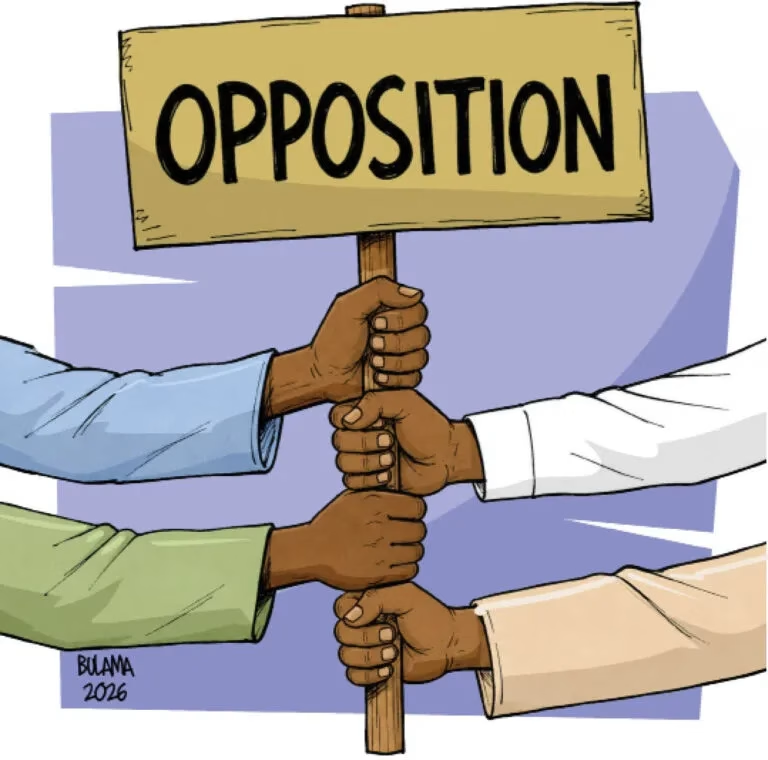
Since the idea of opposition political parties coming together to adopt a common candidate for the 2027 presidential election resurfaced within the week, the question has been how the proposal can be put into practice, especially given the acrimony that attended the primaries of most of the parties.
Recall that prior to the presidential primaries of the six political parties, said to be currently sold to the idea of adopting a common candidate, most of them were together but left at different stages due to disagreements.
Our correspondent reports that the national chairman of the African Democratic Congress, David Mark, its presidential candidate, Atiku Abubakar, the presidential candidate of the Nigeria Democratic Congress (NDC), Peter Obi, his running mate, Rabiu Musa Kwankwaso and others, were all in the same camp and had agreed to work together before they parted ways.
Even after the split, the bid to have a broader platform by including the Peoples Redemption Party (PRP), the Allied Peoples Movement (APM) and Social Democratic Party (SDP) absorbed into the other parties did not sail through.
On Tuesday, a group known as the G-100 reintroduced the idea of the opposition parties coming together again to adopt a common candidate despite previous botched attempts.
Along that line, the group is proposing a Summit of Opposition Political Parties. It was earlier scheduled for Tuesday, August 18 but has now been shifted to Monday, August 31, 2026.
A statement by the convener, Salihu Mohammed Lukman, explained that the summit is to provide a structured platform for the parties to begin the necessary conversations on the modalities for achieving greater opposition unity.
The parties involved are the African Democratic Congress (ADC), Allied Peoples Movement, Nigeria Democratic Congress, Peoples Democratic Party, Peoples Redemption Party and the Social Democratic Party.
Lukman said the shift in date followed consultations with the six participating political parties and members of the Minority Caucus of the House of Representatives.
He said that over the past several days, the G100 had held extensive engagements with the leadership and principal stakeholders of the six participating opposition parties, as well as members of the Minority Caucus of the House of Representatives, and the consultations have been ‘frank, substantive and encouraging.’
“We have been particularly encouraged by the seriousness with which the parties have approached these conversations and the energy behind the deliberations. There is a clear recognition across the different parties that this is an important moment for Nigeria’s democracy; and that the opposition must begin to engage one another with greater purpose and structure.
“What we have enjoyed most about these consultations is their candour. There are differences, as there should be, but there is also a genuine willingness to listen, interrogate the available options and explore practical areas of cooperation. The quality of the conversations gives us confidence that the August 31 summit can be both substantive and consequential,” Lukman said.
He said the G100 would use the intervening period to continue consultations with the participating parties and other relevant stakeholders; and to further develop the proposals and frameworks that would be presented for consideration at the summit.
As the opposition continues consultations, sources in the parties say a major point of disagreement has remained the issue of who will step down for the other if a coalition if formed.
All the six political parties that are talking have their presidential candidates, running mates and national chairmen. So who will concede his position to the other,’ said a member of one of the parties who does not want to be named.
What has changed?
The convener of the summit had earlier explained that the opposition now realised the risk of going into 2027 the elections separately.
He said, “Across these conversations, there has been a clear recognition of the need for Nigeria’s opposition parties to work more closely together ahead of the 2027 general elections, adding that the leaders have also acknowledged that achieving a credible and effective opposition would require sacrifice, compromise and a willingness to place the larger interests of the country above narrow partisan or individual considerations.
He added that the group is now working with the representatives of the parties to finalise modalities and arrangements for the summit while intending to make “the process deliberate, inclusive and anchored on mutual respect, recognising that sustainable political cooperation cannot be imposed, but must be patiently negotiated and collectively owned.”
Parties are willing but waiting for clarification
All the parties mentioned – the ADC, NDC, SDP, PRP, APM, PDP and some of their presidential candidates – have expressed willingness to be part of the process towards having a sole presidential candidate.
The NDC said the party and its presidential candidate, Peter Obi, would be participating in the proposed opposition coalition talks.
The national publicity secretary of the party, Ossai Director, told Weekend Trust that the party was ready.
‘”As I said earlier, the opposition parties will be stronger if they coalesce into one party. Therefore, the NDC is not opposed to the possibility of the opposition coming together,’” he said.
He, however, insisted that such proposition must take into consideration the strongest and most popular of the presidential candidates to lead it, adding that the NDC and its flag bearer is the most visible option for the opposition parties.
Another chieftain of the party who craved anonymity, however, doubted the workability of the proposed coalition, saying most of the politicians in the arrangement are selfish.
He said, ‘”We tried this at the party formation level and it did not work for selfish ambitions, is it now that all the contestants have gotten their parties and the electoral body nod that will work?” He asked.
To him, those in the opposition are not ready to wrest power at the centre.
He added: “Look at what happened during Jonathan’s time, the major opposition blocks, the ACN, the CPC and others came together to form the APC, and together, they fought the administration to a standstill until they wrested power from Jonathan. The present opposition parties are not ready to make the sacrifice like those in the opposition like President Bola Tinubu did.”
SDP presidential candidate also confirms consultation
The Social Democratic Party also confirmed that the G-100 group consulted its leadership as part of efforts to forge greater cooperation among opposition parties ahead of the 2027 general elections.
The party’s presidential candidate, Prince Adewole Adebayo, disclosed this on Friday in response to inquiries by Weekend Trust on the ongoing consultations and the planned opposition summit scheduled for August 18.
Adebayo said the G-100 had contacted the party and held a meeting with its leadership, adding that the party listened to the group and offered its views on the initiative.
“They contacted us and met with SDP leadership as a whole. We listened to them attentively and gave our candid advice, while wishing them all the best in their quest,” Adebayo said.
He added that the SDP remained committed to a united Nigeria and multiparty democracy, saying the party would not oppose efforts capable of advancing democracy and promoting national unity.
“We are committed to Nigeria and will not be a stumbling block to anything that can advance democracy and unite all Nigerians,” he said.
However, Adebayo did not state in his responses whether he would personally attend the summit or willing to withdraw his presidential ambition in favour of another candidate if opposition parties eventually agree on a consensus candidate.
Challenges of one presidential candidate
Our correspondents report that the opposition lack the presence of governors to give the talks the necessary bit.
So far, only two governor -, Seyi Makinde of Oyo and Bala Mohammed of Bauchi – out of 36 – could by the virtue of their belonging to one of the political parties in the alliance be said to be with the coalition.
While Makinde, who is the presidential candidate of the APM, had in the past spoken in favour of adopting a common presidential candidate for all the opposition parties, Mohammed has not been that vocal since he left the PDP.
The ruling APC, on the other hand, has 31 governors and seems to be sitting comfortably with an unprecedented high number that seems to be against the opposition.
Analysts said while the opposition has five governors, at least two of them – Charles Soludo of Anambra and Ademola Adeleke of Osun – have openly identified with the presidential candidate of the ruling party, even as Adeleke is fighting hard to retain his governorship seat.
Apart from Makinde, who is expected to be at the meeting, there is no indication that the other opposition governors would attend.
Analysts who spoke with our correspondent also pointed out the fact that there is internal wrangling within the opposition, with many of its members bearing grievances over the conduct of the respective primaries in their states.
A former Director-General of the Department of State Security, Lawal Daura, only recently left the ADC for the APM due to internal squabbles.
There is also internal rift within the Adamawa state chapter of the ADC, which is Atiku’s home base, where there’s alleged plan to substitute the party’s governorship candidate owing to disagreement between the former vice president and former Secretary to the Government of the Federation, Babachir Lawan, who left the party.
Sources said the bigger challenge is that the parties have already conducted their primaries and elected their presidential candidates and running mates; hence may not be susceptible to negotiations.
An analyst recalled that why it was easier for the APC as its formative stages to make the presidential aspirants work together was because it was agreed on a common primary with the agreement that whoever wins should be supported.
But as it is, the candidates have gone far and have emerged in their various parties; hence asking them to step down for another would be difficult because even their supporters would not agree.
How the Ibadan summit resolution fizzled out
In April, leaders of opposition political parties had converged on Ibadan, the Oyo State capital and had similarly resolved to present a united front by fielding a single presidential candidate for the 2027 general elections.
The resolution formed part of a communiqué issued at the end of the National Opposition Political Parties Summit.
But immediately after the summit, the opposition figures who were battling court cases and other issues of political survival jettisoned the idea.
A Second Republic politician who was very close to former Governor Abubakar Rimi, who doesn’t want his name to be mentioned, confided in our reporter that ego and personal ambition may affect the success of the current movement.
He recalled how similar attempt during the Second Republic was not successful as the parties then had different ambitions and focus.
On the current attempt at an alliance, he said, “If all of them are really serious about displacing APC, they won’t leave their previous parties and join smaller ones separately. We were all together on one platform; they should all come back if they are honest.
“And if they said the PDP, which they once belonged to, failed, and the APC, which they also once entered, has equally failed, what are they doing differently if they are elected now?” He asked.
He recalled that the Second Republic political parties were more ideological than the present ones, arguing that it may be difficult for any of the candidates to step down and support another.
“If at all they knew a day would come that they would need to work together, why disperse in the first place?” He added.
‘Atiku, Obi’s alliance alone won’t defeat Tinubu in 2027’
Dr Kabir Umar Musa Yandaki of the Political Science Department, Umar Musa Yar’adua University, Katsina, is skeptical about the alliance.
He said any political alliance restricted only to former Vice President Atiku Abubakar of the ADC and NDC presidential candidate Peter Obi would not be enough to unseat President Bola Ahmed Tinubu in the 2027 general elections.
According to Yandaki, the chances of defeating the incumbent administration remain very slim unless all major opposition figures in Nigeria, including figures like Rabiu Kwankwaso and Goodluck Jonathan, put aside their differences to forge a broader coalition.
He, however, noted that orchestrating such a massive merger would be exceptionally difficult.
Citing historical precedent, Yandaki argued that deep-seated political dynamics, shaped by Nigeria’s past, made a northeastern political axis a hard sell to the electorate.
He pointed to the enduring political fallout from the January 15, 1966 coup, which claimed the lives of prominent northern leaders, arguing that it created historical divisions that still influence voting behaviour in contemporary northern Nigeria.
While acknowledging past exceptions, such as the 1979 ticket of Shehu Shagari and Alex Ekwueme, Yandaki maintained that the current political landscape made it unlikely for voters in the North to readily back a joint ticket where the presidency or leadership core is shared with the South-East without deep reservations.
The analyst compared the current opposition’s challenges to the successful 2015 coalition of the All Progressive Congress that brought the late President Muhammadu Buhari to power.
That historic merger, he noted, succeeded largely because of a powerful alliance between northern politicians and western political heavyweights, led by Tinubu himself, bolstered by Buhari’s immense personal integrity.
“I don’t think there is any politician today that has half of Buhari’s integrity to make the merger happen the way it did then,” Yandaki noted.
For the opposition to pose a credible threat in 2027, Yandaki reiterated that a much wider, all-encompassing coalition was mandatory, although the likelihood of achieving it remains low.
Opposition coming together might be too late – Ojo
A public affairs analyst and development consultant, Dr Jide Ojo, has said the time for opposition to come together and challenged the ruling All Progressives Congress might already be late.
Ojo said that although one cannot say ‘never say never in politics, he thinks it is rather too late, noting that campaign officially starts for presidential and National Assembly elections on Wednesday, August 19, and the G100 are proposing a summit for August 18, which would be the last day for withdrawal from the race.
“That window for you to substitute candidates will close on 18th, so if they want to now push forward one candidate, who will step down for who? The loyalists of Atiku Abubakar feel he has bigger national acceptance than Peter Obi. But his people feel Obi is more marketable than Atiku Abubakar,” he said.
He also faulted the capacity of the G100 to actually deliver on their plans, but adding that those that have their names as members of G100 are not really political heavyweights. “You are talking of Professor Anthony Killa, Salihu Lookman, who has never won any election. And I have not seen any serving governor, serving senator, serving House of Representatives member on that list. But they are claiming to be G100,” he said.
He said even the Allied People’s Movement, presidential candidate, Seyi Makinde, who hinted about opposition working together during their convention in Bauchi, also announced a new running mate to replace the placeholder in former DG of DSS Lawal Daura.
“So, if they are still doing all of that instead of actually announcing who is withdrawing from the race, I don’t know what is going to happen next. Like what is happening in Osun in the last few days, you have seen a number of candidates saying that they are withdrawing from the race and they are endorsing one person or the other. The APM candidate said he was withdrawing to endorse Governor Adeleke.
“The PDP candidate said he was withdrawing from the race to endorse Adeleke. But these people knew what the law says if you want to withdraw from the race. Why did they not make it when the sun shined? Why did they have to put themselves on the ballot first?
“Coalition has not worked. Alliance has never worked. What has only worked in Nigeria thus far is issue of merger. As far as they didn’t have the grace of merger like APC was able to do in 2013, I think they have missed their chance by now,” he stated.
He added that the group is now working with the representatives of the parties to finalise modalities and arrangements for the summit while intending to make “the process deliberate, inclusive and anchored on mutual respect, recognising that sustainable political cooperation cannot be imposed, but must be patiently negotiated and collectively owned.”
Parties are willing but waiting for clarification
All the parties mentioned – the ADC, NDC, SDP, PRP, APM, PDP and some of their presidential candidates – have expressed willingness to be part of the process towards having a sole presidential candidate.
The NDC said the party and its presidential candidate, Peter Obi, would be participating in the proposed opposition coalition talks.
The national publicity secretary of the party, Ossai Director, told Weekend Trust that the party was ready.
‘”As I said earlier, the opposition parties will be stronger if they coalesce into one party. Therefore, the NDC is not opposed to the possibility of the opposition coming together,’” he said.
He, however, insisted that such proposition must take into consideration the strongest and most popular of the presidential candidates to lead it, adding that the NDC and its flag bearer is the most visible option for the opposition parties.
Another chieftain of the party who craved anonymity, however, doubted the workability of the proposed coalition, saying most of the politicians in the arrangement are selfish.
He said, ‘”We tried this at the party formation level and it did not work for selfish ambitions, is it now that all the contestants have gotten their parties and the electoral body nod that will work?” He asked.
To him, those in the opposition are not ready to wrest power at the centre.
He added: “Look at what happened during Jonathan’s time, the major opposition blocks, the ACN, the CPC and others came together to form the APC, and together, they fought the administration to a standstill until they wrested power from Jonathan. The present opposition parties are not ready to make the sacrifice like those in the opposition like President Bola Tinubu did.”
SDP presidential candidate also confirms consultation
The Social Democratic Party also confirmed that the G-100 group consulted its leadership as part of efforts to forge greater cooperation among opposition parties ahead of the 2027 general elections.
The party’s presidential candidate, Prince Adewole Adebayo, disclosed this on Friday in response to inquiries by Weekend Trust on the ongoing consultations and the planned opposition summit scheduled for August 18.
Adebayo said the G-100 had contacted the party and held a meeting with its leadership, adding that the party listened to the group and offered its views on the initiative.
“They contacted us and met with SDP leadership as a whole. We listened to them attentively and gave our candid advice, while wishing them all the best in their quest,” Adebayo said.
He added that the SDP remained committed to a united Nigeria and multiparty democracy, saying the party would not oppose efforts capable of advancing democracy and promoting national unity.
“We are committed to Nigeria and will not be a stumbling block to anything that can advance democracy and unite all Nigerians,” he said.
However, Adebayo did not state in his responses whether he would personally attend the summit or willing to withdraw his presidential ambition in favour of another candidate if opposition parties eventually agree on a consensus candidate.
Challenges of one presidential candidate
Our correspondents report that the opposition lack the presence of governors to give the talks the necessary bit.
So far, only two governor -, Seyi Makinde of Oyo and Bala Mohammed of Bauchi – out of 36 – could by the virtue of their belonging to one of the political parties in the alliance be said to be with the coalition.
While Makinde, who is the presidential candidate of the APM, had in the past spoken in favour of adopting a common presidential candidate for all the opposition parties, Mohammed has not been that vocal since he left the PDP.
The ruling APC, on the other hand, has 31 governors and seems to be sitting comfortably with an unprecedented high number that seems to be against the opposition.
Analysts said while the opposition has five governors, at least two of them – Charles Soludo of Anambra and Ademola Adeleke of Osun – have openly identified with the presidential candidate of the ruling party, even as Adeleke is fighting hard to retain his governorship seat.
Apart from Makinde, who is expected to be at the meeting, there is no indication that the other opposition governors would attend.
Analysts who spoke with our correspondent also pointed out the fact that there is internal wrangling within the opposition, with many of its members bearing grievances over the conduct of the respective primaries in their states.
A former Director-General of the Department of State Security, Lawal Daura, only recently left the ADC for the APM due to internal squabbles.
There is also internal rift within the Adamawa state chapter of the ADC, which is Atiku’s home base, where there’s alleged plan to substitute the party’s governorship candidate owing to disagreement between the former vice president and former Secretary to the Government of the Federation, Babachir Lawan, who left the party.
Sources said the bigger challenge is that the parties have already conducted their primaries and elected their presidential candidates and running mates; hence may not be susceptible to negotiations.
An analyst recalled that why it was easier for the APC as its formative stages to make the presidential aspirants work together was because it was agreed on a common primary with the agreement that whoever wins should be supported.
But as it is, the candidates have gone far and have emerged in their various parties; hence asking them to step down for another would be difficult because even their supporters would not agree.
How the Ibadan summit resolution fizzled out
In April, leaders of opposition political parties had converged on Ibadan, the Oyo State capital and had similarly resolved to present a united front by fielding a single presidential candidate for the 2027 general elections.
The resolution formed part of a communiqué issued at the end of the National Opposition Political Parties Summit.
But immediately after the summit, the opposition figures who were battling court cases and other issues of political survival jettisoned the idea.
A Second Republic politician who was very close to former Governor Abubakar Rimi, who doesn’t want his name to be mentioned, confided in our reporter that ego and personal ambition may affect the success of the current movement.
He recalled how similar attempt during the Second Republic was not successful as the parties then had different ambitions and focus.
On the current attempt at an alliance, he said, “If all of them are really serious about displacing APC, they won’t leave their previous parties and join smaller ones separately. We were all together on one platform; they should all come back if they are honest.
“And if they said the PDP, which they once belonged to, failed, and the APC, which they also once entered, has equally failed, what are they doing differently if they are elected now?” He asked.
He recalled that the Second Republic political parties were more ideological than the present ones, arguing that it may be difficult for any of the candidates to step down and support another.
“If at all they knew a day would come that they would need to work together, why disperse in the first place?” he added.

Leave a Reply