
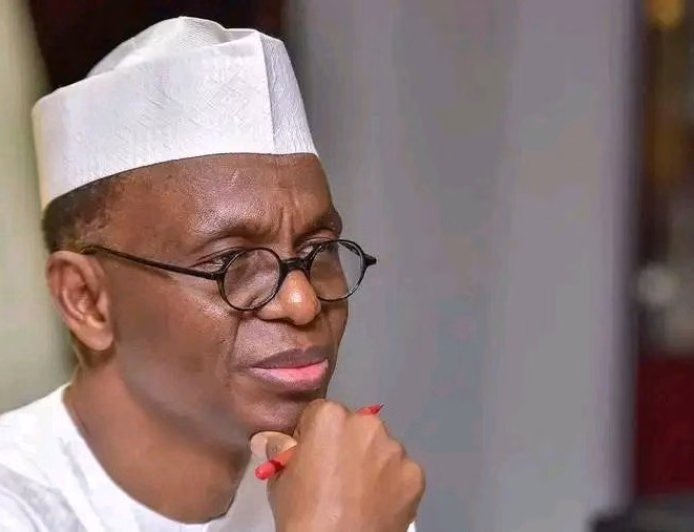
Ex-Governor El-Rufai’s Wife Appeals To International Community, Says Husband’s 150-Day Detention Threatens Rule Of Law
Asia Ahmad El-Rufai, a lawyer and wife of former Kaduna State Governor, Nasir El-Rufai, has appealed to the international community to intervene over what she described as her husband’s prolonged detention.
She argued that his continued incarceration represents “punishment before trial” and poses a threat to Nigeria’s democratic institutions.
In a public statement issued to mark what she described as the 150th day of El-Rufai’s detention and published on the African Report, Asia said she was speaking “not as a politician, lawyer or diplomat, but as a wife, a mother and a Nigerian woman asking that the country my husband served for so many years remember its own conscience.”
Reflecting on the length of her husband’s detention, she wrote: “On the 150th day of Mallam Nasir El-Rufai’s detention, I ask readers outside Nigeria to pause over what that number means. One hundred and fifty days is not a legal phrase. It is five months of missed meals, missed prayers, missed proper mourning of his deceased mother, missed family conversations, interrupted medical care and moments we can never recover.”
She acknowledged that her husband had long been a controversial political figure, having served as head of the Bureau of Public Enterprises, Minister of the Federal Capital Territory and Governor of Kaduna State.
“My husband is no stranger to controversy or public scrutiny. He has spent more than two decades in public life – as head of the Bureau of Public Enterprises, minister of the Federal Capital Territory and governor of Kaduna State. He has been praised, criticised, loved and opposed. That is democracy. But what is happening to him today is not democracy, and it is not accountability. It is punishment before trial,” she said.
Asia alleged that her husband’s ordeal began with “the attempted airport interception, when security officials seized his passport without a warrant and assaulted his aide in public view.”
According to her, El-Rufai voluntarily honoured an invitation from authorities after being summoned but was subsequently detained despite what she described as promises of bail.
“There was the sudden invitation, his voluntary appearance before the authorities, and the promise of bail that existed on paper but not in freedom. There was the night he was moved between locations without warning and without the dignity of allowing his family to know where he was being taken,” she stated.
She also claimed that the former governor became seriously ill while in custody.
“I still remember the helplessness of hearing that he had fallen gravely ill in custody, bleeding from his nose and mouth, while those responsible for his welfare were reluctant to provide the care any person deserves. I remember the anxiety of trying to get his medication to him and wondering whether officials would accept it.”
Describing the emotional toll on the family, she said: “These are not abstract violations. They are the moments that chip away at a family’s resolve and hope. Behind every headline about ‘charges’ and ‘investigations’, there is a family waiting, praying and trying not to imagine the worst.”
While insisting that no public official should be above the law, she argued that the legal process should be conducted fairly and transpaently.
“Let me be clear: I do not ask that my husband be placed above the law. No public official should be immune from scrutiny. If the state believes it has evidence, let it be presented before an impartial court, openly and fairly. But justice cannot be selective. It cannot be pursued through overlapping charges, repeated detention, impossible bail conditions, and public humiliation designed to persuade the nation of guilt before a judge has heard the case.”
She further argued that recent public discussions had raised concerns that Nigeria, alongside some other African countries, was “drifting from accountability into lawfare – the use of legal processes, judicial procedures and state institutions as political weapons.”
“The concern is not whether former officials may be investigated; they can and should be. The concern is whether the law is being applied neutrally or deployed against those who have fallen out of political favour,” she said.
According to Asia, her husband’s disagreement with President Bola Tinubu’s administration and his departure from the ruling All Progressives Congress should not justify what she described as prolonged persecution.
“My husband’s case has become a test of that distinction. His political rupture with President Bola Tinubu’s ruling All Progressives Congress (APC) and his refusal to surrender his independent voice should not make him a target for indefinite punishment or detention disguised as prosecution.”
She also criticised what she described as the complexity of the legal proceedings against El-Rufai.
“The legal architecture surrounding him is bewildering even to trained observers: multiple charges in different courts, overlapping allegations, shifting statutory theories and duplicated claims arising from the same alleged events. If one application for bail is made and the conditions are met, another accusation can be filed the next day. If one judge must consider freedom, another process can be used to delay it.
“This is how judicial procedure becomes premeditated punishment. This is how we have arrived at 150 days of unjust detention.”
Asia argued that the treatment was not limited to her husband, citing the cases of Joel Adoga, Jimi Lawal and Professor Abubakar Bello.
She said Joel Adoga, whom she described as a former public servant and family breadwinner, had endured prolonged detention, including a month in solitary confinement, while Jimi Lawal had reportedly suffered severe health deterioration during custody.
She also referred to “the 7 July arrest and detention of Professor Abubakar Bello, Mallam’s personal physician, with similar impossible bail conditions.”
“These men are beloved family members and Nigerian citizens. These men are not case files. Their families are not collateral damage to be ignored in the pursuit of a political vendetta,” she said.
Appealing to Nigeria’s diplomatic and development partners, Asia urged foreign governments, multilateral organisations and international human rights groups not to ignore the situation.
“This is why I am appealing to Nigeria’s diplomatic and development partners: do not look away. Those who invest in Nigeria’s democracy, security cooperation, anti-corruption institutions, health systems and development programmes have a legitimate interest in whether those institutions respect due process and human dignity.”
She added: “A country cannot receive international support while using ostensibly democratic institutions to annihilate opposition political voices.”
She called on foreign missions, multilateral organisations, human rights groups and democracy advocates to “monitor this case closely; insist on transparent proceedings before competent and impartial courts; demand humane detention conditions and timely medical access; and make it clear that anti-corruption enforcement must never become a cover for political payback.”
Addressing President Tinubu directly, Asia urged him to allow the judicial process to proceed fairly.
“To President Tinubu, I say this with respect and sorrow: history is rarely kind to leaders who allow power to wound the innocent in order to silence the inconvenient. A strong government does not fear a strong critic.”
She added: “If my husband is credibly accused, let him face the accusations with access to his legal team, his doctors and his family. Let the evidence speak in court, not through orchestrated leaks of falsehood.”
Concluding her appeal, Asia argued that the case extends beyond her husband’s personal circumstances.
“Nigeria’s friends must understand that this case is larger than Nasir El-Rufai. It is about whether a citizen can fall out with power and still be protected by law. It is about whether courts will be places of justice or theatres of intimidation.”
She concluded by saying: “I do not ask the world to decide my husband’s innocence. I ask only that it stand for the principles Nigeria and its constitution have promised to uphold. Fairness, due process, humane treatment, judicial independence and equal protection before the law are not partisan demands. They are the bare conditions of any democratic society.”


Leave a Reply