
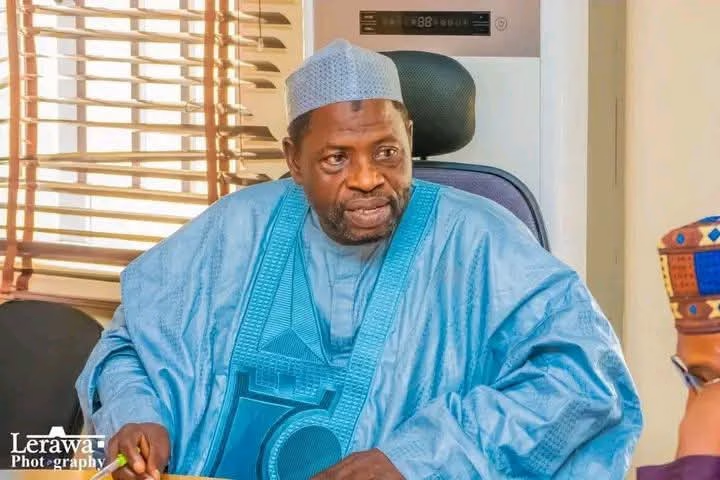
Muhammad Wakili, popularly known as Singham, is a retired commissioner of police who distinguished himself in the fight against crime during his time. In this interview, Singham gave reasons why state police should not be created, saying it will not add any value to the ongoing fight against insecurity in Nigeria.
Looking at the current security challenges in the country, do you think decentralising the Nigeria Police Force is a necessary reform?
This is not a new idea in this country. We operated a similar police system before now. It was abrogated during the 1972 constitutional amendment.
My father was a Wakilin Doka, as they were called. That Wakili in my name means Wakilin Doka. They were under the Native Authority (NA). We saw what happened when the police were under the Native Authority. We have tested that system know the consequences.
Those challenges cannot change because human nature does not change. If you carefully observe how leaders govern this country today, it is not like 20 or 30 years ago. Things have completely changed. Take the president for instance – he governs as if the country were his personal property. He does as he likes. Governors also act as if states were their personal properties – doing whatever they want. Both the president and governors care less whether their actions suit the country or not.
In my opinion, I see no reason to drag us back to the 1960s. There is no reason to bring back state police because, if we do, history will repeat itself. As I speak to you now, I am not convinced that state police is necessary. That is my personal view. I see no reason why state police should be created because the problems that led to its abrogation in 1972 are still here. If we recreate it, the same problems we faced in the 1960s will resurface and worsen our situation; unless we are being selfish and refusing to tell ourselves the truth.
Two things always prevent us from doing certain things – laws and the fear of God. If humans refuse to abide by the law, then we can do anything we want. If we allow that, it means we have a serious problem.
The Nigeria Police Force, as I said in several interviews, is among the best in the world. Let me give you one example: During foreign missions, Nigerian police perform wonderfully. In fact, we usually lead other countries. The records are there. Why? Because modern facilities and motivation are available there. What the police from other countries see as difficult work is nothing to a Nigerian policeman. A Nigerian policeman does the work of two officers during foreign missions because of his capability, bravery and endurance.
The Nigeria Police Force today is underfunded, understaffed and undertrained. We have poor salaries, dilapidated barracks and no operational vehicles. We also lack modern equipment and training. Above all, how many policemen and officers do we have in the whole country? Some states don’t even have up to 3,000 policemen. These are facts anyone can verify. They are not hidden. So, if we don’t have enough manpower, how can you expect smooth operations from the Nigeria Police Force?
The government should recruit more policemen, give them proper training and equipment, and then see if they won’t perform well. We have enough unemployed youths with qualifications, including degrees, diplomas and HNDs that are looking for jobs.
Another challenge is selective justice. Whoever breaks the law should be punished according to the provisions of the law. For instance, we have the Inspector General of Police who is the overall supervisor of the NPF. He has subordinates such as DIGs, AIGs, commissioners of police, down to divisional police officers. If any subordinate is found wanting in the course of discharging his duty, that person should be punished according to the law to serve as a deterrent to others. But in a situation where those who are supposed to enforce the law are protected from punishment for their wrongdoing, how can such a person prevent the common man from misconduct? This is the situation we are in now. So, if we strengthen the NPF and allow it to do its work, we will surely see changes in conduct and operations.
Muhammad Wakili, popularly known as Singham
If state police is established, what operational framework would ensure that it is effective, accountable and non-partisan?
We can only achieve this through the law that establishes it. State police will be established by law, so the law must explain in detail how it should operate. We have what is called discretion in the operations of the NPF, but the main point is that it was established by law; therefore, it must operate within the provisions of that law. For example, if the president, at his own discretion, intends to do something for national development, no matter how good it is, he must abide by the provisions of the constitution. If the constitution does not allow it, the president must present his case to the National Assembly and seek either a constitutional amendment or a law to back his plan. So, the relationship between state and federal police depends on the provisions establishing both. And you know that laws are not permanent; they can be changed when the need arises. By the time state police commence operations, certain issues may come up. If they warrant an amendment of the law establishing it, I am sure the relevant authorities will not hesitate to amend the law to suit the situation on ground. We are human; wherever we have problems, we should correct ourselves.
Should officers and men of state police have full powers to arrest and prosecute, as well as bear firearms?
Only the law can clarify this. The law that establishes state police will explain what it should be. The same law will state whether state police should have the right to carry arms, arrest and prosecute suspects. The law will also specify which crimes state police should handle and which ones should be left to the federal police. The law will differentiate the work and limitations of state police. I believe these provisions must be included in the state police act. That is why, whenever we have something like this, the government should encourage debate, consultations and experts’ advice.
Nigerians and experts should be allowed to contribute during the drafting of the state police act. But have we done that? That is the big question. And I am sure that has not been done.
Since the NPF has historically managed religious and ethnic conflicts in the country, how would the creation of state police affect the management of such crises?
This is another area the law can help. As I said earlier, both state and the federal police are to be regulated by laws and must operate within the ambit of those laws. State police officers can operate optimally if they receive proper training. A typical policeman has no religion, ethnicity or tribe when discharging his duty. He only knows two people: a complainant and an accused. So, everybody is equal in the eyes of the Nigerian police while discharging his duty. Whether you are Muslim or Christian, Hausa, Yoruba, Igbo, or any other tribe, or even if you have no religion, it does not bother a policeman. All he is after is enforcement of the law. Not only policemen; every leader should be like this. Once a leader starts thinking otherwise, he will end up being biased in discharging his responsibilities. If they receive the desired training, state police will discharge their duties without hindrance. In a nutshell, it is the law that will ensure this.
Given the current wave of banditry, kidnapping and terrorism across the country, would decentralised state police address security challenges?
How? If the federal police can fail to secure this country from Boko Haram, how would state police do it? For how long have we been battling Boko Haram? Have we finished the war? How old is banditry in this country? Have we ended it? If the Nigeria Police Force has failed to secure the country, tell me how state police can end these crimes. Haba! We should wait and see what kind of training state police officers will undergo before we judge whether they can win the fight against banditry, kidnapping, terrorism and Boko Haram. If the Nigeria Police Force that has existed for many decades cannot finish this war, I wonder how state police can win it. I don’t see how state police can add value to the current fight against our security challenges. If anyone has an idea, I would be glad to know it. I think the only role they can play is handling cases of prostitution, thuggery and drug abuse. I don’t think state police can go beyond that. After all, will state police be empowered by law to engage in such war? Do they have the desired training and firearms to face bandits and Boko Haram fighters? Only time can tell. To be honest, the issue of banditry and Boko Haram is not a joke.
What is the way out?
The only way out is to fear God in all our undertakings. We should imbibe the spirit of sacrifice in governance. If leaders and followers can sacrifice for this country, I assure you that things will change for the better. Take kidnapping for instance; if a person is kidnapped and a ransom is demanded and his relatives pay, it means the relatives and the society have lost. There is no sacrifice if your relative is kidnapped and you pay ransom for his release. When criminals kidnap a person, his relatives should mobilise, face the bandits and secure his release. We should sacrifice for the future of our children. Let us face the bandits. Of course, they will kill some of us and we will kill them too. If we sustain this, we will get to a point where we chase the bandits and force them to stop kidnapping.
The only way out is to fear God and emulate our forefathers in governance. We should be patriotic in our dealings. Without patriotism and sacrifice, we will not go anywhere. The prevailing insecurity lies in lack of fairness and equity in governance. If our leaders are just, I can confidently tell you that we won’t be in this situation. But because of hypocrisy, today we cannot tell our leaders the truth, not to talk of correcting their mistakes.
How would a state police structure avoid abuse by governors, especially during elections and political disputes?
It is impossible to stop governors from abusing state police. It is better to stop the move entirely than to deceive ourselves. Did those agitating for state police do their homework? They should go back to history and find out what happened when we operated a decentralised police system. Are they ignorant of the dangers of decentralised policing? We have heard state governors complain that commissioners of police are not taking orders from them. Whenever you hear this you will discover that the commissioner only refused to carry out the governor’s biddings that are against the law. No responsible commissioner of police will disobey a governor if the directives are in accordance with the law.
In a nutshell, there is no way governors can be prevented from using state police as they wish. That cannot happen in Nigeria.
We have seen how governors use thugs to achieve their goals. If they can do that with thugs, how can you say they will not use state police for the same purpose? Politicians have their reasons for creating state police. But for me, if you are doing it for the sake of the country and the common man, creating state police is not the best. We should rather improve the existing federal police.
America has several security outfits with thousands of personnel, yet there is no country where crime thrives like America because injustice is everywhere.
In a federal system with state police, what should the command structure be during national crises?
We have seen on several occasions where a president declares a state of emergency on certain issues that affect the country’s integrity. It happened during former President Olusegun Obasanjo when he removed Dariye from office as governor. And we saw how Governor Fubara was removed from office. Federal law always supersedes state law.
Should recruitment for state police prioritise indigenes? If yes, how do we protect non-indigenes from bias or exclusion?
Again, it is the law establishing state police that will determine this. But one thing is sure: If that happens, it would get to a point where someone would go to court to challenge that clause. A Nigerian is a Nigerian in the eyes of the law. Someone from Gombe can relocate to Lagos and claim rights given by the constitution. A Yoruba or Igbo man can come to Gombe and claim similar rights because he is Nigerian. If this issue comes up, it would lead to litigation.
Those agitating for state police should understand that anytime you bring something that will divide the people, you are weakening the country. Take the geopolitical zones for example — they weakened the country and further divided Nigerians. When the North was one entity, like the Western Region, northerners were united. Now, we are divided. I don’t understand why some people want to divide us further.
How can the government resolve conflicts when, for instance, a suspect commits crime in Kano but flees to Jigawa?
We have the federal police. If a suspect flees to Jigawa after committing a crime in Kano, the federal police should handle it. Alternatively, Kano State police should liaise with Jigawa State police to handle such cases. This is a simple issue and has been practised among commissioners of police under the present practice. But it depends on the gravity of the crime a suspect committed.
How would jurisdiction work when a crime spans multiple states? Who takes charge between the federal police and the states?
I think the same approach can be used. But as I said, it depends on what the law says and the gravity of the crime. A crime at the state level is a crime at the federal level. So the federal police can come in and take over the case. You cannot commit a crime in one state and flee to another, thinking you will escape justice. No. federal police will not allow that. But all these can only be achieved if the laws are clear and judiciously implemented. Enacting laws is not easy. Many things must be considered. We must be prepared for the consequences of creating state police and must prepare to make amendments as soon as the state police come.
Some Nigerians already have issues with the operations of some state security outfits, such as Amotekun, Ebube Agu and Hisbah; what lessons should state police take from such outfits?
This largely depends on the training state police personnel will receive. It begins at recruitment. There must be specifications for the right personnel.
If state police receives adequate training and discharge duties according to the provisions of the law, they will definitely earn public respect. If they go contrary, they will face the same challenges experienced by those security outfits.



Leave a Reply