
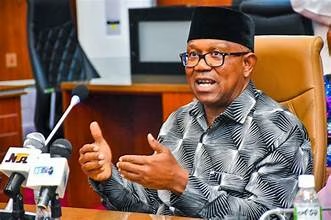
The media office of the Nigerian Democratic Congress (NDC) presidential candidate, Peter Obi, has accused President Bola Tinubu’s administration of deliberately avoiding critical questions about governance and accountability by shifting attention to what it described as the “charade election” conducted on Saturday.
In a statement issued on Wednesday, the Peter Obi Media Office said Obi’s recent call for Tinubu’s resignation was rooted in concerns over worsening poverty, insecurity and economic hardship in the country, but alleged that the Presidency responded with attacks and distractions instead of addressing the substantive issues raised.
According to the statement, rather than engage with questions surrounding the administration’s performance, Tinubu’s aides focused on defending the outcome of the weekend election and debating constitutional differences between presidential and parliamentary systems.
“The innocuous call by the presidential candidate of the Nigeria Democratic Congress (NDC), Peter Obi, on President Bola Ahmed Tinubu to resign from office, having failed to improve the living conditions of Nigerians in recent years, has generated a lengthy reaction from his media aides but has failed to address the issue,” the statement said.
The media office maintained that Obi’s intervention was inspired by the resignation announcement of the British Prime Minister, who stepped down after acknowledging public dissatisfaction over economic conditions and unfulfilled promises.
“Our principal’s call was for President Bola Tinubu to learn a lesson from the action of the British Prime Minister, who chose to resign after acknowledging that his government had failed to sufficiently improve the living conditions of its citizens,” it stated.
The statement argued that Obi’s comments were not about the type of political system Nigeria operates but about leadership responsibility and accountability.
“Rather than address the issue of leadership and accountability, the presidency embarked on shadow chasing, talking about the weekend’s charade election and the types of government, whether presidential or parliamentary,” it said.
“We would like to state clearly that our principal’s comments were not about whether Nigeria operates a presidential or parliamentary system. They were about a fundamental principle of leadership: accepting responsibility for outcomes.”
The media office also faulted claims that resignation is inconsistent with presidential democracies, citing former United States President Richard Nixon, former Brazilian President Fernando Collor de Mello, former Peruvian President Pedro Pablo Kuczynski and former Argentine President Fernando de la Rúa as examples of leaders who stepped down under pressure.
It further recalled that Tinubu himself repeatedly called for the resignation of former President Goodluck Jonathan during the fuel subsidy protests and after the abduction of the Chibok schoolgirls, despite Nigeria operating the same presidential system at the time.
“Leadership standards should not change depending on who occupies the office,” the statement added.
Obi’s media office claimed that poverty levels had worsened significantly under Tinubu’s administration, alleging that the number of Nigerians living below the poverty line had risen from about 87 million when Tinubu assumed office to approximately 140 million.
“The debt burden accumulated under this administration is unprecedented, yet it has not been matched by a corresponding improvement in the lives of ordinary citizens,” the statement said.
It also pointed to worsening economic conditions, arguing that businesses are shutting down, manufacturers are struggling with rising production costs, and consumer demand has weakened due to declining purchasing power.
“No amount of political rhetoric and grandstanding can conceal the fact that millions of Nigerians are enduring unprecedented economic hardship,” it stated.
On security, Obi’s media office acknowledged isolated successes by security agencies but argued that insecurity had spread across virtually every part of the country.
“Kidnapping, banditry, violent crime, and attacks on communities have become national concerns rather than regional challenges,” it said.
The statement also criticised the Presidency’s reliance on economic indicators such as GDP growth, revenue increases and stock market performance, arguing that such statistics mean little if they do not translate into improved living standards for ordinary Nigerians.
“Economic growth that does not translate into improved living standards is merely statistical growth. The true measure of economic success is not the performance of the stock market but the well-being of the average citizen,” it said.
The media office further dismissed attempts by the Presidency to cite the outcome of Saturday’s election as evidence of public support for the administration.
“The presidency cites the outcome of the weekend elections as evidence of public endorsement of its performance. Nothing could be further from the truth,” it stated.
“It is disheartening that what many Nigerians viewed as a deeply flawed electoral exercise is now being presented as proof of good governance.”
According to the statement, if the conduct of the election reflects the future direction of Nigeria’s electoral process, the country’s democracy could face serious challenges.
The media office also questioned government spending priorities, noting that while about ₦298 billion was allocated to primary healthcare, approximately ₦873 billion was budgeted for elections.
“Such a situation demands urgent national reflection,” it said.
Reaffirming Obi’s position, the statement insisted that his call for Tinubu’s resignation was neither personal nor politically motivated but intended to promote a culture of accountability in governance.
“Obi did not call for resignation out of malice or political calculation. He sought to draw attention to a leadership culture that must evolve if Nigeria is to make meaningful progress,” it stated.
The media office urged the government to focus on addressing poverty, insecurity, unemployment, power shortages and declining productivity rather than attacking critics.
“Nigeria deserves leadership that listens more than it lectures, serves more than it celebrates itself, and accepts responsibility rather than constantly searching for excuses,” the statement added.

Leave a Reply