
MARCEL MBAMALU
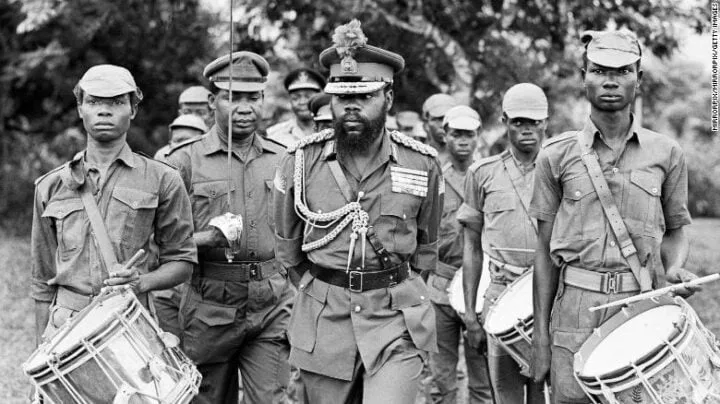
Fifty-six years should be enough time to bury a war. But in Nigeria, the Civil War refuses to die. It lives in ballots, in agitations, in every argument about who belongs and who doesn’t.
This week, Yakubu Gowon exhumed it.
His new memoir, “My Life of Duty and Allegiance”, points a finger from the grave of history at Chukwuemeka Ojukwu — accusing the dead Biafran leader of lying about Aburi, arming the East for war, and dragging Nigeria into bloodshed. Ojukwu, buried since 2011, cannot answer.
So Nigeria is left arguing with ghosts again. Gowon preaches “peace” and “unity.” But as his own book reminds us, peace without justice is just silence under tension. And for millions of Easterners massacred in 1966, for three million starved in Biafra, for the children still kidnapped in Oyo schools today, that tension never left.
The question isn’t just what happened at Aburi. It’s this: 56 years after “No Victor, No Vanquished,” why does Nigeria still feel vanquished by its past?
Let’s look at what Gowon actually said — and what he didn’t.
In “My Life of Duty and Allegiance” Gowon is blunt. Ojukwu lied about Aburi, he says. The January 1967 talks in Ghana never approved secession. Ojukwu sold a different story to the East, smuggled arms, and readied for war while preaching peace. Gowon even cites a 1966 plane crash in northern Cameroon as proof of a disrupted arms build-up. Strong claims. But here’s what’s missing: Why was the East so ready to believe Ojukwu? Gowon preaches national unity, but unity for who? The book doesn’t answer the question that lit the fire in 1966 — why Easterners no longer trusted Nigeria to keep them alive. Peace has layers. And the layer Gowon skips is the one about fear, about pogroms, about a federation that watched thousands of Igbos butchered in the North and called it a “disturbance.”
The road to Aburi was paved with corpses!
To understand Ojukwu, you have to count the dead. January 1966: young officers, mostly Igbo, kill Prime Minister Balewa, Premier Bello, and other Northern leaders. The coup fails, but the North sees an ethnic plot. Major General Aguiyi-Ironsi, an Igbo, takes power. His Decree 34 scraps the regions for a unitary state. To the North, that confirmed their fears: Igbo domination. July 1966: Northern officers strike back. Ironsi is murdered alongside Fajuyi. Gowon emerges. Then the slaughter begins. Across Kano, Kaduna, Jos, Zaria — Igbos are hunted in streets, in churches, in markets. Homes looted. Children hacked. Estimates run 10,000 to 30,000 killed. Trains carried coffins, not passengers, back East. Survivors staggered into Enugu with machete wounds and stories the federal government wouldn’t hear. That was Aburi’s context. Ojukwu didn’t walk into Ghana paranoid. He walked in carrying a region’s trauma. Gowon says there was no deal on secession. Fair. But there was also no deal on security. And for a people fresh from mass graves, security was the only deal that mattered.
Peace without justice is a ceasefire
Johan Galtung, the peace scholar, drew a line we still ignore: “Negative peace” is just no shooting. “Positive peace” is justice, equity, belonging. Nigeria declared “No Victor, No Vanquished” in 1970, then spent 50 years proving it false. The 3Rs — Reconciliation, Reconstruction, Rehabilitation — became a slogan, not policy. Federal jobs, contracts, and ports stayed shut to former Biafrans for years. “Abandoned property” wasn’t returned. A £20 policy wiped out Igbo bank savings. That’s structural violence. That’s Galtung’s warning in real time. So when Gowon writes today about Ojukwu’s “deception,” many Easterners hear something else: the state still won’t say “we failed you in 1966.” You cannot preach unity while debating if the massacre happened. You cannot demand silence from a grave and call it peace. The war’s casualty count — 1 to 3 million, mostly children starved by blockade — isn’t an Ojukwu problem. It’s a Nigeria problem. And it’s why Aburi still matters. Because it was the last room where trust could have been saved. It wasn’t.
Ojukwu wasn’t a saint. But he wasn’t the only sinner
Balance demands this: Ojukwu failed too. Critics aren’t wrong. He walked into Aburi with a region’s grief, but walked out playing politics with it. He declared Biafra knowing minorities in the East — Ijaw, Efik, Ibibio — were uneasy. He gambled on foreign recognition that never came. He kept fighting even as children’s ribs pressed through skin in the photographs that shamed the world. By 1970, Biafra was a graveyard. “No Victor, No Vanquished” was Gowon’s line, but it was Ojukwu who left his people to hear it alone, fleeing to Ivory Coast. So no, this isn’t hagiography. Ojukwu escalated. Ojukwu misread. But here’s the difference Gowon’s memoir won’t touch: Ojukwu’s sins were judged by war, exile, and history. The federal state’s sins in 1966 — the pogroms, the silence, the failure to protect — were never judged at all. You can’t write about Aburi’s “lies” without writing about Kano’s corpses. One man’s deception doesn’t erase a state’s dereliction. That’s the part the book leaves out.
A dead man can’t defend himself. That’s why this hurts
Why now? Ojukwu died in 2011. He never wrote a full memoir. Frederick Forsyth’s Emeka told parts of his story. So did aides and old interviews. But Nigeria never got his unfiltered account, page by page, claim by claim. So when Gowon’s “My Life of Duty and Allegiance” accuses him of deception, of arms smuggling, of war-mongering, it lands in a vacuum. The other voice is ash. And that’s what makes this week feel like more than history. It feels like a trial with only one lawyer in the room. Nations that heal don’t do this. South Africa had TRC hearings — victims and perpetrators, living, speaking, cross-examined. Rwanda had Gacaca courts. Nigeria had… silence. Then a memoir. If Gowon wanted truth, why not push for a full, joint record while Ojukwu lived? Why not declassify federal war files? Why revisit Aburi without revisiting Asaba, where federal troops massacred hundreds in 1967? Memory isn’t justice when it’s selective. And justice delayed 56 years starts to look like justice denied.
The mirror isn’t cracked. It’s the same face
This isn’t 1967. But squint. Oyo State, last month: armed men storm schools, beat children in the bush, drag teachers away. Plateau, Benue, Southern Kaduna: villages buried at night, same as 1966. IPOB says “Nigeria can’t protect us.” Yoruba Nation says “we want out.” The language is different. The fear is identical. Ojukwu’s core argument in 1967 wasn’t secession. It was this: a state that cannot guarantee life has lost the right to demand loyalty. Gowon’s memoir calls that treason. But today, a mother in Oyo, a farmer in Zamfara, a trader in Imo — they’re asking the same question Ojukwu asked: where is the state when the killers come? Aburi failed because there was no answer. 56 years later, there’s still no answer. So the war lives on. Not with guns, yet. But in distrust. In every election rigged along ethnic lines. In every federal appointment that “balances” regions instead of rewarding competence. In every kid taught that “Nigeria” is why his grandfather died hungry. Gowon’s book was meant to close a chapter. It reopened the whole damn book.
Bottom Line — Bury the war, or it buries us
So what now? If Gowon’s memoir matters, it isn’t because it settles Aburi. It doesn’t. It matters because it proves we’re still arguing about the same things: security, justice, belonging. “No Victor, No Vanquished” was a promise. Promises rot when you don’t keep them. Nigeria doesn’t need another book. It needs a reckoning.
First, declassify everything. War files, Aburi transcripts, Asaba reports, intelligence memos from 1966. Let historians, not generals, tell us what happened. Second, truth. Not a one-sided memoir, but a national truth process — living victims, living soldiers, living children of the dead. South Africa faced its demons. Rwanda did. Nigeria pretends it has none.
Third, fix the state. Ojukwu was wrong to choose war. But he was right about one thing: a country that cannot protect its people will breed more Ojukwus. In Oyo, in Zamfara, in Imo, the state is still failing that test. End the killings. Jail the killers. Or don’t be shocked when the next generation picks up the old argument.
Gowon is 90. He won’t be here to write a sequel. Ojukwu is gone. The 3 million are gone. But their question isn’t. Until Nigeria answers it — with justice, not slogans — the war isn’t history. It’s prophecy.
Bottom Line: You don’t heal a wound by debating who cut first. You clean it. You stitch it. You tell the truth about how deep it went. Gowon’s book opened the scar. Nigeria must decide: keep picking at it, or finally let it heal.
Dr Mbamalu is a journalist, columnist and publisher

Leave a Reply