
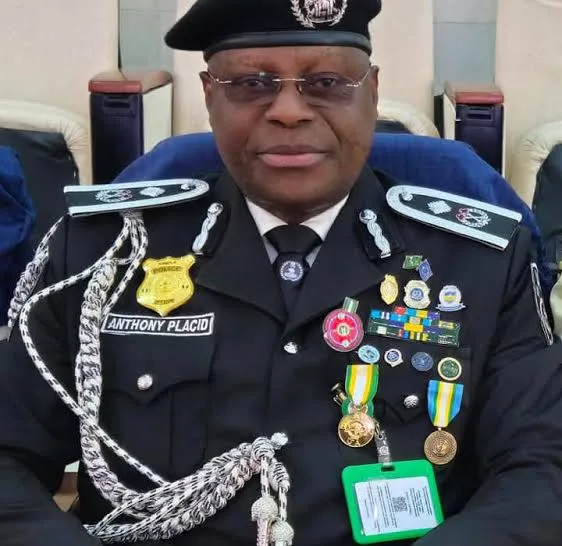
The Inspector-General of Police, Olatunji Disu, on Thursday backed the call by the Infrastructure Concession Regulatory Commission for the establishment of 3,000 new police stations across the country, warning that the existing security infrastructure is grossly inadequate for Nigeria’s growing population.
Disu stated that the Nigeria Police Force currently operates only about 2,000 police stations nationwide, a figure he said cannot effectively serve a population of more than 200 million people.
He spoke at Infrastructure Dialogue 2026, a programme organised for entrepreneurs by Deutsche Partners Holding in Abuja.
The IGP, who was represented by the Commissioner of Police in charge of Works, Obiora Oranwusi, said the scale of the country’s security infrastructure deficit requires urgent intervention through public-private partnerships, development finance institutions and capital market instruments.
He said, “The Infrastructure Concession Regulatory Commission has identified the need for 3,000 new police stations, 1,000 new prisons, and 170 new barracks—a scale of investment that necessitates PPPs, DFIs, and capital market instruments.
“As of today, we have only about 2,000 police stations nationwide. These deficits directly affect operational effectiveness and must be addressed through sustainable financing models.
“The police are undergoing a strategic reorientation—one that positions us as a proactive enabler of national development.
“Our mandate extends beyond crime response; it encompasses the creation of a stable, predictable environment in which legitimate enterprise can flourish.”
Disu lamented the poor state of policing infrastructure in the country, listing outdated communication systems, inadequate surveillance coverage, insufficient patrol vehicles, weak ICT and data systems, dilapidated police stations and barracks, limited forensic laboratories and a shortage of protective equipment among the major operational setbacks facing the police.
According to him, insecurity remained a major threat to national development and investor confidence, especially where criminal activities disrupt critical infrastructure projects.
“Our nation continues to confront threats to critical infrastructure—vandalism, sabotage, extortion, and disruptions by organised criminal networks.
“Recent incidents, including the apprehension of vandals through advanced CCTV surveillance on the 3rd Mainland Bridge, underscore both the scale of the challenge and the necessity of technology-enabled policing,” he said.
A November 2025 report by the European Union Agency for Asylum revealed that more than 100,000 officers of the Nigeria Police Force are currently assigned to protect politicians and other Very Important Persons, despite the country’s estimated police strength of about 371,800 officers serving a population of roughly 236.7 million people.
The report warned that the diversion of a substantial number of officers to VIP protection has worsened policing deficits, weakened community policing and reduced security coverage for ordinary Nigerians.
Reacting to the concerns raised by the police hierarchy, the Governor of Nasarawa State, Abdullahi Sule, acknowledged the severe infrastructure gaps confronting the Force and linked the broader infrastructure crisis to issues of investment confidence and poor returns on investment.
He said, “On a lighter note, I wanted to ask the IGP to pay us for the new standard bridge his men have been complimenting.
“That’s what I wanted to say earlier. But then, in your own speech, I started hearing you mentioning so many inadequacies the police have. You are having problems with a lack of vehicles, a proper communication system and equipment.
“So, I changed my mind and said I’d better not ask for the money now. You have already complained so much about what you don’t have.
“When we begin to talk about infrastructure, what most people think of are bridges, power, schools and maybe water.
“People don’t understand that infrastructure goes beyond that. That was also the reason His Excellency Boni Haruna mentioned clearly that it is not just about financing because, in reality, Nigeria has so much money.”



Leave a Reply