
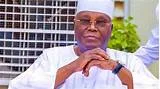
When Atiku Abubakar appeared on television for an exclusive interview recently, many Nigerians had expectations. They wanted specific answers about his 2027 political ambition; they wanted to know if the veteran politician and serial presidential aspirant would run or support another candidate within the coalition in 2027. But the former vice-president left everyone guessing. In one breath, his responses suggested he may contest for the presidency; in another, he said he would back any candidate that emerges. In that interview, he left many things unsaid, leaving Nigerians even more confused about his intentions and asking: What does Atiku really want?
To understand this question, let’s situate the name, Atiku, within Nigeria’s contemporary political history and, more precisely, since 1993. Since the return to democracy in 1999, few politicians have shown the kind of persistence Atiku has, with perhaps Buhari as the only exception. After serving as vice president under Olusegun Obasanjo from 1999 to 2007, Atiku has contested for president multiple times: 2007, 2011, 2015, 2019, and 2023. Before the return to democracy in 1999, Atiku was also a major political gladiator in the botched Babangida transition experiment. In 1993, he ran against MKO Abiola and Kingibe in the Social Democratic Party (SDP) presidential primaries but lost. His consistency in contesting the presidency every election cycle has been criticised as a kind of obsession with power. Depending on who you ask, Atiku is seen either as a politician passionate about his vision for Nigeria or a perennial candidate chasing a lifelong ambition.
But ambition alone does not seem to fully explain Atiku’s continued chase for the presidency. The presidential field has had a long line of contenders, but few have sustained a decades-long run as Atiku has done. What the former VP appears to want is unfinished business. Having come close, particularly in 2019 and 2023 when he emerged as the candidate of the People’s Democratic Party and mounted a strong challenge, he likely believes the presidency is still within reach. For someone who has invested so much political capital over the years, stepping aside may feel like abandoning his dream..
Then there is the issue of legacy. In Nigerian politics, the presidency remains the ultimate prize for politicians of Atiku’s calibre. Atiku’s contemporaries have either achieved it or exited the stage. Muhammadu Buhari contested multiple times before finally winning in 2015, reinforcing the idea that persistence can pay off. Bola Tinubu, the current president, also wanted to be president and got it. It is not unreasonable to assume that Atiku sees his own journey through a similar lens; that if Tinubu, Buhari and political upstarts like Jonathan, Yardus could be president, why not him?.
Advertisement
However, Atiku’s comments during the interview revealed why he is likely to run or back a northern candidate. He suggested that the North has been shortchanged in the distribution of presidential power. He argued that a northern presidency could “correct the ‘deficit’ because according to him ‘the south has governed for eighteen years, the north ten’. Atiku’s argument is derived from the thinking that the death of Yardua cut short the northern presidential term. However, Atiku’s position still puts him at odds with the widely held expectations of rotational presidency between North and South, especially after Buhari’s eight years. By downplaying zoning as merely a Peoples Democratic Party policy rather than an unspoken national consensus, Atiku has portrayed himself as not bound by informal political arrangements if they stand in the way of his ambition.
This brings this discourse closer to the core of the question. What does Atiku really want? Beyond ambition and legacy, there is a strong indication that he wants relevance. By keeping his 2027 intentions ambiguous, Atiku ensures that he remains the main figure in the ADC coalition talks. His involvement in the emerging coalition also reflects this desire. Historically, coalitions in Nigerian politics are often less about ideology and more about strategic alliances and interests. Atiku’s involvement in the coalition means he can keep his 2027 options open. If the political winds favour him, he runs. If not, he plays kingmaker. Either way, he remains influential.
Atiku’s critics, however, interpret his recent move differently. For them, his continued candidacy raises questions about generational transition. Our democracy is young, yet the political leadership remains dominated by older politicians. By 2027, Atiku will be around 80 years old. Many Nigerians argue that it is time for a new generation to take the reins of leadership. There are also questions about his motivation to contest for the presidency again. Atiku has consistently framed his ambition in terms of national interest, often criticising the performance of the current administration and presenting himself as a better alternative.
In his Arise TV remarks, he described Tinubu’s government as the worst government in Nigeria’s history, which should not be allowed to continue. But scepticism about his intentions remains. Some Nigerians believe his ambition is driven not just by a desire to govern but by personal and political calculations, including the restoration of influence and networks that may have weakened since he left office in 2007. Yet it would be simplistic to reduce Atiku’s interest in the presidency to personal gain. Turaki Adamawa has built a vast political network over decades of supporters, allies, and stakeholders who have invested in his ambition. Walking away from it all won’t be a personal decision; it will affect an entire political structure across the country that depends on his candidacy.
So, what does Atiku really want? The most honest answer is that he wants multiple things at once. He wants the presidency, certainly. But he also wants relevance, legacy, and influence. He wants to remain a central figure like his contemporaries in shaping Nigeria’s political future, whether as a candidate or as a power broker. The ambiguity in his recent interview is not accidental; it is a political strategy. By neither confirming nor denying his intention to run for the presidency in 2027, Atiku keeps both his supporters and rivals guessing. He buys time, tests the political environment, and retains bargaining power within the ADC coalition where he holds the aces.
For Nigerians, the question goes beyond Atiku’s personal ambitions for the presidency. The question many are asking is: Should the country continue to rely on old politicians, or is it time to embrace new leadership? Is experience more important than the need for generational change? These are the questions that Atiku’s candidacy raises.
As 2027 approaches, Atiku may eventually declare his intention. But until then, his silence and his mixed signals will continue to fuel speculation. And Nigerians will keep asking,

Leave a Reply