
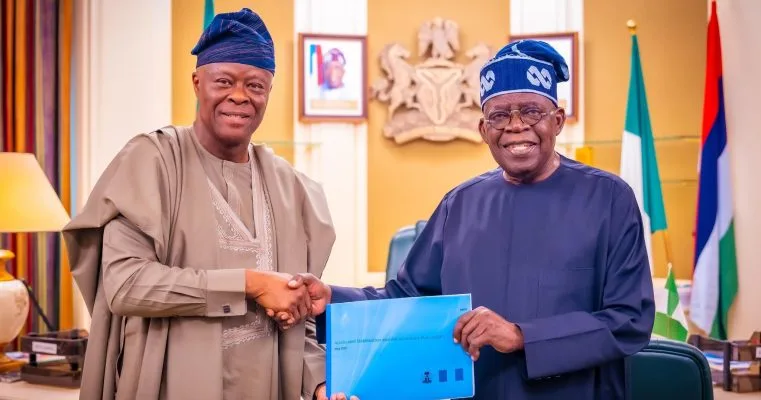
Yemi Cardoso, Yemi Osinbajo, Wale Edun, Dele Alake, Rauf Aregbesola, all have one thing in common – they were part of the tight-knit circle that defined the political machinery of President Bola Ahmed Tinubu.
These were men who didn’t just work with Tinubu, but knew him intimately. They were not mere associates, but trusted allies, confidants, and architects of a political legacy that shaped up in Lagos. Each of them was appointed Commissioner when Tinubu became governor of Lagos in 1999 and they operated at the very heart of power, shaping policies and steering the direction of Africa’s most populous city.
Their proximity to Tinubu wasn’t just professional — it was personal, forged in long hours of strategy, debate, and shared ambition.
In one of the editions of Bola Tinubu Colloquium, the annual event which was rested the year Tinubu got into Aso Rock, former Vice-President Osinbajo offered a glimpse into that inner sanctum.
He recalled intense policy sessions where Tinubu would lock his team in a room for rigorous debates. And when disagreements became too heated, Tinubu, never one to shy away from asserting authority, would rise and challenge them: “Are you the ones they voted for? Why this argument?” It was a leadership style that blended openness with a firm reminder of where ultimate power lay.
But time, as it often does, began to test those bonds. Gradually, cracks emerged within the once-solid circle — a reminder that even the strongest alliances are not immune to strain. Political ambitions shifted, loyalties evolved, and relationships that once seemed unbreakable began to fray. The rifts involving Osinbajo, Aregbesola and Tinubu are now part of Nigeria’s political folklore.
Yet, another story is quietly unfolding — that of Edun. This was a fellow whom Tinubu reportedly recommended to the late President Muhammadu Buhari to be made Minister, but was overlooked. Around that time, Edun was chairman of the Board of Directors of a newspaper company owned by Tinubu, just as Alake was head of a broadcast company belonging to the President. And when Tinubu was elected President, he named Edun Head of the Presidential Transition Council. As President, Edun and Alake made the list of his first set of appointees. First as Special Advisers, then Ministers.
On Edun, it was Tinubu himself who opened up that the sacked Minister made contributions to his inauguration speech as President.
Tinubu, Edun with UK Minister of Small Business and Economic Transformation, Blair McDougall, after the signing of a £746 million financing agreement to modernise Apapa and Tin Can Island ports in Lagos, held at Lancaster building, London, during Tinubu’s state visit.
Addressing an audience of Nigerians based in France during his first visit to Europe after taking power, the President had said, “Wale Edun and co started debating, putting my speech together without the question on subsidy. I got to the podium, I was possessed with courage and I said subsidy is gone.”
Not every ally or aide would have access to the inaugural speech, so the point was made clear.
However, signs that Edun’s influence was waning began manifesting before Tinubu’s mid-term. As history has shown, no political circle remains intact forever. And in Tinubu’s world, where unquestionable loyalty reigns supreme, the line between insider and outsider can shift with time.
Sources said Edun was among those penciled for exit during the first cabinet reshuffle. But a well-respected voice in the kitchen cabinet created a soft landing for the Minister. But for how long? Time and again, Tinubu has proven to be a kind of person who hardly shifts his stance once his mind is made up. This played out recently in Lagos where the governor and the president were said to have reconciled after an embarrassing episode. The public was not privy to the cold war between Tinubu and one of his mentees until the President refused to exchange handshakes with the governor in public.
The video which went viral set tongues wagging and perhaps a spin was put up to say the issue had been laid to rest. However, during the much publicized 2-day working visit to Lagos, we saw what played out. Tinubu, who commissioned projects in Ogun the day before, skipped the exercise in Lagos, though he was physically present in the state. Despite attempt to cover-up that the president couldn’t commission the projects because he was receiving security briefing, Tinubu proceeded to Bayelsa the next day to do what he failed to do in his state.
Back to Edun, the cracks continued to manifest as both men started to sing in discordant tunes.
While President Tinubu repeatedly projected optimism about Nigeria’s fiscal outlook, at one point declaring that the country had exceeded its revenue expectations, Edun’s public statements occasionally struck a more cautious tone, particularly around fiscal sustainability and debt exposure.
Edun has, in multiple forums, emphasized prudence in borrowing and warned against excessive debt accumulation. That stance appears to contrast with the administration’s increasing reliance on loans to fund budget deficits and infrastructure expansion.
Can Oyedele fill the large shoes?
There are insinuations that Edun’s apparent reluctance toward extensive borrowing may have placed him at odds with broader government priorities, especially in a system where political imperatives often demand rapid results.
Aside from the policy disagreements, there is also the question of messaging.
For instance, one of the most telling moments came in late 2025, when Edun publicly indicated that the federal government was facing a significant revenue shortfall. He noted that only a fraction of projected revenue had been realised.
Tinubu had stated in September 2025, while addressing stakeholders of the Buhari Organisation who visited him at the Presidential Villa in Abuja that “Today, I can stand here before you to brag: Nigeria is not borrowing. We have met our revenue target for the year, and we met it in August.”
However, Edun raised fresh concerns about the sustainability of Nigeria’s public finances.
The minister said the federal government recorded a wide revenue shortfall in the 2025 fiscal year in December 16, 2025, during an interactive session with the House of Representatives Committees on Finance and National Planning.
“The current trajectory indicates that federal revenues for the full year will likely end at around ₦10.7 trillion, compared with the ₦40.8 trillion that was projected.”
Edun attributed the shortfall largely to weak oil and gas revenues, particularly lower-than-expected collections from Petroleum Profit Tax and Company Income Tax paid by oil and gas companies, among others.
Their relationship continued drifting to the extent the president quietly clipped Edun’s wings, transferring key responsibilities to then Minister of State for Finance, Doris Uzoka-Anite. The situation reached its height when Edun’s successor was appointed in junior capacity. At the launch of the new complex of Nigeria Revenue Service (NRS) last week, Tinubu praised Oyedele to high heavens, without making any utterance about his estranged ally, a glaring sign that things had deteriorated.
The manner in which Edun was shown the way out also points to the breakdown in their relationship. Unlike Abubakar Badaru, former Defence Minister; Kayode Egbetokun, former Inspector-General of Police; Uche Nnaji, for Minister of Innovation, Science and Technology, among others whom Tinubu gave a sort of dignified exit through resignation option, Edun was fired out.
An inner source said the sack letter was prepared on Edun’s 70th birthday, 20th April, 2026, but higher forces prevailed on the authorities to deliver it a day after.
On a broader perspective, Edun’s legacy as Finance Minister and Coordinating Minister for the economy is a story for another day. A seasoned technocrat with over 40 years of experience, Edun has a background in international merchant banking and corporate finance. An alumnus of the University of London and the University of Sussex, his career spanned roles at Chase Merchant Bank, Lehman Brothers in New York, and the World Bank.
For someone with such a rich pedigree, many expected positive turnarounds. But under his watch, inflation rose to the highest numbers, exchange rates hit the rooftop while growth was seen in numbers but not the lives of ordinary Nigerians. Purchasing power diminished drastically. His battle with local contractors who place caricature coffin of his at the Finance Ministry’s headquarters is well documented.
Edun’s exit reflects the realities of governance at the highest level, where long-standing alliances are sometimes tested. But one thing is clear, the exit of one of Tinubu’s most trusted lieutenants sends a clear message that anyone could be hit. For Oyedele, the new bride, Nigerians are watching how he will handle the economy and project the Renewed Hope vision.

Leave a Reply