

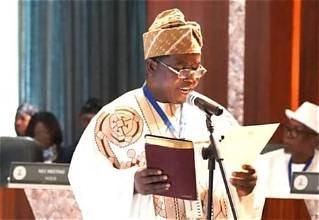
A civil society organisation, the Movement for Credible Elections (MCE), has called for the immediate resignation of the Chairman of the Independent National Electoral Commission (INEC), Joash Ojo Amupitan, over allegations of partisanship and loss of public trust ahead of the 2027 general elections.
In a press statement issued on Sunday, the group said Amupitan no longer possesses the credibility required to oversee a free and fair electoral process, citing what it described as “a deepening crisis of confidence” surrounding his office.
“The Movement for Credible Elections (MCE) is compelled, in the overriding public interest… to issue this statement as touching the deepening crisis of confidence surrounding the office of the Chairman of INEC,” the group stated.
According to the MCE, recent “digital footprints” allegedly linking Amupitan to partisan expressions sympathetic to the ruling All Progressives Congress (APC) have triggered a legitimacy crisis.
“While Professor Amupitan has issued categorical denials, such denials—within the context of modern digital forensics—do not extinguish suspicion; rather, they activate a higher threshold for verification,” the statement read.
The group stressed that in today’s technologically advanced environment, mere denial is insufficient.
“In this digital age, denial is not a defence—it is an invitation to forensic scrutiny,” MCE said, adding that “the public domain is already saturated with analytical trails allegedly connecting the disputed account to identifiable personal and financial markers.”
Raising concerns about possible legal consequences, the group warned that the controversy could spiral into a full-blown constitutional and judicial crisis if not urgently addressed.
“Banking and identity verification systems, particularly those governed by BVN and NIN protocols, provide traceable ownership structures that are legally discoverable under subpoena,” it said.
It further noted that “digital platform operators maintain device-level access logs, including IMEI-linked login histories, which are admissible in judicial proceedings,” warning that any escalation into sworn testimony could raise “the spectre of legal crisis bordering on perjury.”
The MCE also accused the electoral body under Amupitan of exhibiting a troubling pattern of bias against opposition parties.
“Beyond the immediate controversy, the MCE is alarmed by a growing pattern of actions and decisions by INEC that have been widely interpreted as detrimental to opposition political participation in Nigeria,” the statement added.
It cited “administrative inconsistencies, selective enforcement of electoral regulations, and operational conduct” as factors eroding the level playing field in Nigeria’s multi-party democracy.
The group warned that the situation could damage Nigeria’s international reputation, noting that aggrieved parties may approach regional courts such as the ECOWAS Court of Justice.
“Should aggrieved parties seek redress… the Nigerian State may face international embarrassment, adverse rulings, and financial liabilities,” it cautioned.
Questioning the moral fitness of the INEC chairman, the group said alleged past digital expressions supportive of the APC, if proven, would amount to “prima facie evidence of pre-existing partisan alignment.”
“That inevitably leads to a troubling conclusion: that the appointment of Professor Amupitan may have been influenced by partisan considerations,” it added.
The group, therefore, issued a series of demands, including the immediate stepping aside of Amupitan to allow for an independent investigation.
“That Professor Joash Ojo Amupitan immediately step aside… to allow for a truly independent, transparent, and forensic investigation into the allegations,” the statement read.
It also called on the federal government to set up “an impartial panel comprising judicial, digital forensic, and civil society experts” and urged authorities to halt “all forms of intimidation, harassment, or threats against citizens raising legitimate concerns.”
Describing the situation as a defining moment for Nigeria’s democracy, the group warned of grave consequences if urgent action is not taken.
“Professor Amupitan must recognize that this is no longer a personal matter of denial—it is a national question of trust,” the statement concluded.
“The only honourable path… is to step aside and submit to the cleansing light of transparent investigation.”
Recently, artificial intelligence tool Grok linked an X (formerly Twitter) account to Prof. Amupitan, the INEC Chairman. The account was said to have been created under the username “joashamupitan” and contained posts that appeared supportive of the APC and its 2023 presidential candidate, Bola Tinubu. Tinubu is the incumbent president, having won the 2023 presidential election.
The AI-generated link between Amupitan and the account raised questions about his neutrality as head of INEC. Social media users began sharing old posts allegedly from the account, some dating back to before his appointment as chairman.
These posts were interpreted by critics as evidence of partisan leanings, which led to public debate about whether he could remain impartial in overseeing elections.
Civil society groups, opposition parties, and commentators have expressed concern. Many of them have called for Amupitan’s resignation, arguing that the credibility of INEC is at stake.
INEC issued a formal denial, stating that Amupitan does not operate any personal X account. His spokesperson described the allegations as false and fabricated, and said they were part of a campaign to discredit the Commission.
Meanwhile, INEC has announced plans to engage forensic experts to investigate the resurfacing of controversial tweets allegedly linked to an account associated with its Chairman, Amupitan.
Speaking on Channels TV’s Morning Brief last Monday, the INEC Director of ICT, Lawrence Bayode, disclosed that the commission was treating the matter as a potential threat to institutional integrity amid its preparation for the 2027 general elections.
Addressing the controversy, Bayode emphasised that the commission would not be pressured into making a hasty judgment based on social media circulated images. According to him, a rigorous, evidence-based approach is necessary to determine the authenticity of the posts.
“We are taking this further because even though like I said we have referred this to security agencies, like I said we relied on evidence,” Bayode stated. “I will not base my judgment on screenshots. I will not allow that to guide my conclusion.”



Leave a Reply