 Premium News
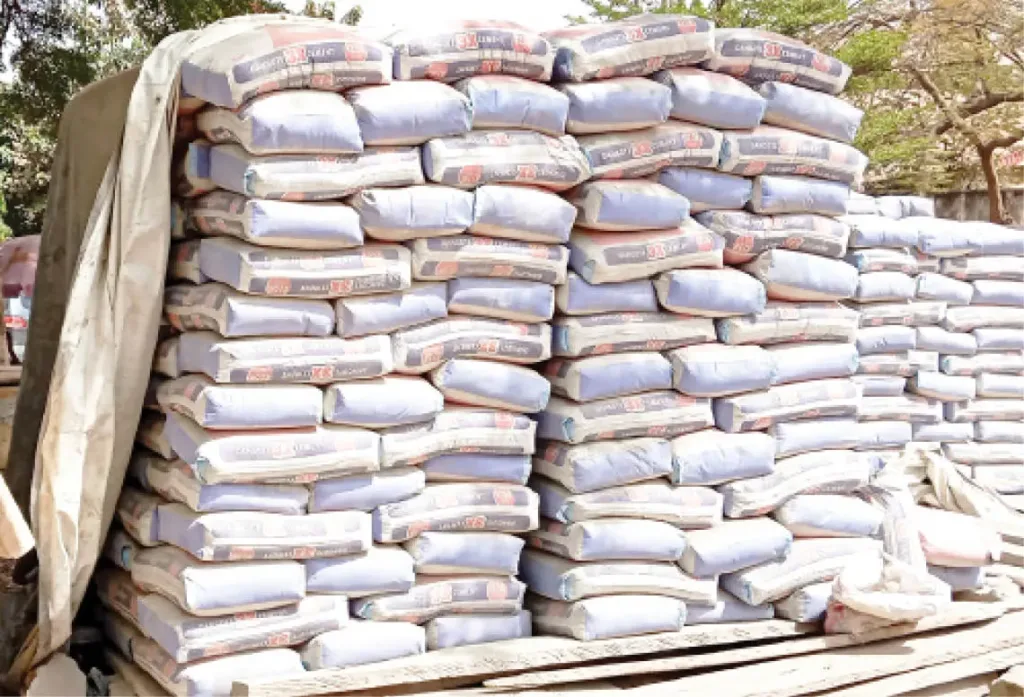
Consumers and builders across several states are groaning under the weight of fresh increases in cement prices, with a bag now selling between N10,500 and N11,000 in many parts of the country.
Market surveys conducted in Kwara, Abuja, Kano, Kaduna, Jigawa and other northern states indicate that the upward review has become widespread, cutting across major brands and leaving household builders, block makers and contractors struggling to adjust their budgets.
In Ilorin and other parts of Kwara State, cement that previously sold for around N9,300 to N9,700 per bag last month now averages between N10,500 and N10,700 depending on the brand and location.
At major building material hubs in the state capital, a bag of Dangote Cement which earlier sold for about N9,500 now goes for between N10,500 and N10,600.
Similarly, BUA Cement has risen from roughly N9,500–N9,600 to about N10,600–N10,700.
Lafarge Africa products are also being sold within the same N10,600 to N10,700 range, while Mangal Cement, which was the most affordable at about N9,300–N9,400, now sells for between N10,500 and N10,600.
Traders attribute the development to what they describe as rising supply chain costs and increased production expenses.
However, consumers say the explanations offer little comfort as the new prices are stretching already tight budgets.
An Ilorin-based dealer, who operates under the name Orire Cement, confirmed that customers have been complaining bitterly about the hike.
“Sales have dropped because people cannot afford to buy in large quantities again. Even those who buy trucks of 900 bags are reconsidering because the total cost has increased significantly,” she said.
In Abuja, the situation is similar. A market survey in Utako and other building materials markets showed that BUA cement is currently selling at about N11,200 per bag in some locations.
Dangote cement is selling at N10,800 in Utako market, while other outlets offer it at N11,000.
Dealers said that customers who purchase an entire truckload of Dangote cement can still secure it at around N10,500 per bag, but such bulk discounts are beyond the reach of many small-scale builders.
A dealer in Abuja explained that transportation, loading charges and distributor margins further widen the gap between ex-factory prices and what end-users eventually pay.
Dealers, middle men blamed for increase in Lagos
The sudden increase in cement prices in Lagos has sparked outrage among builders, contractors, block makers and consumers.
The price of a 50kg bag of cement rose from around N9000 in December 2025 to N10,000 in January 2026 and now to N11,500 in recent times, leaving many to wonder who is behind the steep hike.
Our correspondent who visited some cement sellers in the state discovered that sellers are pointing fingers at dealers, and middle men, accusing them of hiking prices arbitrarily.
They told our correspondent that the exorbitant markups are not justified, considering that the manufacturers’ prices have not changed significantly.
“We buy cement from middle men and dealers and not directly from manufacturers. The dealers and middle men buy at a reasonable price, but turn around to inflate the prices,” said Ikechukwu Anthony, a cement seller in the Ojo area of Lagos.
“They claim that the prices have increased due to transportation costs and other expenses, but we know that’s not true,” he added.
Another seller, who identified himself as Ibrahim Ojo, at Mowo area of Badagry also blamed dealers and middle men for the price hike.
The dealers, however, have remained tight-lipped about the price increase, fueling speculation that they may be behind the hike.
Dealers lament in Kano
In Kano, cement dealers are equally lamenting the trend as the benchmark price has effectively shifted to N10,500 and above.
Alhaji Nasiru Awwalu Mustapha, a BUA cement dealer in Maidile quarters, Kumbotso Local Government Area, said manufacturers are now supplying to dealers at N10,500 and above.
“BUA is giving us N10,500. Dangote is N10,450 while Mangal is N10,550 per bag. By the time we add transport and other expenses, retail prices go to N10,800 or N11,000,” he said.
He expressed concern that the frequent adjustments are affecting demand and slowing down building activities.
“Customers complain every day. Some have suspended their projects. We are not happy either because when prices go up too fast, sales volume drops,” he added.
Another dealer, Sani Maigemu, corroborated Mustapha’s position, saying the development has created uncertainty in the market.
According to him, cement companies have cited taxes and other statutory obligations as part of the reasons for the new pricing structure.
Block makers are already feeling the ripple effects. Aminu Inuwa, a block maker in Kano, said they now buy cement from dealers at N10,800 to N10,900 depending on the brand.
“Mangal is about N10,900, while BUA and Dangote are around N10,800. Because of this, we have increased the price of blocks. A nine-inch special block that was N750 is now N800,” he said.
He noted that if cement prices continue to rise, further increases in block prices may become inevitable.
Checks in Kaduna revealed that BUA cement is selling at N10,900, while Dangote and Mangal are priced at around N10,800. In Jigawa State, dealers confirmed that cement now sells for as high as ₦11,000 per bag.
In Zaria, however, some dealers said Sokoto cement, BUA and Dangote were still available at about N10,200, offering slight relief compared to other cities.
Cross-border price difference
Beyond domestic complaints, some dealers raised concerns about cross-border price differentials.
Mustapha claimed that Nigerian cement manufacturers supply dealers in neighbouring countries at lower rates when converted to naira.
A Nigerian resident in Niamey, Niger Republic, Muazzamu Sani, told our correspondent that BUA cement sells at the equivalent of about N7,500 per bag in the Nigerien capital, although prices vary by location.
Explaining the calculation, he said a bag costs “Jakka uku” (three thousand CFA francs), and with an estimated conversion of about N2,500 per 1,000 CFA francs, the total comes to roughly N7,500.
The claim has fueled frustration among some dealers who argue that local consumers should not pay more than buyers in neighbouring countries.
However, industry observers caution that cross-border pricing often reflects differences in tax regimes, transport logistics, exchange rates and market strategies.
They also point out that manufacturers may offer export incentives or promotional pricing in certain markets, which does not necessarily reflect the full cost structure in Nigeria.
For many households, the immediate concern is the impact on housing affordability. With inflation already eroding purchasing power, the additional N1,000 to N1,500 increase per bag represents a substantial jump in total project costs.
A modest two-bedroom bungalow can require hundreds of bags of cement from foundation to roofing stage. An increase of N1,000 per bag could therefore translate into hundreds of thousands of naira in additional expenditure.
A stakeholder in the built industry who spoke with Daily Trust expressed concerns over the increase saying this is not good for the economy and the construction industry.
The implication, he stated, would be that the number of houses being built would reduce.
The stakeholder, a former President of the Nigerian Institute of Builders, Kunle Awobodu said, “What we are hearing is that the prices of cement are cheaper in the neighbouring countries which means there would be reduction in smuggling.
“Naturally one will not expect cement prices to become very unbearable. Purchasing power is highly affected. Today, on Victoria Island, two major ready mixed companies had no cement to produce and the cement price was high when a bag of cement climbed to N11,000 and N11,500.
“It is not good for the economy. It is not an encouragement for development, it doesn’t help the construction industry in Nigeria because when purchasing power is low and prices of building materials continue to skyrocket, it would result in fewer buildings being constructed.”
Awobodu called on the federal government to intervene, adding, “We need to further interrogate the manufacturers to understand the reason things are like that despite the fact that we have abundance of limestone which is the major raw materials for cement. The government needs to intervene to see if there are areas they could be of assistance to the manufacturers in order to make the price affordable.”
For now, consumers, dealers and builders alike are navigating a market where N10,500 has become the new floor price, and N11,000 is increasingly common.
As one frustrated builder in Ilorin put it, “Every time we adjust to a price, it changes again. Planning has become very difficult.”
An official of one of the cement manufacturers who spoke with our correspondent on the condition of anonymity however said the price increase is not peculiar to a particular manufacturer, blaming it on importation of some materials which are priced in dollars.
“I believe with the dollar coming down, very soon the price will come down,” he stated.
