 Premium News
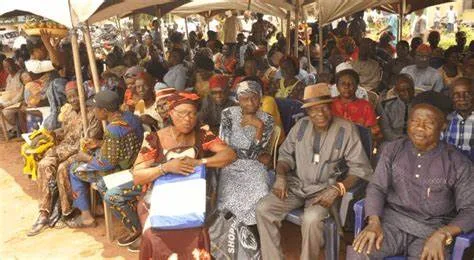
The Kukah Centre, Yiaga Africa, and some other civil society organisations on Thursday criticised President Bola Ahmed Tinubu’s assent to the newly enacted Electoral Act 2026, describing it as “a missed opportunity for transformative electoral reform.”
The groups made the condemnation under a coalition of Civil Society Organisations at a press conference in Abuja. Other groups at the conference were: the International Press Centre, TAF Africa, Centre for Media and Society, Nigerian Women Trust Fund, and Elect Her.
President Tinubu had on Wednesday signed the amended Electoral Bill 2026 amidst controversy and protests from civil society organisations, prominent Nigerians and opposition parties over real-time electronic transmission of results.
Both chambers of the National Assembly had on Tuesday passed the harmonised version of the bill after heated sessions.
Opposition lawmakers had insisted on passage of mandatory real-time electronic transmission of results from polling units to IRev portal.
However, despite the protest, Tinubu assented to the bill at the Presidential Villa in the presence of the president of the Senate, Godswill Akpabio; the Speaker of the House of Representatives, Abbas Tajudeen and other government officials.
After signing the bill, the president charged the Independent National Electoral Commission (INEC) and all those saddled with implementation to guard against glitches.
He commended the National Assembly and its leadership for managing the process, saying “What is crucial is the fact that you managed the process to the extent that there will be no confusion, no disenfranchisement of Nigerians, and we are all going to see democracy flourish.”
Addressing journalists on behalf of the coalition of CSOs yesterday, Founder and Chief Executive Officer of TAF Africa, Jake Epelle, argued that the speed and opacity of the legislative process that produced the new electoral act undermined public confidence in the reform.
He said, “The civil society organisations acknowledge the passage of the Electoral Bill 2026 by the National Assembly and the presidential assent that followed, but warn that the process fell short of democratic standards.
“The speed and opacity raise serious concerns about legislative transparency and the commitment of lawmakers to genuine electoral reform.
“The decision of the Presidency to grant assent without addressing the substantive legal, technical, and democratic concerns raised by civil society sets a dangerous precedent. Such an approach risks eroding public trust at a time when confidence in the electoral system remains fragile.”
Epelle also criticised the imposition of a N50 million administrative fee for new political party registration under Section 75(6) of the Electoral Act, calling it “a financial moat designed to exclude grassroots movements, youth-led parties, and non-elite political formations from formal competition.”
On party primaries, the coalition said that restricting nomination methods to direct primaries or consensus limits flexibility and heightens the risk of vote-buying and manipulation.
The coalition, however, urged the National Assembly to publish the assented version of the Electoral Act, while calling on the Independent National Electoral Commission to urgently release a revised timetable for the 2027 general elections.
“The civil society organisations call on the National Assembly to immediately publish the final version of the Electoral Act 2026 as signed into law to ensure public awareness, legal clarity, and stakeholder engagement.
“We also urge INEC to urgently release a revised timetable for the 2027 general elections in line with the new 300-day notice requirement, issue comprehensive regulations to clarify ambiguous provisions, and conduct a nationwide simulation of electronic transmission across all polling units,” Epelle added.
Despite their reservations, the coalition said civil society would remain engaged in monitoring the implementation of the law ahead of the next general election.
Also, the Resource Centre for Human Rights and Civic Education (CHRICED) condemned President Tinubu for what it described as “hasty and undemocratic” assent to the Electoral Act Amendment Bill 2026.
‘Democracy thrives not on speed, but on legitimacy’
In a statement issued yesterday and signed by its Executive Director, Dr. Ibrahim M. Zikirullahi, the group criticised the president for signing the bill into law less than 24 hours after its passage by the National Assembly.
CHRICED said the speed of assent, despite what it called heated objections in both chambers, raises concerns about transparency, democratic consultation and respect for the will of Nigerians.
The group faulted the inclusion of Clause 60(3), which permits manual transmission of election results in cases of “network challenges” or “unforeseen circumstances.” It argued that Nigerians and civil society organisations had consistently demanded mandatory real-time electronic transmission of results to curb manipulation and political interference.
According to CHRICED, the provision represents a setback for electoral transparency and undermines public confidence in the integrity of elections.
While signing the bill, President Tinubu reportedly maintained that election credibility depends more on human management than on real-time electronic transmission. However, the group said this position runs contrary to the wishes of many Nigerians who favour electronic transmission as a safeguard against result tampering.
CHRICED also cited public assurances by the Association of Licensed Telecom Operators of Nigeria (ALTON) and the Nigerian Society of Engineers that the country has the capacity for real-time electronic transmission of election results.
It further referenced the Transition Monitoring Group (TMG), which deployed Parallel Vote Tabulation during the 2015 presidential election.
The group questioned the justification for reverting to manual transmission despite what it called significant public expenditure on electoral technology by the Independent National Electoral Commission (INEC), noting that over N300 billion has reportedly been spent on electoral technology, with an estimated N873.78 billion proposed for the 2027 general elections.
CHRICED described the development as troubling, adding that several other critical legislative reforms, including comprehensive electoral offences legislation and constitutional amendments on devolution of powers, remain pending.
The organisation urged the National Assembly to review Clause 60(3) and make electronic transmission mandatory, and called on INEC to clarify its technological capacity.
It also called on civil society groups, professional bodies, youth organisations and the media to intensify advocacy for transparent electoral reforms, while urging all Nigerians to hold their lawmakers accountable.
“Democracy thrives not on speed, but on legitimacy,” the statement added, affirming CHRICED’s commitment to defending electoral integrity and institutional independence.
Also speaking, a civil society organisation, Kimpact Development Initiative, raised concern over the signing of the new Electoral Bill into law by President Tinubu, describing the process as “highly suspicious” while acknowledging improvements recorded in the legislation.
In a chat with Daily Trust yesterday, Senior Programme Manager and Head, Democratic Accountability and Elections Programme at KDI, Umar Mohammed Dan’Asabe, said although civil society groups share in the disappointment over contentious provisions—particularly the caveat on electronic transmission of results—the recognition of the IRev portal in the new law marks a significant gain.
“For us, we understand and share the pain of other civil society organisations that have put in a whole lot of effort to ensure we get the process right,” he said. “However, the way the whole thing turned out, especially with the caveat added to the transmission aspect, is something we tried as much as possible to get removed.”
The CSO also recalled the protests that trailed the amendment process at the National Assembly, where some activists were reportedly tear-gassed, describing the development as embarrassing.
He further questioned the speed with which President Bola Ahmed Tinubu assented to the bill, alleging that certain sections were removed before it was signed into law.
“We find the quick assent highly suspicious because of some findings we later discovered—some sections were taken out from the bill. That gives a bit of concern to the entire electoral amendment process,” he said.
Despite the concerns, the CSO acknowledged that the new law contains notable improvements over the 2022 Electoral Act, particularly the formal recognition of the IREV.
“What we have currently is that the IREV is now part of our laws. Unlike before, where the result-viewing portal was not recognised by the 2022 Electoral Act, the 2026 Electoral Act now recognises it,” he explained.
According to him, the legal backing means that results uploaded on the portal are now official property of the Independent National Electoral Commission (INEC) and can be relied upon in court.
“In a situation where there are collation discrepancies and the physical result contradicts what is on the IREV, what is uploaded can now be tendered and accepted in court. It is now a valid document Nigerians and political actors can litigate with,” he said.
He added that the provision would serve as a deterrent against result manipulation, as electoral officials would be aware that uploaded results could be scrutinised and challenged.
“For us, it is now a law, and we will continue to engage and push for necessary reforms as we move forward,” he stated.
Tinubu has signed death warrant on credible election – ADC
The African Democratic Congress (ADC) on Thursday said it would mobilise Nigerians nationwide to protect the integrity of future elections, accusing President Tinubu of weakening democratic credibility by signing the amended Electoral Act into law.
The party describes the signing of the electoral law as a “death warrant on credible election.”
The ADC made its position known in a statement by its National Publicity Secretary, Bolaji Abdullahi, who questioned what the party described as the undue haste with which the president approved the bill despite widespread public objections.
“With the alarmingly speedy assent to the Electoral Act Amendment Bill, President Bola Ahmed Tinubu has signed the death warrant on credible elections and, by so doing, set Nigeria’s democracy back by several decades.
“In signing the bill into law, the president claimed to be consolidating the country’s democracy, but in reality, he has simply corrupted it further by introducing ambiguity and permitting excessive discretion in the collation and transmission process,” the statement added.
The party said the speed of the amendment’s passage and assent had raised questions about the government’s confidence in a transparent electoral process.
“It is quite instructive that despite claiming to control more than 30 state governments and commanding a majority in both chambers of the National Assembly, the extraordinary haste with which this amendment was passed and signed raises the unavoidable question of why a government that wrongly boasts about being so politically dominant would rush changes to the electoral framework unless it harbours deep-seated doubts about submitting itself to a truly transparent and competitive process.
“The African Democratic Congress is also deeply concerned about what this amendment portends for Nigeria’s forthcoming elections. In the absence of firm guarantees of electronic transparency, vigilant citizens may feel compelled to physically safeguard their votes to prevent discrepancies between polling units and collation centres, as has been witnessed in the past.
“As a duly constituted political party in the Federal Republic of Nigeria… the ADC affirms in the strongest and clearest possible terms that we are ready, willing, and prepared to defend the sanctity of Nigeria’s democracy using every constitutional and lawful means available to us.
“We will mobilise Nigerians toward vigilance, toward lawful participation, and toward unity in defence of their constitutional rights. We stand firm in the belief that the will of the people must prevail and that no law, however, hastily enacted, can extinguish the democratic aspirations of a free nation,” the ADC said.
ACF seek disclosure of Electoral Bill content
Meanwhile, the Arewa Consultative Forum (ACF) has backed President Tinubu’s swift assent to the 2026 Electoral Bill, describing the move as a necessary step ahead of the 2027 general elections.
The northern socio-cultural group, however, demanded the immediate release of the full contents of the law, saying Nigerians had only seen “snippets” of the document.
ACF’s National Publicity Secretary, Prof. Tukur Muhammad-Baba, made the position known in Kaduna.
He said that although the president’s assent appeared hurried, the legislation addressed time-bound electoral processes that could not be delayed.
“The Electoral Bill as assented to by the President, as hurried as it may seem, deals with processes of the electoral system which are time-bound,” he said.
Muhammad-Baba added, “Given that we are just about a year to the 2027 General Elections, the time to put the law in place is a critical, even non-negotiable step.”
The bill has generated public debate, particularly over provisions relating to the mode of transmission of election results.
Muhammad-Baba noted that beyond the contentious issue of results transmission, the public was yet to see the full details of the legislation.
“The general public, including the ACF, has to date, only snippets of the Bill. Outside of the contentious issue that emerged recently, that is, provisions regarding the mode of transmission of election results, we would like to see the contents of the full Bill, warts and all,” he said.
He stressed that until the complete document was made available, stakeholders would have to rely on the information currently in the public domain.
“For now, we have to work with what is on the ground,” he added.
The ACF spokesman also addressed allegations that certain provisions in bills passed by the National Assembly were sometimes altered before presidential assent.
He urged lawmakers to exercise vigilance and ensure that the final versions of bills accurately reflected legislative decisions.
“However, again with regards to allegations of tampering of provisions in bills passed by the National Assembly, it remains for all to urge patriotic National Assembly members to scrutinise the bills very well so as to ensure the fidelity of their decisions,” he said.
Muhammad-Baba warned that, given what he described as the desperation of political actors, no aspect of the electoral process should be taken for granted.
“Given the obvious desperation of political actors, absolutely nothing should be left to chance or taken for granted. The destiny of the country is at stake, and all citizens must stay alert,” he stated.
