 Premium News
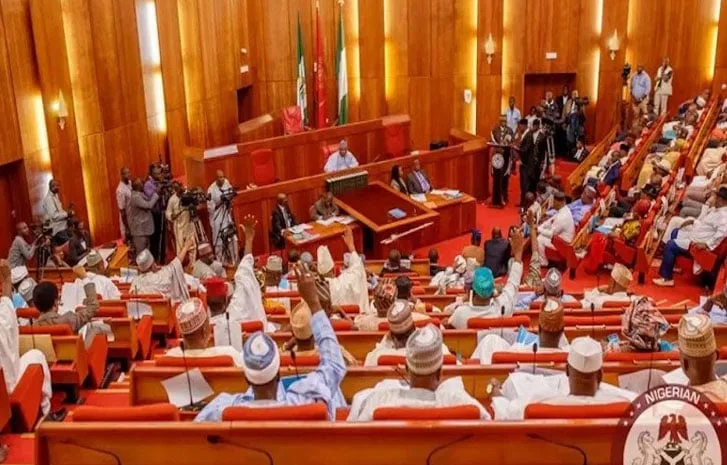
To forestall a possible clash of the 2027 general elections with next year’s Muslim Ramadan and Christian Lent, the Senate earlier on Tuesday reopened debate on the Electoral Act 2022 (Repeal and Re-enactment) Bill 2026, rescinding its earlier passage and recommitting the legislation to the Committee of the Whole.
This is to give room for fresh amendments to take care of the possible clash between the 2027 general elections and major religious observances, including the Muslim fasting period of Ramadan and the Christian Lenten season.
The decision followed consultations between the leadership of the National Assembly and the Independent National Electoral Commission (INEC), which had fixed the Presidential and National Assembly elections for February 2027 in line with the 360-day statutory notice requirement prescribed under Clause 28 of the amended law.
Leading the motion during plenary presided over by Senate President Godswill Akpabio, Senate Leader, Michael Opeyemi Bamidele, invoked Orders 1B and 52.6 of the Senate Standing Orders to justify the reconsideration of a bill already passed.
Bamidele explained that the Senate had passed the bill during an emergency sitting last week, but INEC subsequently announced its election notice and timetable, fixing the polls for February 2027.
He disclosed that representatives of Muslim communities had approached the INEC to express concern that the election date would fall within the Ramadan fast, while projections also showed that the Christian Lenten season would extend into March 2027, potentially overlapping with the general election period.
“Where it is possible for INEC to review its timetable without creating any conflict as envisaged, INEC could go ahead and reschedule,” Bamidele said.
“However, INEC further briefed us that in view of the provision we passed requiring more than 360 days’ notice before elections, time was already running, and there would be need for a further amendment for it to adjust its programme.”
He added: “The primary reason for convening today is to further amend the relevant provisions of the Electoral Act so that INEC can review its timetable in line with the concerns raised. Time is already running and without legislative intervention, it would be impossible for the Commission to adjust the schedule. This is not politically motivated; it is about inclusiveness, fairness and broad participation.”
Bamidele warned that elections conducted during intense periods of fasting and religious devotion could dampen voter turnout, complicate logistics, strain security operations and weaken public confidence in the process.
He said the Senate, therefore, decided to rescind its earlier decision in order to “jettison what we had earlier passed” and insert a clause that would empower the electoral body to review its timetable without breaching statutory timelines.
Beyond the faith-calendar concerns, the Senate Leader disclosed that a critical review of the bill also revealed wide-ranging technical inconsistencies and drafting errors in the long title and several clauses, including Clauses 6, 9, 10, 11, 22, 23, 28, 29, 32, 42, 47, 51, 60, 62, 64, 65, 73, 77, 86, 87, 89, 93 and 94, affecting cross-referencing, serial numbering and internal consistency.
“These scrivener’s errors and drafting gaps must be corrected to ensure coherence and prevent conflicting interpretations,” he added.
According to him, a technical harmonisation committee, comprising the leadership of both chambers, members of the conference committee, clerks of the Senate and House of Representatives and legal drafting experts from the National Assembly’s Directorate of Legal Services had met to address the anomalies.
Chairman of the Senate Committee on Electoral Matters, Simon Lalong, who seconded the motion, dismissed suggestions that the current INEC chairman deliberately fixed an election date that would clash with Ramadan.
He clarified that the long-term election timetable was originally unveiled in 2019 and had projected election cycles up to 2031, stressing that the issue was not a fresh decision targeted at any faith group.
After debate, the Senate unanimously adopted two motions. First, to rescind its previous decision on the bill and second, to recommit it to the Committee of the Whole for comprehensive reconsideration and necessary amendments.
Akpabio subsequently dissolved the chamber into the Committee of the Whole, where lawmakers repealed the earlier version of the bill in its entirety and commenced fresh clause-by-clause consideration.
The major amendment of the day, Clause 28, was altered to provide that the “Commission shall, not later than 300 days before the day appointed for holding of an election under this Bill, publish a notice in each state of the federation and the Federal Capital Territory, stating the date of the election and appointing the place at which nomination papers are to be delivered.
“The notice shall be published in each constituency in respect of which an election is to be held.
“In the case of a by-election, the Commission shall, not later than 14 days before the date appointed for the election, publish a notice stating the date of the election.
“There shall not be substitution of candidates in a by-election except where a candidate of a political party in a by-election dies, the party shall submit to the Commission the name of its substitute candidate within seven days of the death of the candidate in the Form prescribed by the Commission.”
This amendment effectively opened the window for the 2027 general elections to be held between December 2026 and January 2027.
However, proceedings turned rowdy when the Senate arrived at Section 60(3), dealing with the electronic transmission of election results.
Senator Enyinnaya Abaribe, rising on a point of order, strongly objected to the proviso that allows the use of Form EC8A to manually record results at polling units where internet connectivity is unavailable for immediate upload to INEC’s Result Viewing Portal (IREV). He demanded a formal division of the Senate to determine the matter.
“Mr President, Order 72 (1): ‘Any senator may challenge the opinion of the president by claiming a division.’ So, I am calling for a division. Thank you,” Abaribe said.
Akpabio responded, “Point of order by Senator Abaribe calling for a division on Section 60(3).
“What Senator Abaribe is saying is that in the event that the electronic transmission fails, we should leave it at that. We should not put a proviso that the primary source of collation, which is the EC8A, should be taken to the next centre for collation. So in view of that, he does not want to hear the word proviso.”
As the sergeant-at-arms was summoned to commence the voting process, Akpabio directed lawmakers, “Those who want the proviso that in the event that there is a communication failure and we cannot transmit the form EC8A at that time, and then we take it to the next centre, stay on the right side.”
His instruction was met with loud protests of “noooo” from opposing senators.
Intervening, Bamidele advised, “Mr President, you are the presiding officer. By the grace of God and the mandate given to you by our colleagues here, you are the presiding officer. Nobody is going to tell you how to conduct this division. If you like, it can be by show of hands. If you like, you can ask for a show of hands. If you want us to be on a particular aisle, we can go there.”
Akpabio then modified the voting method, stating, “Now, this is the procedure that I’m going to take. You will stand up on your seat and also raise your hand.
“So, if you are in support of the proviso which enables the presiding officer to proceed to the next centre for collation with the hard copy of the signed form EC8A so that collation can continue, if you are in support of that proviso, can you stand and raise your hand? Sergeant-at-arms, come and count. Only stand up, raise your hand so that people can see you.
The social media must see you. Wherever you are, stand so that people can see you.”
Turning to the opposing camp, he added, “This is democracy in action. Those who have voted have been counted. Now, we want to see those that are insisting that if the transmission or communication fails, that the election stops there.”
They responded, “No, we said no proviso.”
Akpabio then directed, “Those opposed to the proviso, can you now stand up and raise your hand?”
The senators counted included Abdul Ningi, Natasha Akpoti-Uduaghan, Aminu Tambuwal, Victor Umeh, Seriake Dickson, Peter Jiya and Tony Nwoye.
Announcing the outcome moments later, Akpabio said: “The result is as follows. The results have just tumbled in from the IREV. Those who do not want any proviso are 15 in number, and those who want the proviso are 55 in number. And so, the proviso stays.”
With the decision taken, the Senate continued clause-by-clause consideration of the bill. After concluding deliberations in the Committee of the Whole, lawmakers passed the bill for third reading, adjourned for 30 minutes and reconvened to formally adopt the votes and proceedings.
In his remarks, Akpabio thanked his colleagues for displaying democracy, “particularly those who had the courage even in the face of overwhelming majority to stand up and to answer your father’s name by showing so much courage to vote against a proviso in 60(3).”
He continued, “Your minority status notwithstanding, you showed overwhelming courage. You were able to prove democracy at work. I also want to thank those who voted for the proviso to remain that you have saved democracy by making sure that we don’t go on continuous reruns and repeats of elections. By ensuring that the primary mode of election results is the form EC8A.
“I want to also thank the Senate for introducing electronic transmission of polling unit results through the portal to the IReV, which will now make it possible for election monitors, including foreigners, who monitor our results, who are not able to visit the 176,000 plus polling units in Nigeria, to see the polling unit results dropping into the IReV.
“This is a major innovation since 1960, which is still a stance to be applauded. I also want to thank you for noting that elections are done in the polling units. Elections are not done at the collation centres. That is why you insisted that the polling unit results filled by presiding officers and co-signed by the polling clerk as well as agents of candidates and political parties where available remain the primary mode of collation of all results in Nigeria.
“I thank you for your innovation that we should undertake in the future that there is only direct consensus in our primary system because this will enable all the party people to partake in the choice of their candidates.
“Above all, I thank you for cancelling your budget defence and coming to undertake this plenary to bring this issue to an end. Congratulations to all for ensuring a smooth election in 2027.”
