
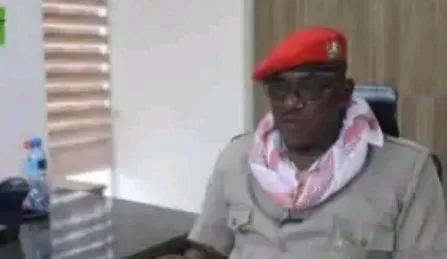
A former Minister of Youths and Sports, Solomon Dalung, has raised concerns over the presence of American troops in Nigeria, questioning their effectiveness in addressing the country’s worsening security challenges.
Dalung made the remarks during an interview with RT, where he expressed scepticism about the role of the United States in Nigeria’s counter-terrorism efforts, particularly in the fight against insurgent groups such as Boko Haram.
Speaking on the issue, Dalung suggested that opposition to potential U.S. intervention could indicate complicity in the country’s security crisis.
“If the Americans are concerned and they want to intervene, and they are against the coming of the Americans, then it means they are responsible for what is happening to Nigerians,” he said.
However, he went further to argue that the presence of American forces may have exacerbated insecurity rather than improved it.
According to him,
“The coming of the Americans has even worsened the situation. The terrorists are more emboldened with the arrival of the Americans.
They have been more assertive and they have also been more aggressive in terms of attacks.”
He added, “So one will tend to want to want to wonder whether the coming of the Americans have added salt to injury. Because we have not had any efforts by the American troops.”
Dalung also questioned the effectiveness of surveillance technology reportedly deployed by U.S. forces, particularly drones.
“The drone they have been flying, I don’t know where the drones exist. If the drones were effective, why could they not detect Boko Haram was moving to attack a military formation today in Maiduguri where they killed a Commander?” he said.
Continuing, he criticised what he described as a lack of visible results from such operations.
“Where were the drones, the terrorists move kinetically, that is, using motorcycle vehicles? If they had drones that the Americans brought, these drones did not see them.”
He further raised doubts about whether the drones were functioning optimally, stating,
“Could it be that these drones have been blinded from seeing the terrorists, so I think the issue of the presence of Americans in Nigeria has created more problems for the Nigerian security situation, compared to when they were not here, and I am confused as to what they are actually doing here.”
Dalung’s comments come amid ongoing debates over foreign military assistance and its effectiveness in addressing Nigeria’s complex security landscape, particularly in the North-East where insurgency and attacks on military formations have persisted.
In February, Nigeria and the United States agreed to deepen military cooperation following growing concerns over terrorist threats in West Africa, leading to the deployment of a small team of U.S. troops to Nigeria.
The agreement was confirmed by the head of the United States Africa Command (AFRICOM), General Dagvin R.M. Anderson, who said both countries concluded that existing efforts were not sufficient to address evolving security challenges in the region.
The renewed cooperation came weeks after U.S. President Donald Trump ordered airstrikes in December on what he described as Islamic State targets in Nigeria.
Trump had also warned at the time that further American military action could follow, signalling a tougher U.S. posture toward extremist groups operating in West Africa.
Speaking at a media briefing , Anderson said discussions between Washington and Abuja resulted in an understanding that closer collaboration was necessary, culminating in the deployment of U.S. personnel to support Nigeria’s counterterrorism efforts.
“That has led to increased collaboration between our nations to include a small US team that brings some unique capabilities from the United States,” Anderson told journalists.
While confirming the agreement, the AFRICOM commander declined to provide details on the size of the U.S. team, its specific role, or the duration of its presence in Nigeria. He also did not disclose whether the troops would be involved in combat operations or play advisory and support roles.
The U.S. deployment marked the first official acknowledgement of American troops operating on Nigerian soil since the December airstrikes.

Leave a Reply