
By Femi Orebe
Given the excessive hoopla now ŏcascading the ranks of members and supporters of the African Democratic Congress (ADC) since being joined by Mallam Mohammed Rabi’u Musa Kwankwaso, FNSE FNIQS, former governor of Kano state (1999 – 2003 and from 2011 – 2015), Minister of Defence and later, one – term senator representing the good people of Kano Central Senatorial District, one thing has become quite obvious, namely: that his movement is not just being seen as a case of the ‘more the merrier’ but, rather that this is one Northern catch to have on their Presidential ticket rather than the revered, but serial election
loser, the Waziri Adamawa, Atiku Abubakar who, being a consumate financier of political parties at elections, most Nigerians have assumed would head the party’s Presidential ticket.
That being the case, it would then follow, logically, that the other front runner, Peter Obi, the 2023 Labour party Presidential candidate, would now be expected to head the team with new comer, Rabiu Kwankwaso as the Vice- Presidential candidate since the ticket cannot, constitutionally consist of two Northerners.
This, I suspect, must be one reason the likes of Kenneth Okonkwo, an Igbo member of the National Working Committee (NWC) of the party , have been waxing lyrical of late.
That fact will also mean that former President Obasanjo has successfully escaped the wrath he feared God might inflict on him if , with all he claims to know, Atiku ever became the Nigerian President. It is, therefore, already looking like Obasanjo has got his boy, no mentee, Peter Obi, ( probably one of the reasons he failed in ’23) exactly where he wanted him since he has been canvassing an Obi/ Kwankwaso ticket which I earlier poo – poo-ed in an article on these pages.
I urge the reader to consider the above scenario as the logic behind the article you are about to read.
But then this will not be Obi’s first attempt at the Presidency and with all the ethno- religious baggage he carries, some of which this essay would touch on, we shall wait and see how far he goes.
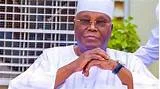
The article is, therefore, something of a dirge on Atiku Abubakar’s long and spirited -attempts at trying to become Nigeria’s Number One Citizen.
And what a courageous effort!
When former President Olusegun Obasanjo first muttered that Atiku Abubakar’s presidential fixation traced back to “marabouts” — the itinerant Islamic diviners who trade in amulets and electoral prophecy across the Sahel — most Nigerians filed it under OBJ’s usual ‘bad belle’ politics. But the image stuck: Atiku not merely as a restless Adamawa businessman-politician, but as a man haunted by nighttime consultations, cowrie-shell promises, and the old Northern belief that power can be foretold, bought, and ritually secured. For twenty-five years that notion shadowed his march from vice-president (1999-2007) to perennial PDP contender and now, in 2027 calculations, to the man now edged aside for Peter Obi.
The marabout thread is not literal documentation; Obasanjo never produced a receipt from a Mallam in Maroua as evidence of his claim. Rather it is a metaphor that came to describe Atiku’s method: coalition-building, as divination, delegate congresses treated like prayer sessions, with the ambition sustained by the hope that the next ballot will finally deliver; almost akin to playing ‘kalo kalo’.
He lost PDP primaries in 1993, ran under AC in 2007, returned to PDP for 2011, 2019 and 2023 bids. Each defeat was followed by a quiet recalibration — new alliances, new financing, new readings of the political tide. Like a client returning to a marabout after a failed charm, he never abandoned the craft.
Peter Obi entered that spiritual marketplace late. In 2019 he accepted the vice-presidential slot beside Atiku. The pairing lost, but Obi absorbed the clientele, mostly young urban voters who treat politics less as fate than as spreadsheet. By 2023 he had walked out of PDP, ran on Labour, leveraging almost solely on ethnicity and religion both 0f which he hugely bastardised,
and polled over six million votes, making him a direct challenge to Atiku’s claim on opposition leadership. Thus Where Atiku’s story depended on endurance, Obi’s relied on rupture.
The 2027 cycle has made things more explicit. While Atiku was still lobbying inside the African Democratic Congress, Obi’s supporters, the Obidients with Baba Obasanjo’s annoiting, now describe him as “already accepted” by the ADC’s grassroots and warn Atiku against seeking a “one-term Deputy” arrangement. Headlines speak of Atiku being “out” while Obi is “in.” Obasanjo’s marabout jab resurfaces on Twitter not because anyone believes Atiku carries a marabout about, but because it captures a deeper weariness: the sense that his ambition has become ritual, a charm repeated until the beads wear smooth and the competition becomes: Obi or nothing.
What a life!
Atiku’s odyssey mirrors Nigeria’s own post-1999 dream: that civilian politics could be routed through bargaining elites who, if they balanced zones and pockets, would eventually produce governance. The marabout metaphor fits because it was always about intermediaries — emirs, generals, businessmen — who claimed to read the unseen.
Atiku mastered that system. He survived Obasanjo’s impeachment plots, EFCC investigations, and party switches because he knew which Mallams and generals to visit. In ’23, they browbeat Tambuwal so much he ended up messing up the PDP primaries and finally ended up scattering that party.
But the voters he courted in 2023 are no longer waiting for intermediaries. Existential challenges have changed all that – fuel queues, Naira collapse, kidnappings and allied insecurities have rendered prophecy feel obscene.
Obi’s ascendancy in the opposition is the subversion of that logic, underpinned mostly by his ethnic Igbo enthusiasts in the Obidient movement and a couple of pastors and ‘Yes Daddies’ who think nothing of turning their pulpits to campaign rostrums. They did it once, they’ll do it again.
There is, of course, some irony. The North that Obasanjo once described as “led by marabouts”, now houses governors — Uba Sani of Kaduna among them — who publicly blamed Northern elders, not Abuja, for insecurity and underdevelopment. They call out the same fatalism Obasanjo mocked: the habit of outsourcing responsibility to charms or to the Federal Government. In that sense, Atiku’s underwhelming politics is also the North’s critique of its own old politics.
The odyssey ends, then, not with a coup or a scandal, but with a ballot dilution. If Obi finally secures the ADC ticket and Atiku retires, the moral will be this: political longevity is not the same thing as inevitability. Marabouts can advise, but they cannot manufacture a majority of voters.
The marabout-inspired journey that carried a Vice-President from 1999 through four failed bids finishes not in prison or exile but in polite obsolescence. Ritual replaced by résumé.
But for tribe and religion – loving Peter Obi, even this victory can only be phyrric as it won’t take him near the diadem. Therefore, Atiku die- hards like Dele Momodu in ADC need not fret unnecessarily..
Ordinarily, the new hegemons – Obi and Kwankwaso – cannot afford to summarily deal with the Atiku group in the party – those powerful men Atiku had handpicked to run the party in the wake of their hurriedly purchasing a party in an inchoate manner as it is fast turning out.
Trouble is, however, Obi has enough troubles of his own – troubles to drown his Presidential ambition.
Nigerians are no fools and the days of a candidate winning 99 per cent of votes in his/her geo-political zone as always happen in the Southeast is long gone.
Besides that, Peter Obi’s appeal rests on a counter-mythology to Atiku’s marabout endurance act, that is, the myth of the austere, incorruptible politician who will rescue Nigeria by sheer personal frugality.
Really?
Where is the truth of that as a correct reading of Obi’s tenure as the Anambra state governor? He claimed he left ₦75 billion in savings, invested in International Breweries but what did his successors as Anambra governos say of that dubiety?
What was his answer to the allegation that he invested state funds in family business?
How much unpaid debt did he leave on his way out, not minding that his supporters continue to clip those false effusions into a legend: Obi never steals, Obi flies commercial, Obi reads budgets while rivals consult seers etc.
But the downsides stick to that same legend. First, sanctimony. Obi’s “go and verify” rhetoric slides easily into a holier-than-thou posturing which alienates educated minds which, incidentally, most Igbo are.
It is like the Northern power brokers Obi is ever so ready to please – going to, and kneeling, in Mosques, hugging El Rufai and others, promising that a people, the Igbos, who are yet to have a Nigerian President in decades, would be content with him serving only a term of 4 years, when they are no fools.
All they hear is “I don’t give shishi” which they translate as “he lacks the pragmatic generosity that nourishes their system. Politics in the Third World runs on patronage, refuse it absolutely and you risk even your own victory at the polls.
His party has shaky structures, no governors, weak, even negligible NASS presence, with some court cases still ongoing.
Obi’s charisma, if I can say that, cannot deliver the Republic.
He is merely grandstanding. And Nigerians cannot, and should not expect any miracles from an Obi/ Kwankwaso Presidential ticket.
The 7th Waziri Adamawa has had his run, he has done his utmost and it is my prayer that he finds inner contentment.

Leave a Reply