
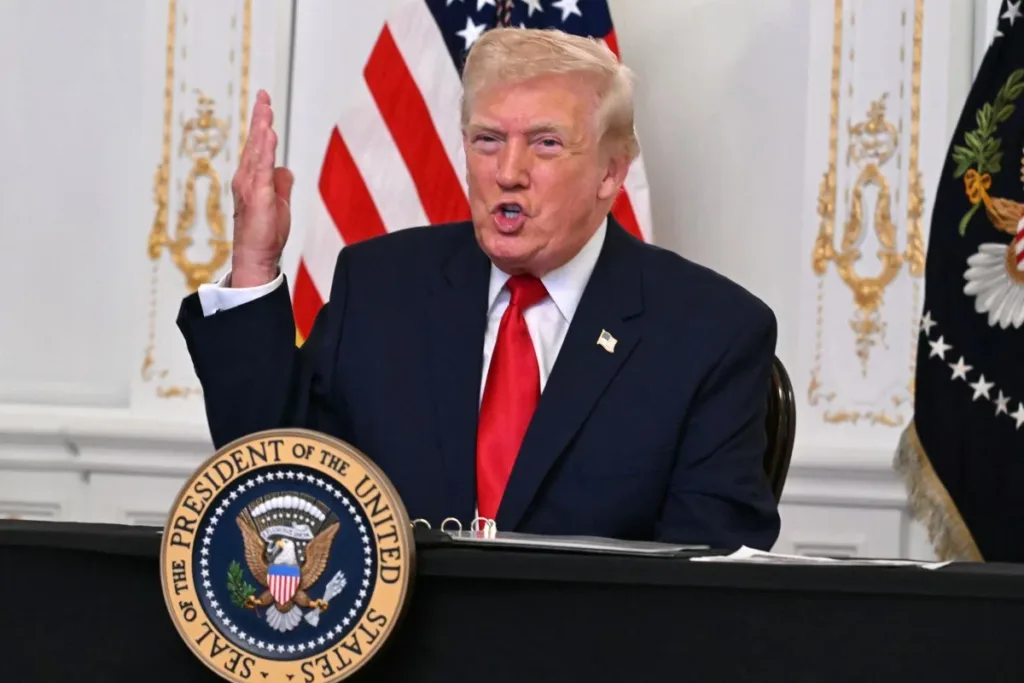
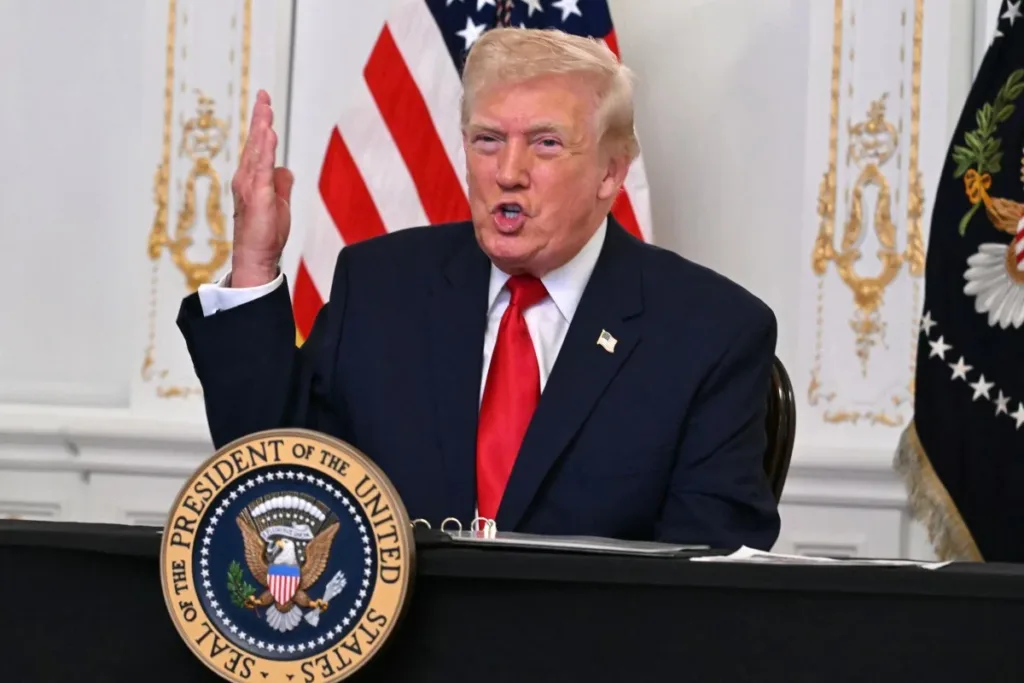
Donald Trump warned that he is not ready to seek a deal to end the war with Iran, as US ally Israel launched a new wave of strikes on Sunday and Tehran’s Revolutionary Guards threatened to hunt down and kill the Israeli leader.
The US president, in an interview with NBC News, said he thought Tehran was keen to come to the table but that Washington would fight on for better terms and might bomb targets on Iran’s oil hub Kharg Island once again, “just for fun.”
More than two weeks into the US-Israeli war against the Islamic Republic, neither side is moderating its rhetoric despite a mounting death toll and economic damage from soaring oil prices caused by the effective closure of the Strait of Hormuz sea lane.
“Iran wants to make a deal, and I don’t want to make it because the terms aren’t good enough yet,” Trump told NBC News, warning that US forces would step up strikes on the Iranian coast north of the strait to clear a path for oil shipments to resume.
Iran’s new supreme leader, Ayatollah Mojtaba Khamenei, has—in a written statement—vowed to keep Hormuz closed. But Trump dismissed this and suggested his foe might not even be in control, saying, “I don’t know if he’s even alive. So far, nobody has been able to show him.”
Iran said on Saturday that “there is no problem with the new supreme leader,” even though he has yet to appear in public.
The Israeli military, meanwhile, announced a wave of strikes against targets in western Iran after Iran’s Revolutionary Guards branded Prime Minister Benjamin Netanyahu a criminal and vowed that they would pursue and kill him.
The United States has urged its citizens to leave Iraq, where pro-Iranian groups have launched attacks on the US embassy and bases hosting Western military units.
Despite the hardline talk from all sides, the citizens of Tehran were able to go about their work week in the most normal atmosphere since the start of the war on February 28, when US-Israeli strikes killed the previous supreme leader, Mojtaba’s father, Ali Khamenei.
Traffic was busier than last week, and some cafes and restaurants had reopened.
One resident whizzed down the street on an electric hoverboard, and more than a third of stalls in the Tajrish bazaar, a popular shopping hub in the north of the capital, had reopened five days before Nowruz, the Persian New Year.
Some shoppers queued at ATMs to withdraw cash. Online operations at Bank Melli, one of the country’s largest, had been paralysed in recent days.
Further on, passengers were waiting at bus stops, which had been largely deserted since the beginning of the war.
Trump has suggested an international naval operation could escort oil tankers through the Strait of Hormuz, lessening pressure on the oil price and securing supplies for countries whose economies are most exposed to the conflict.
“Hopefully, China, France, Japan, South Korea, the UK, and others, that are affected by this artificial constraint, will send Ships to the area,” Trump said in a social media post on Saturday.
Asked about this, the UK Ministry of Defence was noncommittal. “As we’ve said previously, we are currently discussing with our allies and partners a range of options to ensure the security of shipping in the region,” it said.
South Korea said it was “closely monitoring President Trump’s remarks on social media.”
The policy chief of Japanese Prime Minister Sanae Takaichi’s ruling party, Takayuki Kobayashi, said the bar for sending Japanese navy ships to the region under existing laws was “extremely high.”
Bahrain and Saudi Arabia said separately on Sunday they had intercepted renewed barrages of projectiles after an AFP journalist heard warning sirens in Manama.
Late Saturday, authorities in Dubai also said air defences had made further interceptions after Iran’s military warned UAE and civilians to avoid port areas.
US forces struck Iran’s Kharg Island on Friday—from which nearly all of Iran’s oil exports flow—but both sides confirmed that the strikes only took out military defences and left the oil export terminals intact.
More than 1,200 people have been killed by US and Israeli strikes, according to Iranian health ministry figures that could not be independently verified.
The UN refugee agency says up to 3.2 million people have been displaced in Iran, most of them fleeing the capital and other cities to seek safety.
The Pentagon says more than 15,000 targets in Iran have been hit by US and Israeli forces.

Leave a Reply