
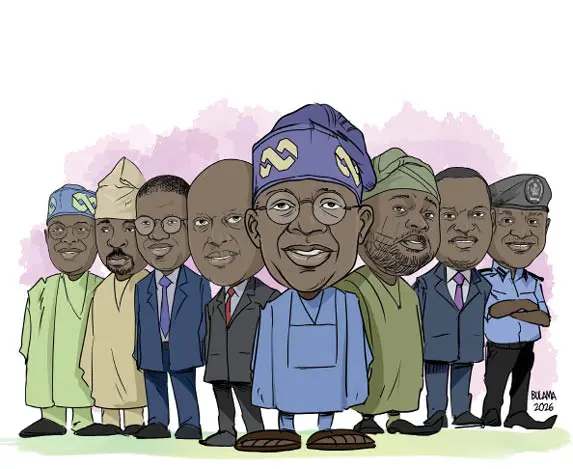
The recent elevation of the Chairman of the Presidential Committee on Fiscal Policy and Tax Reforms, Taiwo Oyedele, as the Minister of State for Finance, is viewed in many quarters that President Bola Ahmed Tinubu is expanding his kitchen cabinet ahead of the 2027 general elections.
The president is almost three years into his first term and evidently, alignments and realignments are taken shape in earnest as another round of election inches closer.
Sources said what is happening now at the presidency is not new; as Tinubu’s propensity to surround himself with tested allies has been documented way ahead of his becoming the governor of Lagos State.
On Friday, the presidency announced the postings of ambassadors, which Weekend Trust learnt went through intense lobbying.
overlay-clevercloseLogo
Harrowing world of Plateau, Benue children of war
How Ramadan feeds needy, small businesses
It appears that while the opposition parties are working on how to confront the ruling All Progressives Congress (APC), President Tinubu is also not taking anything to chance to ensure that he gets a second term in office.
The Presidential Committee on Fiscal Policy and Tax Reforms, which Oyedele heads, was set up by President Tinubu in October 2023 to carry out critical reforms bordering on fiscal governance, revenue transformation and economic growth facilitation.
The bill for the tax reforms was widely opposed initially, but after some adjustments and subsequent implementation, it is held that Oyedele had delivered on that mandate, which, according to speculations, may have earned him the appointment as Minister of State for Finance.
Oyedele’s appointment also came a few days after Olatunji Disu was appointed Inspector General of Police.
Disu worked with President Tinubu previously as Aide-De-Camp (ADC) when the latter was Lagos State governor.
The recent developments have, according to keen political watchers, proven that those who had close relations with the president are doubling down on their influence.
A few months after the president made key appointments in his government, there were criticisms that it was dominated by those who worked with him in Lagos. It gave rise to what was called the Lagos group then, which comprised people that were part of his political journey in the state, with only a scanty reach to those outside that circle.
In less than three years, those known to be close to the president have not only consolidated their influence in running the government but have moved further up the ladder.
They are currently playing significant roles while interacting and collaborating with the president.
Political watchers have expressed fears that the repositioning of the men and women close to the president might be part of his plans for the general elections. Some say one of the areas the president needs to work on is the economy and that that may be why he has nominated one of his trusted men for the Ministry of Finance.
Dr Abdussalam Kani, an economist and academic at Sa’adatu Rimi College of Education in Kano State, said the government has a lot to do on the economic front.
He said, “From the time this government took over, poverty has escalated, unemployment has worsened, and insecurity has deepened. Inflation has declined, but insignificantly.
“Our reserves have improved, but again insignificantly. When you compare the revenue generated from subsidy removal and tax expansion with the debt burden, you see that the economy has not improved beyond expectation. Look at the power sector, infrastructural deficit, education, maternal and child mortality — these are areas where progress is either absent or negligible. So, while there are minor improvements, they are not sufficient to claim that the economy is truly improving.”
An economist at Al-Hikmah University, Ilorin, Dr Wasiu Olasunkanmi Lawal, said the appointment of Mr Taiwo Oyedele as the Minister of State for Finance carries significant economic, political and administrative implications for Nigeria, particularly in the area of fiscal policy and tax reforms.
Lawal noted that Oyedele’s previous role as the head of the Presidential Committee on Fiscal Policy and Tax Reforms already placed him at the centre of Nigeria’s tax reform agenda, adding that his new position provides an opportunity to drive the implementation of the proposed reforms.
“I think the appointment of Mr Taiwo Oyedele as the Minister of State for Finance has several economic, political and administrative implications for Nigeria. We already know his influence when he led the Presidential Committee on Fiscal Policy and Tax Reforms, and he is expected to help implement the major tax reforms,” he said.
Those believed to be the president’s men include the Minister of Finance, Wale Edun; Governor of the Central Bank of Nigeria, Yemi Cardoso; former Lagos State Head of Service and current Principal Private Secretary (PPS) to the president, Hakeem Muri-Okunola; Bayo Onanuga, and Chief of Staff to the president, Femi Gbajabiamila.
There’s the family circle, which consists of close family members like the First Lady, Remi Tinubu, and the president’s son, Seyi Tinubu.
Since the inauguration of the current administration, the First Lady, Senator Remi Tinubu, has maintained high visibility, projecting the president as a compassionate and visionary leader.
She has used her goodwill to win people over to the administration and has made humanitarian interventions in cases of emergencies.
Seyi Tinubu, the first son, as he is called, has been actively campaigning for his father and at a time described him as one of the best the country has had. He is known to be a rallying point for those intending to work on the president’s 2027 campaign.
There’s also the elders’ circle, comprising the elders whom the president defers to due to age, like former governor of Ogun State, Segun Osoba, and former governor of Osun State, Bisi Akande. There’s also Senator Abu Ibrahim, one of his allies from the northern part of the country.
Connected by appointments
Among the president’s close allies are those who, by their appointments, moved into the circle, and they include the Minister of Trade, Dr Jumoke Oduwole; Comptroller-General of Customs, Adewale Adeniyi; Chairman of the Nigerian Revenue Services, Dr Zacch Adedeji; Group Managing Director of the Nigerian National Petroleum Corporation Limited (NNPCL), Bayo Ojulari; Adeleye Falade of the Nigerian Liquefied Natural Gas (NLNG); Odulare Sunday, NDIC; Ayodeji Oludare Sotunrin, Bank of Agriculture; and Dr Olasupo Olusi, who heads the Bank of Industry, and the Minister of Education, Dr Tunji Alausa.
Aside from the formal sector, there is also Musiliu Akinsanya, popularly known as MC Oluomo, who is the National President of the Union of Road Transport Workers (NURTW). Though not directly appointed by Tinubu, analysts say that Oluomo’s current position is a positive for the president due to the influence he wields.
The president is believed to have built and sustained a political structure. From his days as a senator to when he was in the democratic struggle, and later Lagos State governor, to Nigeria’s president, his politics has been shaped not only by his personal ambition and political skill but also by the network of loyal allies popularly referred to as “Tinubu’s men.”
Femi Gbajabiamila
Over the years, Femi Gbajabiamila, the present Chief of Staff to the President, has emerged as one of the most prominent figures within Tinubu’s expansive political network, rising through the ranks from Lagos politics to the pinnacle of national governance.
His journey reflects the workings of the political structure built by Tinubu over more than two decades, a network that has produced governors, ministers, legislators and party leaders across Nigeria.
Gbajabiamila’s political rise began during the formative years of Tinubu’s political dominance in Lagos State.
A trained lawyer who practiced in the United States before returning to Nigeria, he entered politics in the early 2000s and was elected to the House of Representatives in 2003 representing Surulere Federal Constituency.
His ability to navigate legislative politics earned him increasing influence within the opposition bloc that later transformed into the All Progressives Congress.
Gbajabiamila’s political career reached a major milestone in 2019 when he emerged as Speaker of the House of Representatives.
Gbajabiamila’s influence did not diminish after his tenure as Speaker ended. Following Tinubu’s victory in the 2023 presidential election, he was appointed Chief of Staff to the President, placing him at the heart of the federal government’s decision-making structure.
As Chief of Staff, Gbajabiamila plays a critical role in coordinating presidential operations, managing access to the president, and overseeing the implementation of key policy directives.
Hakeem Muri-Okunola
Within the growing network of trusted aides surrounding President Tinubu, one figure whose influence has steadily expanded is Hakeem Muri-Okunola. Known within government circles simply as “HMO,” Muri-Okunola has built a reputation as a discreet but powerful administrator.
Those in the president’s camp said the rise reflects the technocratic side of Tinubu’s political establishment.
Unlike many of the president’s allies who emerged primarily through electoral politics, Muri-Okunola’s ascent has been shaped largely by his bureaucratic expertise and administrative competence.
From being Head of Service at a young age, he enjoyed a rare meteoric rise in the service of the Lagos civil service.
Muri-Okunola’s background is deeply rooted in Nigeria’s political history. He is the son of the late Muritala Okunola, a respected Nigerian administrator who served as Secretary to the Government of Lagos State during the military era.
It was learnt that Muri-Okunola is considered a son to the president, given Tinubu’s closeness to the family.
Muri-Okunola’s national visibility increased significantly when he was appointed Head of Service of Lagos State in 2019 by Governor Babajide Sanwo-Olu.
Following Tinubu’s emergence as Nigeria’s president in 2023, Muri-Okunola’s proximity to the Lagos political establishment positioned him for a role within the federal administration.
He was subsequently appointed Principal Secretary to the President, a strategic role within the presidency that places him at the centre of executive coordination.
At the moment, HMO is said to be a leading contender in the Lagos governorship race in 2027. Despite holding a powerful office, Muri-Okunola maintains a relatively low public profile compared to other figures in the president’s circle. He rarely engages in overt political commentary and prefers to operate behind the scenes.
Wale Edun
Wale Edun is widely regarded as one of the most trusted technocrats in the inner political and economic circle of President Tinubu. His relationship with Tinubu spans decades and predates the current administration.
Edun’s association with Tinubu dates back to the late 1990s when Tinubu served as governor of Lagos State between 1999 and 2007. During that period, Edun was appointed Commissioner for Finance in Lagos. In that role, he helped shape the financial reforms that later became a model for fiscal restructuring among Nigerian states.
Under Tinubu’s governorship, Edun worked closely with other technocrats to modernise Lagos’ revenue system, expand internally generated revenue, and introduce financial discipline into public finance management.
Edun also played a major role during Tinubu’s 2023 presidential campaign. He served as chairman of the economic advisory team that drafted the policy blueprint that later evolved into the administration’s economic agenda.
After Tinubu assumed office in May 2023, Edun was first appointed Special Adviser on Monetary Policies before later becoming Minister of Finance and Coordinating Minister of the Economy.
But recent speculations around Edun point to a rift between him and the presidency, with some forces trying to subjugate him in the economic management team. At one point, the then Minister of State for Finance, Doris Uzoka-Anite, was said to have taken charge of affairs in the ministry, taking strategic decisions in place of the senior minister.
Be that as it may, Edun still remains an important figure in the orbit of President Tinubu. And analysts say he occupies a strategic role that could be of benefit to the president as he navigates the battle for a second term.
Rise of Obasa
The political ascendancy of Mudashiru Obasa within the Lagos power structure has become one of the most striking examples of loyalty, strategy, and grassroots political mastery in the orbit of President Bola Ahmed Tinubu.
Over the past two decades, Obasa has transformed from a relatively obscure Lagos politician into one of the most influential figures in the state’s legislative and political architecture, consolidating his status as a key pillar in Tinubu’s political empire.
Apart from being the longest-serving legislator, he is also the longest-serving lawmaker of the House.
Obasa’s political journey began in the densely populated suburb of Agege, a historically important political base in Lagos. Known for its vibrant grassroots politics, Agege has produced several influential politicians within the ruling All Progressives Congress.
Before becoming Speaker, Obasa had already established himself as a grassroots mobiliser and a dependable party loyalist. People around him say his early political influence stemmed from his ability to connect with ward-level structures and community leaders. This has endeared him to the president and made him an invaluable asset in Tinubu’s political empire.
Taiwo Oyedels
Taiwo Oyedele was little known within the president’s circle until after the 2023 election when Tinubu was sworn in. Oyedele has an extensive background in finance, taxation, and public policy. He previously served in senior roles in both the private and public sectors, including positions in global accounting and consulting firms.
His experience includes designing tax policy frameworks, advising on fiscal reforms, and implementing strategies to improve revenue mobilisation.
This expertise made him a natural choice to guide Tinubu’s economic team. Coming from PwC, one of the foremost global consulting groups, Oyedele was appointed Chairman of the Presidential Fiscal Policy and Tax Reforms Committee shortly after Tinubu assumed office in 2023. In this role, he was responsible for reviewing and overhauling the nation’s tax policy framework, advising on revenue generation strategies, and engaging with international partners to align Nigeria’s tax system with global best practices.
The work of his committee led to the drafting of four new tax bills, which have been passed into law with the aim of reforming the nation’s tax system.
The bills are the Nigeria Tax Bill (Ease of Doing Business), which aims to consolidate Nigeria’s fragmented tax laws into a harmonised statute; the Nigeria Tax Administration Bill, which will establish a uniform legal and operational framework for tax administration across federal, state, and local governments.
Others are the Nigeria Revenue Service (Establishment) Bill, which repealed the Federal Inland Revenue Service Act and created a more autonomous and performance-driven national revenue agency — the Nigeria Revenue Service (NRS); and the Joint Revenue Board (Establishment) Bill, which provides for a formal governance structure to facilitate cooperation between revenue authorities at all levels of government.
With the passage of these bills into law, it was expected that Oyedele, regarded as the ‘Taxman’, would have concluded his assignment until this week, when the president nominated him as a Minister of State for Finance.
This would now propel him into the mainstream of Tinubu’s economic team, and sources say he would be made to oversee strategic revenue-generating agencies like the NRS, formerly known as the Federal Inland Revenue Service (FIRS), among others.
Olayemi Cardoso
Olayemi Cardoso stands out as one of President Tinubu’s most trusted technocrats and a cornerstone of his economic team, managing the monetary policy of the administration. Appointed Governor of the Central Bank of Nigeria (CBN) shortly after Tinubu assumed office in 2023, Cardoso’s role is pivotal in shaping monetary policy, stabilising the naira, and supporting the administration’s broader economic reform agenda.
Cardoso is a seasoned banker and economist with decades of experience in both the private and public sectors. Before his appointment, he held senior positions in top financial institutions, including advisory roles in international banking and financial consultancy. His deep understanding of global finance, risk management, and macroeconomic trends positioned him as a natural choice to guide Nigeria through a period of significant economic transition.
Cardoso’s influence extends beyond standard central banking duties. He is an integral part of Tinubu’s economic inner circle, alongside others coordinating strategies that balance monetary stability with fiscal reforms.
He has been a member of the president’s team since the 1990s, when he served as Commissioner for Budget and Economic Planning under Tinubu as governor. He was regarded as a thoroughbred due process man and, as the CBN Governor, he has quietly managed the monetary policy of the government in alignment with Tinubu’s economic philosophy: market-driven growth, fiscal prudence, and institutional reforms.
His stewardship of the CBN is critical in ensuring the success of reforms such as currency stabilisation, exchange rate realignment, and financial sector modernisation. His position remains strategic both in present and future events, according to analysts.
Adegboyega Oyetola
Adegboyega Oyetola is widely regarded as one of President Bola Ahmed Tinubu’s allies and a key player in consolidating the president’s influence within the political landscape. A seasoned politician with decades of experience in governance and party politics, Oyetola exemplifies the blend of strategic loyalty and political acumen that characterises Tinubu’s inner circle.
Oyetola served as Governor of Osun State from 2018 to 2022, representing the All Progressives Congress (APC).
Before becoming governor, Oyetola held several influential positions in state government and within the APC, allowing him to develop a robust network of political alliances across southwestern Nigeria. His deep roots in the region, combined with his loyalty to party leadership, positioned him as a reliable ally for Tinubu.
Oyetola, who hails from Iragbiji, a town in Osun State believed to be the ancestral root of the president himself, has consistently supported the president’s political agenda, including party consolidation efforts, electoral mobilisation, and policy advocacy. Analysts say he is crucial to how the president will perform in the coming elections.
IGP Tunji Disu
The new Inspector-General of Police, IGP Olatunji Disu, is undoubtedly a thoroughbred police officer, but he is also a Tinubu man to the core. He combines professionalism, competence and capacity with loyalty to the Tinubu dynasty.
Born on April 13, 1966, Tunji Disu hails from Lagos Island LGA of Lagos State. He had his post-primary education at Mayflower Junior School, Ikenne, Ogun State; attended Pobuna Secondary Grammar School, Epe; and Saint Gregory’s College, Lagos.
He also obtained a Bachelor of Arts degree in English (Education) at Lagos State University in 1989; and a Post-Graduate Diploma in International Relations and Strategic Studies, also at Lagos State University.
He has been serving Tinubu since the 1990s. When the president was the governor, Disu was his Aide-De-Camp (ADC). After serving as his ADC, he was redeployed to the Ogun State Police Command to serve as the Divisional Police Officer (DPO) in charge of Ago-Iwoye. At a point, he was elevated to a new rank as an Assistant Commissioner of Police (ACP) and was Deputy Head at the Criminal Investigation Department (CID) of the Rivers State Police Command before his transfer to the Lagos State Command and subsequent deployment as the Commander in charge of the Rapid Response Squad (a position the now ex-IGP, Kayode Egbetokun, held from 2005–2007).
Disu took over as RRS Commander on 13 June 2015 until his elevation to the rank of Deputy Commissioner of Police (DCP) on 10 April 2019. He was re-appointed the next day, a position he held until 2020 when he was redeployed to Force Headquarters, Abuja, at the Department of Operations. As the number one security officer, his position and influence have grown and are crucial to major activities across the country.
Zacch Adelabu Adedeji
Adedeji is the Executive Chairman of the Nigeria Revenue Service. He served as the Commissioner for Finance in Oyo State under late Governor Abiola Ajimobi and was later appointed as the Executive Secretary of the National Sugar Development Council (NSDC).
He was appointed Executive Chairman of the Federal Inland Revenue Service (FIRS) in September 2023. His handling of the revenue service is said to have endeared him to the president. His current position places him in a strategic position.
Bayo Onanuga
In October 2023, President Tinubu appointed Bayo Onanuga his Special Adviser on Information & Strategy. Before then Ajuri Ngelale was his official spokesperson. There was reported clash over the roles while the two functioned, Later, after a mild restructuring three official, cabinet-level spokespersons emerged managing the media and communication team for the Presidency.
But Onanuga, who had contested the senatorial position in Ogun east district in the 2023 general election under the platform of All Progressives Congress, proved to be the closest to the President calming down the anxiety that arose over having multiple spokespersons and their roles.
He worked with Tinubu during the military era and went on exile only to return to Nigeria after the death of Sani Abacha.
Dele Alake
The Minister of Solid Minerals, Dele Alake, is also considered one of Tinubu’s close associates. He served as Tinubu’s Commissioner for Information and Strategy between 1999 and 2007 when he was the governor of Lagos State. He has concentrated on his role as Minister of Solid Minerals, but is believed to be actively working behind the scenes for the president’s second-term agenda.
Nuhu Ribadu
Malam Nuhu Ribadu the National Security Adviser to the president has been able to maintain his closeness with his boss.
He is beloved to have the ears of the President especially on security matters as well as political strategies concerning the north.
Their relationship dates back to when Ribadu left office as chairman of the Economic and Financial Crimes Commission.He and later ran for the office of the President of Nigeria in 2011 using the Action Congress, a platform established by Tinubu.
He is one of the few close to the President from the northern part of the country
MC Oluomo
Alhaji Musiliu Akinsanya popularly known as MC Oluomo has risen from being a grassroots transport union leader to a renowned political mobiliser for the president.
He is a close loyalist of the president and has continued to leverage on his influence within the informal transport sector to win elections in Lagos.
Within that ecosystem, MC Oluomo represents the street-level power that has helped sustain the dominance of the All Progressives Congress (APC) in Lagos and beyond.
MC Oluomo’s relevance stems largely from his influence in the National Union of Road Transport Workers (NURTW).
From being a unit chairman, asserting his authority in Oshodi, one of the most populous suburbs of Lagos to being the state chairman, he has catapulted into the national arena becoming the National President of the Union albeit in controversial circumstance.
Weekend Trust reports that the transport union has historically played a significant role in Lagos politics because of its extensive reach among drivers, park operators, and commuters across the state. Control of motor parks often translates into the ability to mobilise thousands of people during elections, rallies, and political campaigns.
Already at every major motor park in Lagos, the banner of the president’s re-election campaign can be seen adorning every corner.
For years, MC Oluomo has held that constituency tightly. His role involved coordinating transport workers who often doubled as political foot soldiers during campaigns. During key elections in Lagos, including gubernatorial and presidential contests, the NURTW structure under MC Oluomo became a formidable mobilisation machinery for Tinubu’s political camp.
Observers of Lagos politics often note that Tinubu’s strength lies not only in elite political alliances but also in his deep connection with grassroots organisations.
Speaking on the issue, Dr Wasiu Olasunkanmi Lawal, a political analyst, said one of the immediate implications of the appointment is that the new minister, Oyedele, is likely to play a central role in implementing Nigeria’s tax reform programme, which is designed to simplify the tax structure and improve revenue generation for the government.
He said this should bring about reductions in the number of taxes and improved tax administration and compliance. “From all indications, this will also help the government generate more revenue to fund development projects,” Lawal explained.
He added that the development could strengthen fiscal policy management and improve coordination between key areas of government economic planning.
“What we are looking at is the possibility of better coordination between budget implementation, taxation and public spending, considering his expertise in fiscal policy. We also expect more effective economic planning and stronger management control,” he said.
Lawal further stated that the appointment could boost investor confidence and encourage both domestic and foreign investment, given Oyedele’s background in fiscal and tax policy reforms.
“With this appointment, investor confidence is expected to improve because of his knowledge and experience in fiscal and tax reforms. This can lead to increased domestic and foreign investment and ultimately improve the overall business environment in Nigeria,” he said.
He said despite concerns expressed in some quarters about the potential impact of the reforms, Lawal said he does not see any reason for apprehension over the appointment.
He added that the appointment has naturally raised expectations among Nigerians, particularly because Oyedele is widely regarded as a fiscal policy and tax expert.
“There is always high public expectation for someone like that. Many Nigerians expect quick improvements in economic conditions because of his background. People want to see better revenue performance, lower inflation and a more stable economy,” he said.
The economist also pointed out that the new minister is assuming office at a time when Nigeria faces several economic challenges, including debt pressure, inflation, currency instability and rising cost of living.
He stressed that effective collaboration among key economic institutions would be critical to the success of the reforms.
“We expect the finance ministry to work closely with the budget ministry, the Central Bank and the National Assembly. If coordination between these institutions is weak, it will definitely slow down economic reforms,” he said.
Lawal further explained that the core objective of the ongoing tax reform initiative is to address Nigeria’s long-standing revenue challenges.
Dr Wunmi Bewaji, a constitutional lawyer and Executive Secretary of the Coalition of Democrats for Electoral Reform (CODER) and former member of the House of Representatives, said even when late President Muhammadu Buhari was in office, people accused him of nepotism of a kind, that he was appointing people from his tribe, but Buhari said that he will appoint people that he knows.
“So, a lot of these people are not politicians, they are professionals. Don’t forget that in Lagos, one of the reasons some people rose against Tinubu was because he said he was known for his preference for professionals rather than career politicians and that was why he brought in somebody like Fashola. By the time Fashola was brought, people felt why not a party man? Even Ambode (former Governor Akinwunmi Ambode) was not a politician.
“So, there is a consistency in this and that consistency is that when he sees talents, he will use it. As far as the office of the president is concerned, appointments are always bound by federal character and I think by and large, the president has been faithful to it. There is no state in Nigeria that is not represented by minister or special advisers and all of that,” he said.

Leave a Reply